Huanhe Park
⭐ 3.80
Huanhe Park, Beiguan District, Anyang City, Henan Province, China
 Anyang served as the final capital of the Shang Dynasty (c. 1600–1046 BC), a Bronze Age kingdom whose oracle bones constitute the earliest confirmed corpus of Chinese writing. Comparable in archaeological stature to Mesopotamia's Ur or Egypt's Thebes, the city's Yinxu ruins earned UNESCO World Heritage status in 2006. Huan Shui Park functions as a green prelude to this heritage, transforming a forgotten stretch of the Huan River into a contemplative space where visitors can acclimatize to Anyang's three-thousand-year legacy before encountering the tomb of Queen Fu Hao and the palace-temple complex beyond.
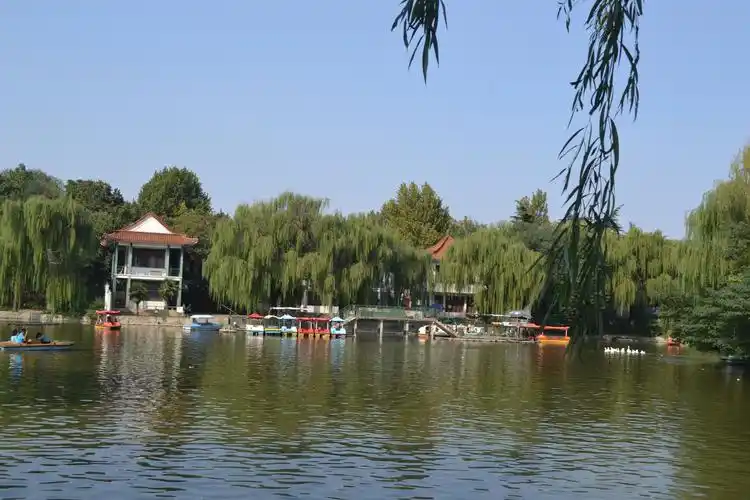
Opened free to the public in 2005 and conceived in 1984, the park centers on a 9-hectare lake carved from the old river's U-shaped bend. The layout follows the classical Chinese principle of "mountains to the north, water to the south"—a design philosophy echoed at Beijing's Summer Palace, though on a more intimate scale. Six themed zones, including "Drawing Antiquity by the Stream" and "Lotus Pond of Fragrance," wind through more than 400 plant species. Summer lotuses draw the most devoted photographers, while bamboo groves offer a quieter, more meditative retreat.
A 100-meter painted mural forms the park's cultural spine, displaying the twelve zodiac animals and twenty-four solar terms rendered in oracle-bone script—pictographs that preceded modern Chinese characters by over three millennia. Several panels include QR codes linking to audio explanations, creating an open-air classroom beloved by school groups. Three historical pavilions anchor different eras: the Baixiang Terrace honors Su Qin, the 3rd-century BC diplomat who forged alliances among rival states; the Huimeng Pavilion recalls the "Covenant by the Huan" between warlord Xiang Yu and General Zhang Han; and a fishing platform preserves the angling spot of early-20th-century statesman Yuan Shikai.
Admission is free year-round, with extended summer hours (6:00–22:00 from May to September) and reduced winter hours (6:30–21:00 from October to April). The park has no cafés, shops, or amusement rides—pack water and snacks. Summer visitors should bring long sleeves and mosquito repellent; lotus blooms peak in August, when soft evening light from 4:00 to 7:00 PM makes the lake ideal for hanfu photography or quiet strolls. No metro line reaches the park yet, so a ride-hailing service to "Huan Shui Park East Gate" at the intersection of Zhangde Road and Renmin Avenue is the most reliable approach.
Pair the park with the Yinxu Museum new building, some 3–4 km away, for a layered cultural day: absorb Shang symbolism among the lotuses in the morning, then dive into excavated bronzes and oracle bones in the afternoon. One important distinction: Huan Shui Park is a free urban park within city limits and entirely different from the Huanhe Canyon Scenic Area, a separate ticketed mountain landscape roughly 50 km away in Long'an District. Confusing the two could mean an unintended detour into the countryside, so confirm your destination before departure.
For travelers who have already ticked off the Terracotta Warriors or the Forbidden City, Huan Shui Park offers something rarer: an unhurried, almost English-garden-like encounter with China's foundational civilization. Locals call it Anyang's "Little West Lake," and the comparison is apt—misty water, wandering paths, and pavilions steeped in memory. Think of it less as a standalone attraction than as a doorway into one of East Asia's oldest continuously inhabited places, where Bronze Age echoes linger beside Republican-era nostalgia and modern lotus blooms.
Anyang served as the final capital of the Shang Dynasty (c. 1600–1046 BC), a Bronze Age kingdom whose oracle bones constitute the earliest confirmed corpus of Chinese writing. Comparable in archaeological stature to Mesopotamia's Ur or Egypt's Thebes, the city's Yinxu ruins earned UNESCO World Heritage status in 2006. Huan Shui Park functions as a green prelude to this heritage, transforming a forgotten stretch of the Huan River into a contemplative space where visitors can acclimatize to Anyang's three-thousand-year legacy before encountering the tomb of Queen Fu Hao and the palace-temple complex beyond.
Opened free to the public in 2005 and conceived in 1984, the park centers on a 9-hectare lake carved from the old river's U-shaped bend. The layout follows the classical Chinese principle of "mountains to the north, water to the south"—a design philosophy echoed at Beijing's Summer Palace, though on a more intimate scale. Six themed zones, including "Drawing Antiquity by the Stream" and "Lotus Pond of Fragrance," wind through more than 400 plant species. Summer lotuses draw the most devoted photographers, while bamboo groves offer a quieter, more meditative retreat.
A 100-meter painted mural forms the park's cultural spine, displaying the twelve zodiac animals and twenty-four solar terms rendered in oracle-bone script—pictographs that preceded modern Chinese characters by over three millennia. Several panels include QR codes linking to audio explanations, creating an open-air classroom beloved by school groups. Three historical pavilions anchor different eras: the Baixiang Terrace honors Su Qin, the 3rd-century BC diplomat who forged alliances among rival states; the Huimeng Pavilion recalls the "Covenant by the Huan" between warlord Xiang Yu and General Zhang Han; and a fishing platform preserves the angling spot of early-20th-century statesman Yuan Shikai.
Admission is free year-round, with extended summer hours (6:00–22:00 from May to September) and reduced winter hours (6:30–21:00 from October to April). The park has no cafés, shops, or amusement rides—pack water and snacks. Summer visitors should bring long sleeves and mosquito repellent; lotus blooms peak in August, when soft evening light from 4:00 to 7:00 PM makes the lake ideal for hanfu photography or quiet strolls. No metro line reaches the park yet, so a ride-hailing service to "Huan Shui Park East Gate" at the intersection of Zhangde Road and Renmin Avenue is the most reliable approach.
Pair the park with the Yinxu Museum new building, some 3–4 km away, for a layered cultural day: absorb Shang symbolism among the lotuses in the morning, then dive into excavated bronzes and oracle bones in the afternoon. One important distinction: Huan Shui Park is a free urban park within city limits and entirely different from the Huanhe Canyon Scenic Area, a separate ticketed mountain landscape roughly 50 km away in Long'an District. Confusing the two could mean an unintended detour into the countryside, so confirm your destination before departure.
For travelers who have already ticked off the Terracotta Warriors or the Forbidden City, Huan Shui Park offers something rarer: an unhurried, almost English-garden-like encounter with China's foundational civilization. Locals call it Anyang's "Little West Lake," and the comparison is apt—misty water, wandering paths, and pavilions steeped in memory. Think of it less as a standalone attraction than as a doorway into one of East Asia's oldest continuously inhabited places, where Bronze Age echoes linger beside Republican-era nostalgia and modern lotus blooms.