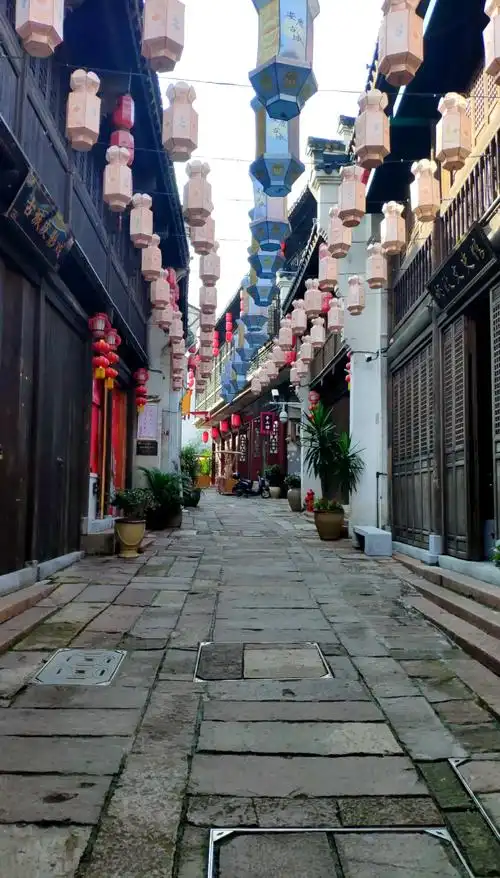
Anqing Old Street traces its origins to the Southern Song Dynasty, roughly 800 years ago, making it contemporary with the establishment of Europe's great medieval trading towns along the Hanseatic League. The block served as the commercial and cultural nerve center of the ancient walled city through the Yuan, Ming, and Qing dynasties, and later became a crossroads of Republican-era commerce. Its name, "Daobashi" (literally "Upside-Down Lion"), comes from a folk legend about the Ming-era stone archway that still anchors the district—a peculiar fixture local residents have passed down through countless generations.
The architecture presents a striking tableau of Jianghuai building traditions, with whitewashed walls and dark-tiled rooftops echoing the visual rhythm of southern Chinese historic districts like Huizhou's Hongcun, though on a much smaller scale. The arcaded *qilou* buildings, with covered walkways supported by columns, recall the colonial-era shophouses of Southeast Asia or even Lisbon's lower town, creating shaded passages for pedestrians in every season. Original bluestone paving remains underfoot, and narrow lanes thread between *horse-head* gables that rise like stepped silhouettes against the sky.
Culturally, the block offers layers of local heritage in a remarkably compact footprint. The Hai Zi Poetry Memorial Hall honors Anqing's most celebrated modern poet, whose works echo the contemplative intensity of Western lyrical traditions. A vintage postal counter allows visitors to send postcards bearing a special commemorative postmark, while the Old Anqing Photography Museum weaves together visual memories of the city's 20th-century transformation. Together, these small institutions reveal how Anqing, once a provincial capital of importance, shaped its regional identity.
No visit would be complete without sampling the heritage food brands that have anchored the street for generations. *Mailongxiang* bakery still produces traditional pastries using century-old recipes, *Hu Yumei* continues fermenting its famous broad-bean chili sauce, and *Jiangmao* dumpling shop draws crowds for its clear-broth wontons. These establishments function much like the historic guild shops of Bruges or the old bakeries of Vienna's Graben—a living connection to pre-industrial food craftsmanship that remains accessible to casual visitors.
The block is open around the clock and free to enter, though individual shops and exhibition halls typically operate from 10:00 to 22:00, with some cultural sites closed on Mondays. Aim for the late afternoon, between 16:30 and 20:00, when the soft light highlights the architectural details and red lanterns begin to glow overhead, transforming the lanes into a scene reminiscent of festive evenings in Rome's Trastevere. A taxi from Anqing Railway Station takes only about ten minutes, and walking or cycling is the best way to explore once inside.
Plan roughly two hours for a relaxed citywalk, beginning at the iconic Daobashi archway, drifting through Guohuo Street's cultural sites, and ending among the old eateries around Sipailou. If time allows, continue on foot to the nearby Dananmen (Zhenhai Gate) for sunset views over the Yangtze River, or climb the pagoda of Yingjiang Temple for a panoramic sweep of the city—much like ascending Lyon’s Fourvière for a complete view. This compact extension transforms a simple street stroll into a rich immersion in one of China’s lesser-known but genuinely historic river-port cities.