Longgan Lake, Huaining
⭐ 2.50
Longgan Lake Scenic Area, Huaining County, Anqing City, Anhui Province, China
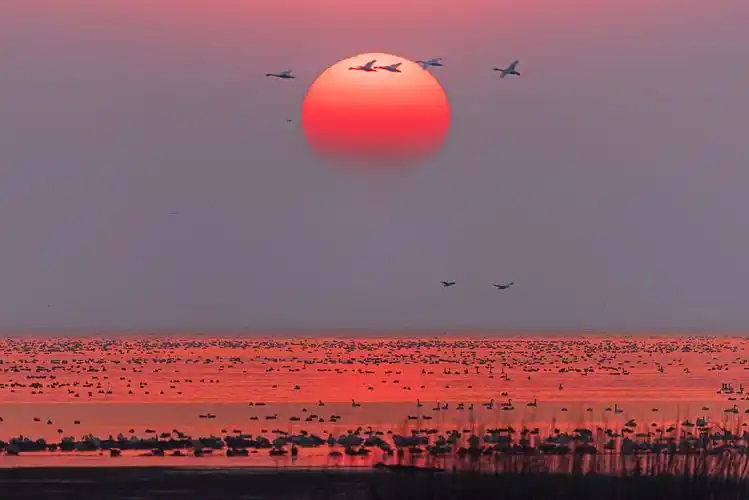 Longgan Lake's ancient name, "Leichi" or "Thunder Pool," has resonated through Chinese literature for nearly two millennia. The phrase "not to step beyond Leichi even one step" originates from the Book of Jin's biography of Yu Liang, a 4th-century statesman who warned his subordinate against crossing a political boundary—much like the Western caution to "not cross the Rubicon." The lake served as a critical flood-regulation reservoir for the Yangtze's middle and lower reaches, accumulating layers of human memory across dynasties. In 2009, its core wetlands were elevated to National Nature Reserve status, marking a new chapter that balances heritage preservation with modern conservation.
Stretching roughly 420 square kilometers along the Yangtze's northern bank, Longgan Lake forms a vast freshwater wetland that connects directly with the river's flow. Reed marshes, tidal mudflats, and meandering shorelines create a rich mosaic of habitats where water plants thrive and fish populations flourish. On the Hubei side, wooden boardwalks and birdwatching platforms extend gently over the shallows, allowing visitors to observe wildlife without disturbing it. The Anhui side remains largely within reserve boundaries with restricted access. Together, these features make Longgan Lake one of East Asia's most significant wetland ecosystems—a living counterpart to Europe's Camargue or Lake Neusiedl in ecological importance.
Beyond its ecological role, Longgan Lake occupies a special place in Chinese cultural consciousness through the "Leichi" idiom—a phrase still invoked today when discussing boundaries or limits. The lake embodies the transition from traditional reverence for nature to contemporary ecological civilization, where wildlife protection is seen as essential to humanity's future. Today it is celebrated as a "Bird Paradise" of the middle and lower Yangtze, vividly illustrating the harmony between people and nature. For travelers interested in the deeper layers of Chinese landscape—where history, language, and biodiversity intersect—Longgan Lake offers a uniquely layered experience far beyond typical scenic destinations.
Longgan Lake divides into two main access points: the Hubei side (Huangmei County), which features Longgan Lake Park with well-developed walking trails and birdwatching facilities, and the Anhui side (Susong County), which lies mostly within the protected reserve and has limited public entry. Open zones are free to visit, but visitors should check current access boundaries in advance and respect reserve regulations. The site is best reached by private car or chartered vehicle, as public transport connections remain limited. Lakeside dining options are minimal, so packing snacks and plenty of water is advisable.
The optimal visiting season runs from November through March, when peak wintering brings over 100,000 migratory birds to the lake—among them hooded cranes, black storks, and great egrets. Spring and autumn offer milder weather for lakeside hiking and landscape photography, while early mornings and late afternoons provide the softest light. Visitors should bring binoculars, insect repellent, sturdy footwear, and warm layers during winter, when lakeside temperatures drop sharply. Drone photography requires advance permission from reserve management to avoid disturbing wildlife. Few experiences in eastern China combine classical literary heritage with world-class birdwatching as seamlessly as Longgan Lake.
Longgan Lake's ancient name, "Leichi" or "Thunder Pool," has resonated through Chinese literature for nearly two millennia. The phrase "not to step beyond Leichi even one step" originates from the Book of Jin's biography of Yu Liang, a 4th-century statesman who warned his subordinate against crossing a political boundary—much like the Western caution to "not cross the Rubicon." The lake served as a critical flood-regulation reservoir for the Yangtze's middle and lower reaches, accumulating layers of human memory across dynasties. In 2009, its core wetlands were elevated to National Nature Reserve status, marking a new chapter that balances heritage preservation with modern conservation.
Stretching roughly 420 square kilometers along the Yangtze's northern bank, Longgan Lake forms a vast freshwater wetland that connects directly with the river's flow. Reed marshes, tidal mudflats, and meandering shorelines create a rich mosaic of habitats where water plants thrive and fish populations flourish. On the Hubei side, wooden boardwalks and birdwatching platforms extend gently over the shallows, allowing visitors to observe wildlife without disturbing it. The Anhui side remains largely within reserve boundaries with restricted access. Together, these features make Longgan Lake one of East Asia's most significant wetland ecosystems—a living counterpart to Europe's Camargue or Lake Neusiedl in ecological importance.
Beyond its ecological role, Longgan Lake occupies a special place in Chinese cultural consciousness through the "Leichi" idiom—a phrase still invoked today when discussing boundaries or limits. The lake embodies the transition from traditional reverence for nature to contemporary ecological civilization, where wildlife protection is seen as essential to humanity's future. Today it is celebrated as a "Bird Paradise" of the middle and lower Yangtze, vividly illustrating the harmony between people and nature. For travelers interested in the deeper layers of Chinese landscape—where history, language, and biodiversity intersect—Longgan Lake offers a uniquely layered experience far beyond typical scenic destinations.
Longgan Lake divides into two main access points: the Hubei side (Huangmei County), which features Longgan Lake Park with well-developed walking trails and birdwatching facilities, and the Anhui side (Susong County), which lies mostly within the protected reserve and has limited public entry. Open zones are free to visit, but visitors should check current access boundaries in advance and respect reserve regulations. The site is best reached by private car or chartered vehicle, as public transport connections remain limited. Lakeside dining options are minimal, so packing snacks and plenty of water is advisable.
The optimal visiting season runs from November through March, when peak wintering brings over 100,000 migratory birds to the lake—among them hooded cranes, black storks, and great egrets. Spring and autumn offer milder weather for lakeside hiking and landscape photography, while early mornings and late afternoons provide the softest light. Visitors should bring binoculars, insect repellent, sturdy footwear, and warm layers during winter, when lakeside temperatures drop sharply. Drone photography requires advance permission from reserve management to avoid disturbing wildlife. Few experiences in eastern China combine classical literary heritage with world-class birdwatching as seamlessly as Longgan Lake.