Shangrao Old City Historic Buildings
⭐ 2.80
Shangrao Old City Historic Buildings, Xinzhou District, Shangrao City, Jiangxi Province, China
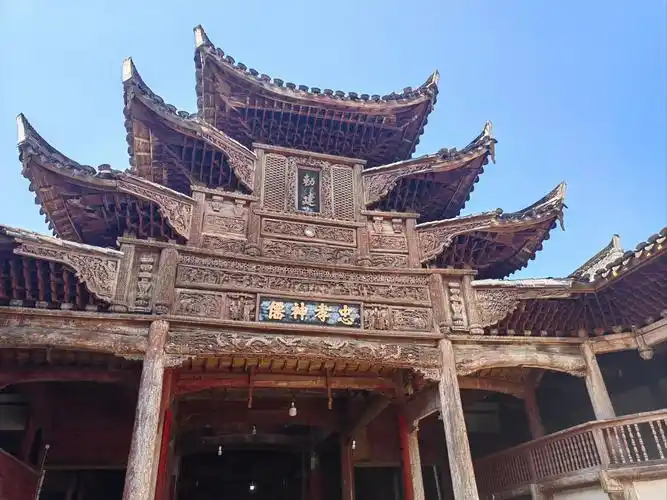 Shangrao's recorded history reaches back to the Song and Yuan dynasties (10th to 14th centuries), contemporary with medieval Florence and the Plantagenet court. Yet the surviving fabric is largely Ming, Qing, and Republican (roughly 1350 to 1949), since walls and temples were swept away by modern upheaval. Think of it less as a heritage park and more like Rome's Trastevere: ancient foundations swallowed by later centuries, occasionally resurfacing in a pagoda or a stone bridge. The city's role as a trading port on the Xinjiang River once made it the Oxford of northeastern Jiangxi, a scholarly and commercial crossroads whose memory lingers in fragments rather than a single grand ensemble.
The undisputed star is Yongfu Temple Pagoda, a slender Song Dynasty brick tower roughly 800 years old, comparable in age to Europe's earliest Gothic cathedrals, standing alone amid modern shops. Its vermillion walls and weathered gray brick create a tableau worthy of a Caspar David Friedrich painting. Along Xinjiang West Road, Republican-era shophouses display a hybrid style unique to southeastern China: ground-floor arcades reminiscent of Singapore's shophouse quarters or Havana Vieja, topped with stepped horse-head gables borrowed from Huizhou merchant architecture. Yang Family Stone Bridge, built during the Shunzhi reign (1644 to 1661) and carefully restored in 2016, anchors the streetscape with quiet authority.
What makes Shangrao's old town genuinely unusual is its refusal to be tidied up. Survivors like the Qing-dynasty Xijiang Academy (the local Confucian equivalent of Eton), the Yuan-era Taizi Temple, and the Ming-era Kuiwen Pagoda sit alongside functioning hair salons and wholesale stalls, a coexistence recalling Lisbon's Alfama rather than China's often-sterilized heritage zones. The Jinlong Gang district, designated a national tourism and leisure block, exemplifies a national trend of converting obsolete factory buildings into creative clusters, not unlike Berlin's post-industrial galleries or London's Hackney Wick, where a former rice warehouse now houses independent coffee roasters and design studios.
Good news for budget travelers: nearly all sites are free, with no entrance tickets required. Yongfu Temple Pagoda can be climbed for a small fee for skyline views, while Xijiang Academy asks visitors to book ahead, much like a small Italian state museum. Most other landmarks can only be admired from the street. Aim for late afternoon rather than midday: the raking golden light is perfect for photographing pagoda silhouettes and arcade colonnades, and Jiangxi's summer heat is punishing at noon. Many old houses remain family homes, so do not wander into private courtyards even if doors appear open.
A relaxed half-day route covers the essentials comfortably. Start with a morning stroll along Xinjiang West Road past Yang Family Stone Bridge and the old Sanguan Temple site, absorbing the wholesale-market atmosphere. Break for lunch on local specialties such as qingtang (delicate pork-and-dumpling broth) or fanfu guo (a chewy rice-flour cake). Afternoon brings Yongfu Temple Pagoda and Xijiang Academy, followed by an evening shift to Jinlong Gang for dinner amid art walls and night-market buzz. Travelers expecting the contiguous old-town drama of Lijiang should consider Wuyuan's preserved villages an hour west. But for those drawn to authentic, lived-in history, Shangrao delivers something rarer than polish: continuity.
Shangrao's recorded history reaches back to the Song and Yuan dynasties (10th to 14th centuries), contemporary with medieval Florence and the Plantagenet court. Yet the surviving fabric is largely Ming, Qing, and Republican (roughly 1350 to 1949), since walls and temples were swept away by modern upheaval. Think of it less as a heritage park and more like Rome's Trastevere: ancient foundations swallowed by later centuries, occasionally resurfacing in a pagoda or a stone bridge. The city's role as a trading port on the Xinjiang River once made it the Oxford of northeastern Jiangxi, a scholarly and commercial crossroads whose memory lingers in fragments rather than a single grand ensemble.
The undisputed star is Yongfu Temple Pagoda, a slender Song Dynasty brick tower roughly 800 years old, comparable in age to Europe's earliest Gothic cathedrals, standing alone amid modern shops. Its vermillion walls and weathered gray brick create a tableau worthy of a Caspar David Friedrich painting. Along Xinjiang West Road, Republican-era shophouses display a hybrid style unique to southeastern China: ground-floor arcades reminiscent of Singapore's shophouse quarters or Havana Vieja, topped with stepped horse-head gables borrowed from Huizhou merchant architecture. Yang Family Stone Bridge, built during the Shunzhi reign (1644 to 1661) and carefully restored in 2016, anchors the streetscape with quiet authority.
What makes Shangrao's old town genuinely unusual is its refusal to be tidied up. Survivors like the Qing-dynasty Xijiang Academy (the local Confucian equivalent of Eton), the Yuan-era Taizi Temple, and the Ming-era Kuiwen Pagoda sit alongside functioning hair salons and wholesale stalls, a coexistence recalling Lisbon's Alfama rather than China's often-sterilized heritage zones. The Jinlong Gang district, designated a national tourism and leisure block, exemplifies a national trend of converting obsolete factory buildings into creative clusters, not unlike Berlin's post-industrial galleries or London's Hackney Wick, where a former rice warehouse now houses independent coffee roasters and design studios.
Good news for budget travelers: nearly all sites are free, with no entrance tickets required. Yongfu Temple Pagoda can be climbed for a small fee for skyline views, while Xijiang Academy asks visitors to book ahead, much like a small Italian state museum. Most other landmarks can only be admired from the street. Aim for late afternoon rather than midday: the raking golden light is perfect for photographing pagoda silhouettes and arcade colonnades, and Jiangxi's summer heat is punishing at noon. Many old houses remain family homes, so do not wander into private courtyards even if doors appear open.
A relaxed half-day route covers the essentials comfortably. Start with a morning stroll along Xinjiang West Road past Yang Family Stone Bridge and the old Sanguan Temple site, absorbing the wholesale-market atmosphere. Break for lunch on local specialties such as qingtang (delicate pork-and-dumpling broth) or fanfu guo (a chewy rice-flour cake). Afternoon brings Yongfu Temple Pagoda and Xijiang Academy, followed by an evening shift to Jinlong Gang for dinner amid art walls and night-market buzz. Travelers expecting the contiguous old-town drama of Lijiang should consider Wuyuan's preserved villages an hour west. But for those drawn to authentic, lived-in history, Shangrao delivers something rarer than polish: continuity.