Daguan Pavilion
⭐ 4.00
Daguan Pavilion Street, Yixiu District, Anqing, Anhui, China
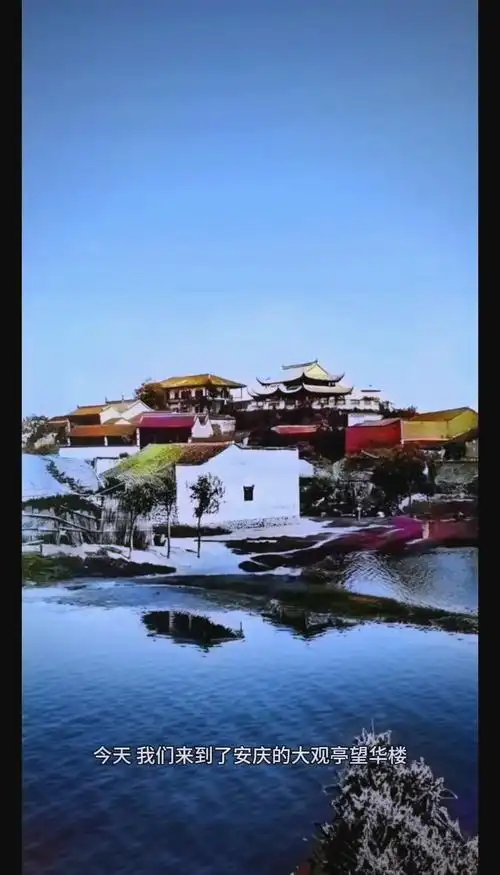 The pavilion dates to the Ming era (1368–1644), a period contemporaries would recognize as China's counterpart to Europe's late Renaissance, when garden architecture and scenic towers flourished across cultured cities. Erected on a Yangtze bluff, Daguan Pavilion became one of central China's prized spots for "climbing high and gazing afar"—a poetic tradition parallel to the Romantic-era fascination with hilltop belvederes in Tuscany or the Rhine Valley. Its destruction in 1938, during the Japanese wartime advance up the Yangtze, severed a continuous cultural thread linking Anqing's literati to their city's landscape.
What remains today is arguably more intellectually compelling than a reconstruction. Visitors can trace the pavilion's original footprint within excavated Qing-dynasty stone foundations and visit the tomb-shrine complex of Yu Que, a Yuan-era magistrate who died defending Anqing in 1359—roughly contemporary with the Black Death ravaging Europe. The surrounding "Nine Dragons Gathering Pearls" street layout, a Ming-baroque conception of curving lanes converging on a central node, mirrors the organic urban geometry found in old quarters of Rome or Prague, and offers insight into how Chinese cities choreographed space before grid planning dominated.
The cultural resonance extends well beyond architecture. Adjacent to the site stands the modest former home of Yan Fengying (1930–1968), the beloved diva of Huangmei opera—a regional lyric theater tradition as emotionally rich as Neapolitan song, and one still performed nightly across the Yangtze region. Nearby lies the reading retreat of Deng Shiru, the eccentric Qing calligrapher whose bold, blocky script anticipated modern design aesthetics. Together, these preserved touchstones make the park a field study in how a single Yangtze port city layered administration, performance, and scholarship across six centuries.
Visiting is straightforward but requires flexibility. The streetscape zone is open free of charge with no reservation, located on Daguan Pavilion Street in Anqing's Daguan District, a short walk from the Yangtze embankment. However, several interior exhibition halls remain under preparation as the site's 2024–2026 conservation project continues, so travelers should consult the Anqing Cultural Tourism Bureau website before departure. Until full completion, expect interpretive signage rather than polished museum displays.
Seasonal timing matters: spring and autumn offer comfortable walking weather, while summer brings intense humidity and mosquitoes along the riverside. Stone paving becomes slippery after rain, so sturdy shoes are essential. For travelers seeking panoramic Yangtze views today, the nearby Yingjiang Temple and its elegant Zhenfeng Pagoda provide an excellent substitute—comparable in silhouette to a slender campanile above a waterway. Foreign visitors may wish to combine this stop with the atmospheric Daopaishi Historic District, completing a satisfying half-day immersion into the Wanjiang cultural corridor.
The pavilion dates to the Ming era (1368–1644), a period contemporaries would recognize as China's counterpart to Europe's late Renaissance, when garden architecture and scenic towers flourished across cultured cities. Erected on a Yangtze bluff, Daguan Pavilion became one of central China's prized spots for "climbing high and gazing afar"—a poetic tradition parallel to the Romantic-era fascination with hilltop belvederes in Tuscany or the Rhine Valley. Its destruction in 1938, during the Japanese wartime advance up the Yangtze, severed a continuous cultural thread linking Anqing's literati to their city's landscape.
What remains today is arguably more intellectually compelling than a reconstruction. Visitors can trace the pavilion's original footprint within excavated Qing-dynasty stone foundations and visit the tomb-shrine complex of Yu Que, a Yuan-era magistrate who died defending Anqing in 1359—roughly contemporary with the Black Death ravaging Europe. The surrounding "Nine Dragons Gathering Pearls" street layout, a Ming-baroque conception of curving lanes converging on a central node, mirrors the organic urban geometry found in old quarters of Rome or Prague, and offers insight into how Chinese cities choreographed space before grid planning dominated.
The cultural resonance extends well beyond architecture. Adjacent to the site stands the modest former home of Yan Fengying (1930–1968), the beloved diva of Huangmei opera—a regional lyric theater tradition as emotionally rich as Neapolitan song, and one still performed nightly across the Yangtze region. Nearby lies the reading retreat of Deng Shiru, the eccentric Qing calligrapher whose bold, blocky script anticipated modern design aesthetics. Together, these preserved touchstones make the park a field study in how a single Yangtze port city layered administration, performance, and scholarship across six centuries.
Visiting is straightforward but requires flexibility. The streetscape zone is open free of charge with no reservation, located on Daguan Pavilion Street in Anqing's Daguan District, a short walk from the Yangtze embankment. However, several interior exhibition halls remain under preparation as the site's 2024–2026 conservation project continues, so travelers should consult the Anqing Cultural Tourism Bureau website before departure. Until full completion, expect interpretive signage rather than polished museum displays.
Seasonal timing matters: spring and autumn offer comfortable walking weather, while summer brings intense humidity and mosquitoes along the riverside. Stone paving becomes slippery after rain, so sturdy shoes are essential. For travelers seeking panoramic Yangtze views today, the nearby Yingjiang Temple and its elegant Zhenfeng Pagoda provide an excellent substitute—comparable in silhouette to a slender campanile above a waterway. Foreign visitors may wish to combine this stop with the atmospheric Daopaishi Historic District, completing a satisfying half-day immersion into the Wanjiang cultural corridor.