Yingjiang Temple
⭐ 3.80
Yingjiang Temple, Yingjiang District, Anqing City, Anhui Province, China
 **Historical Context**
Founded in 974 AD during the Northern Song Dynasty under Emperor Taizu's reign—a contemporary of the early Holy Roman Empire under Otto I—Yingjiang Temple originally bore the name Huguo Yongchang Chan Temple (Temple Protecting the Nation and Flourishing Eternally). For over a millennium, it has commanded a strategic position along the Yangtze, controlling river traffic between central and eastern China. Massively renovated during the Ming Dynasty, the temple complex survives today as a nationally protected cultural heritage site and stands as Anqing's most emblematic ancient monument, comparable in age and importance to many medieval European abbeys along the Rhine or Danube.
**Architecture**
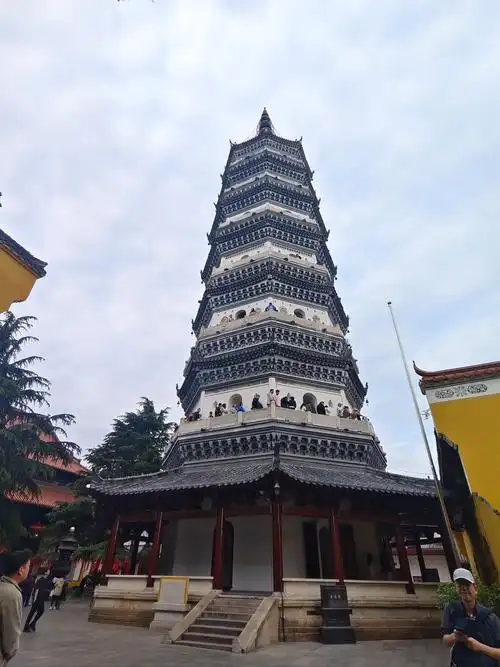
The temple follows a traditional axial layout, with imposing halls including the Heavenly Kings Hall, the Great Hall of the Buddha, and the Vairocana Hall housing nearly 500 Buddhist statues. The star attraction is the Zhenfeng Pagoda, a seven-story octagonal brick tower rising dozens of meters high. Inside, 168 steps lead visitors to the top via a clever "maze" design that shifts the entrance position between floors—turning the climb into a delightful puzzle reminiscent of labyrinthine spiral staircases in European cathedrals like Chartres.
**Cultural Significance**
Two enormous iron anchors, each weighing roughly three tons, guard the entrance. Local legend holds that Anqing's shape resembles a boat, with the Zhenfeng Pagoda serving as its mast—hence the anchors to keep the city from drifting away with the Yangtze's currents. The complex brims with imperial treasures: calligraphy by the Guangxu Emperor, inscriptions by the revered Buddhist leader Zhao Puchu, and plaques bestowed by Empress Dowager Cixi and Emperor Qianlong. Behind the Vairocana Hall, exquisite "Sea Island" sculptural tableaux display masterful craftsmanship, while the scripture library preserves Ming-dynasty gold-illuminated copies of the Lotus Sutra.
**River Views**
Perched on elevated ground directly above the Yangtze, the temple commands uninterrupted panoramic vistas of one of the world's great waterways—comparable to gazing upon the Nile from Luxor's temples or the Danube from Budapest's citadel. From the pagoda's summit, visitors watch ships ply the mighty current while the setting sun paints the tower's silhouette across the water in the classic scene known as "Pagoda Shadow Crossing the River." Photographers and romantics alike find this vantage point unforgettable.
**Practical Information**
Admission is just ¥10 for the temple, with an additional ¥20 to climb the pagoda. Hours run 8:00 AM to 5:30 PM, though ticket sales and tower entry close at 5:00 PM. Plan for 1 to 2 hours. The address is 148 Yanjiang East Road, Yingjiang District, Anqing, accessible via buses 7 and 10. Visitors should dress modestly, refrain from photographing inside the halls, and exercise caution on the steep pagoda stairs—those with vertigo, elderly travelers, and young children may prefer to admire the tower from below.
**Why Visit**
Yingjiang Temple offers a rare convergence of living Buddhist tradition, imperial Chinese architecture, and one of the planet's most legendary rivers—all without the crowds of better-known sites like Nanjing or Shanghai. For Western travelers seeking authentic encounters with China's spiritual and cultural heritage, this riverside gem delivers an intimate, deeply rewarding experience that feels worlds away from the modern metropolis.
**Historical Context**
Founded in 974 AD during the Northern Song Dynasty under Emperor Taizu's reign—a contemporary of the early Holy Roman Empire under Otto I—Yingjiang Temple originally bore the name Huguo Yongchang Chan Temple (Temple Protecting the Nation and Flourishing Eternally). For over a millennium, it has commanded a strategic position along the Yangtze, controlling river traffic between central and eastern China. Massively renovated during the Ming Dynasty, the temple complex survives today as a nationally protected cultural heritage site and stands as Anqing's most emblematic ancient monument, comparable in age and importance to many medieval European abbeys along the Rhine or Danube.
**Architecture**
The temple follows a traditional axial layout, with imposing halls including the Heavenly Kings Hall, the Great Hall of the Buddha, and the Vairocana Hall housing nearly 500 Buddhist statues. The star attraction is the Zhenfeng Pagoda, a seven-story octagonal brick tower rising dozens of meters high. Inside, 168 steps lead visitors to the top via a clever "maze" design that shifts the entrance position between floors—turning the climb into a delightful puzzle reminiscent of labyrinthine spiral staircases in European cathedrals like Chartres.
**Cultural Significance**
Two enormous iron anchors, each weighing roughly three tons, guard the entrance. Local legend holds that Anqing's shape resembles a boat, with the Zhenfeng Pagoda serving as its mast—hence the anchors to keep the city from drifting away with the Yangtze's currents. The complex brims with imperial treasures: calligraphy by the Guangxu Emperor, inscriptions by the revered Buddhist leader Zhao Puchu, and plaques bestowed by Empress Dowager Cixi and Emperor Qianlong. Behind the Vairocana Hall, exquisite "Sea Island" sculptural tableaux display masterful craftsmanship, while the scripture library preserves Ming-dynasty gold-illuminated copies of the Lotus Sutra.
**River Views**
Perched on elevated ground directly above the Yangtze, the temple commands uninterrupted panoramic vistas of one of the world's great waterways—comparable to gazing upon the Nile from Luxor's temples or the Danube from Budapest's citadel. From the pagoda's summit, visitors watch ships ply the mighty current while the setting sun paints the tower's silhouette across the water in the classic scene known as "Pagoda Shadow Crossing the River." Photographers and romantics alike find this vantage point unforgettable.
**Practical Information**
Admission is just ¥10 for the temple, with an additional ¥20 to climb the pagoda. Hours run 8:00 AM to 5:30 PM, though ticket sales and tower entry close at 5:00 PM. Plan for 1 to 2 hours. The address is 148 Yanjiang East Road, Yingjiang District, Anqing, accessible via buses 7 and 10. Visitors should dress modestly, refrain from photographing inside the halls, and exercise caution on the steep pagoda stairs—those with vertigo, elderly travelers, and young children may prefer to admire the tower from below.
**Why Visit**
Yingjiang Temple offers a rare convergence of living Buddhist tradition, imperial Chinese architecture, and one of the planet's most legendary rivers—all without the crowds of better-known sites like Nanjing or Shanghai. For Western travelers seeking authentic encounters with China's spiritual and cultural heritage, this riverside gem delivers an intimate, deeply rewarding experience that feels worlds away from the modern metropolis.