Wang Yangming's Former Residence
⭐ 4.20
Wang Yangming's Former Residence, Yuyao City, Ningbo, Zhejiang Province, China
 **Historical Context with World-History Links**
Wang Shouren—better known as Wang Yangming—was a Ming-dynasty philosopher, military strategist, and official whose ideas parallel those of Western thinkers like Descartes and Emerson in their emphasis on intuitive moral knowledge. Often ranked alongside Confucius, Mencius, and Zhu Xi as one of the "Four Sages of Confucianism," he survived exile to remote Guizhou, where he achieved his famous "enlightenment at Longchang." His doctrines—"the mind is the principle" and "unity of knowledge and action"—anticipated pragmatism by nearly four centuries and shaped Japan's Tokugawa-era ethics. The residence honors his birthplace and childhood vow to "study the sages."
**Architecture**
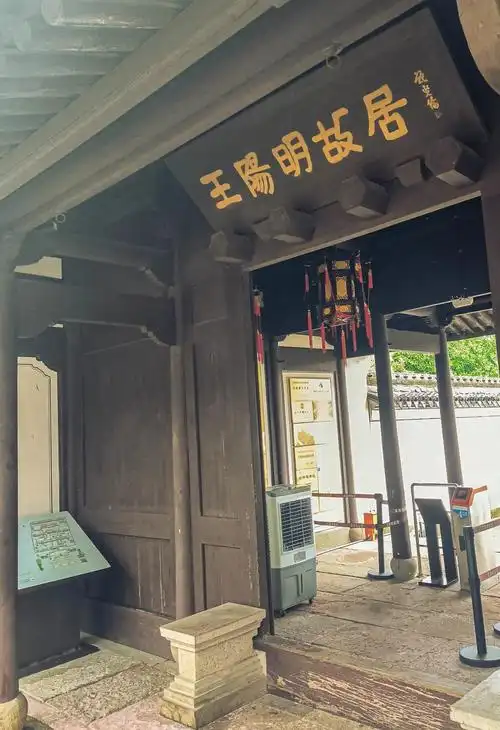
Spanning roughly 4,600 square meters along a north-south axis, the complex mirrors the layout of a typical Ming official's mansion, comparable in scale and dignity to a Tudor-era English manor house or a Florentine patrician villa. Visitors pass through a gate hall, sedan-chair hall, ornate brick-carved gateway, the elegant Shoushan Hall, and finally the two-story timber-framed Ruiyun Cloud Pavilion, where Yangming was born. Flying eaves, carved stonework, and tranquil courtyards create an atmosphere reminiscent of a contemplative monastic cloister.
**Cultural Significance**
The heart of the visit is the Ruiyun Pavilion exhibition, chronicling Yangming's life, his suppression of the Prince of Ning rebellion, and his philosophical breakthrough. A plaque proclaiming "True Three Immortals" celebrates his achievements in virtue, deeds, and words—a Chinese counterpart to the Renaissance ideal of the uomo universale. A stone monument gifted by Japanese admirers testifies to his lasting international legacy, particularly in Japan's Owari and Shido schools of thought.
**Practical Visit Information**
The site sits on the west side of Wushengmen Road in Yuyao's Yangming Subdistrict, easily reached by bus 101 or 201 from downtown Ningbo, or by a short taxi ride. Admission is free, with English-friendly signage in key halls. Hours run Tuesday–Sunday, 8:30–17:00 in summer and 9:00–16:30 in winter; the gate closes at 16:30, and Mondays are reserved for maintenance. Booking a free guided explanation in advance is highly recommended to grasp the philosophical subtleties.
**Why Visit**
Beyond its scholarly weight, the residence offers a meditative atmosphere rare in bustling eastern China—a place to slow down among mossy stones and weathered timbers. Period activities like archery games, calligraphy demonstrations, and traditional crafts invite hands-on engagement, while the adjacent Yuyao Old Street provides a charming coda with tea houses and local snacks. Allow 1 to 1.5 hours, and leave room to contemplate how a 16th-century Chinese general-philosopher still speaks to questions of self-knowledge and ethical action today.
**Historical Context with World-History Links**
Wang Shouren—better known as Wang Yangming—was a Ming-dynasty philosopher, military strategist, and official whose ideas parallel those of Western thinkers like Descartes and Emerson in their emphasis on intuitive moral knowledge. Often ranked alongside Confucius, Mencius, and Zhu Xi as one of the "Four Sages of Confucianism," he survived exile to remote Guizhou, where he achieved his famous "enlightenment at Longchang." His doctrines—"the mind is the principle" and "unity of knowledge and action"—anticipated pragmatism by nearly four centuries and shaped Japan's Tokugawa-era ethics. The residence honors his birthplace and childhood vow to "study the sages."
**Architecture**
Spanning roughly 4,600 square meters along a north-south axis, the complex mirrors the layout of a typical Ming official's mansion, comparable in scale and dignity to a Tudor-era English manor house or a Florentine patrician villa. Visitors pass through a gate hall, sedan-chair hall, ornate brick-carved gateway, the elegant Shoushan Hall, and finally the two-story timber-framed Ruiyun Cloud Pavilion, where Yangming was born. Flying eaves, carved stonework, and tranquil courtyards create an atmosphere reminiscent of a contemplative monastic cloister.
**Cultural Significance**
The heart of the visit is the Ruiyun Pavilion exhibition, chronicling Yangming's life, his suppression of the Prince of Ning rebellion, and his philosophical breakthrough. A plaque proclaiming "True Three Immortals" celebrates his achievements in virtue, deeds, and words—a Chinese counterpart to the Renaissance ideal of the uomo universale. A stone monument gifted by Japanese admirers testifies to his lasting international legacy, particularly in Japan's Owari and Shido schools of thought.
**Practical Visit Information**
The site sits on the west side of Wushengmen Road in Yuyao's Yangming Subdistrict, easily reached by bus 101 or 201 from downtown Ningbo, or by a short taxi ride. Admission is free, with English-friendly signage in key halls. Hours run Tuesday–Sunday, 8:30–17:00 in summer and 9:00–16:30 in winter; the gate closes at 16:30, and Mondays are reserved for maintenance. Booking a free guided explanation in advance is highly recommended to grasp the philosophical subtleties.
**Why Visit**
Beyond its scholarly weight, the residence offers a meditative atmosphere rare in bustling eastern China—a place to slow down among mossy stones and weathered timbers. Period activities like archery games, calligraphy demonstrations, and traditional crafts invite hands-on engagement, while the adjacent Yuyao Old Street provides a charming coda with tea houses and local snacks. Allow 1 to 1.5 hours, and leave room to contemplate how a 16th-century Chinese general-philosopher still speaks to questions of self-knowledge and ethical action today.