Tianyi Square
⭐ 4.00
Tianyi Square Business District, Haishu District, Ningbo City, Zhejiang Province, China
 Ningbo was among the very first Chinese treaty ports opened to Western trade in 1842, and its mercantile legacy still shapes the city's character today. Tianyi Square takes its name from the neighbouring Tianyi Pavilion, built in 1561 by Ming-dynasty official Fan Qin and recognised as one of China's three great private libraries of the imperial era. The contrast between that scholarly heritage and the plaza's bustling commercial scene captures Ningbo's evolution from a hub of Confucian scholarship into a contemporary coastal metropolis, rather like how Bordeaux's historic quays have adapted into lively modern promenades.
The square's perimeter consists of 22 uniformly styled low-rise buildings finished in white stucco with terracotta-red roofs, evoking the feel of a Provençal town square rather than a typical Chinese high-rise district. The central plaza covers roughly 35,000 square metres and incorporates reflective pools that double the visual impact of the surrounding façades after sunset. While the architecture is largely modern, its deliberate European flavour reflects Ningbo's long exposure to overseas influences, much as the Bund in Shanghai evokes that city's treaty-port past.
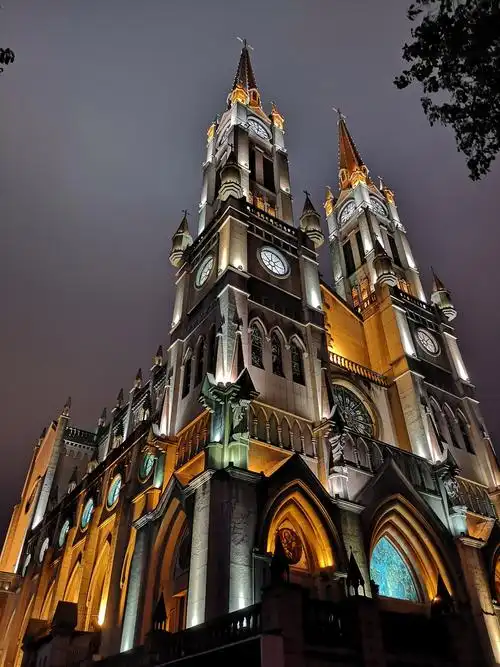
The headline attraction is the large-scale musical fountain, stretching more than 200 metres with jets capable of soaring 40 metres into the night sky. Choreographed to music and synchronised with a water-screen film projection, performances run every evening from 19:00 to 20:45, each show lasting around fifteen minutes. Nearby cultural touchstones include the Romanesque-style Catholic church on Yaohang Street with its pure-white bell tower, a popular "Ningbo" photo wall featuring a colourful staircase, and the elegant reflections cast across the plaza's pools—prime territory for street-style photography.
The square is free to enter and houses over 300 retail brands, including an Apple Store and Uniqlo flagship, alongside the underground "Donggu Dao" food street. Dining runs the gamut from heritage Ningbo names such as Gangyagou, famed for black-sesame tangyuan, to international chains and regional snacks; most outlets stay open until 22:00. The most efficient access is via Metro Line 1, getting off at either Dongmenkou or Gulou Station—weekend evenings make parking difficult, so comfortable walking shoes are essential.
Tianyi Square functions as a launchpad for exploring Ningbo's compact historic core. Within easy walking distance lie the Drum Tower pedestrian street, the City God Temple, Moon Lake Park, and the Tianyi Pavilion itself, easily combining into a half- to full-day city walk. The illuminated waterfront at Laowaitan, where the Yong, Yao, and Feng rivers meet at Sanjiang Kou, lies roughly two kilometres away and pairs perfectly with an evening fountain visit, offering a striking finale of Ningbo's blend of old port-town romance and contemporary urban buzz.
Ningbo was among the very first Chinese treaty ports opened to Western trade in 1842, and its mercantile legacy still shapes the city's character today. Tianyi Square takes its name from the neighbouring Tianyi Pavilion, built in 1561 by Ming-dynasty official Fan Qin and recognised as one of China's three great private libraries of the imperial era. The contrast between that scholarly heritage and the plaza's bustling commercial scene captures Ningbo's evolution from a hub of Confucian scholarship into a contemporary coastal metropolis, rather like how Bordeaux's historic quays have adapted into lively modern promenades.
The square's perimeter consists of 22 uniformly styled low-rise buildings finished in white stucco with terracotta-red roofs, evoking the feel of a Provençal town square rather than a typical Chinese high-rise district. The central plaza covers roughly 35,000 square metres and incorporates reflective pools that double the visual impact of the surrounding façades after sunset. While the architecture is largely modern, its deliberate European flavour reflects Ningbo's long exposure to overseas influences, much as the Bund in Shanghai evokes that city's treaty-port past.
The headline attraction is the large-scale musical fountain, stretching more than 200 metres with jets capable of soaring 40 metres into the night sky. Choreographed to music and synchronised with a water-screen film projection, performances run every evening from 19:00 to 20:45, each show lasting around fifteen minutes. Nearby cultural touchstones include the Romanesque-style Catholic church on Yaohang Street with its pure-white bell tower, a popular "Ningbo" photo wall featuring a colourful staircase, and the elegant reflections cast across the plaza's pools—prime territory for street-style photography.
The square is free to enter and houses over 300 retail brands, including an Apple Store and Uniqlo flagship, alongside the underground "Donggu Dao" food street. Dining runs the gamut from heritage Ningbo names such as Gangyagou, famed for black-sesame tangyuan, to international chains and regional snacks; most outlets stay open until 22:00. The most efficient access is via Metro Line 1, getting off at either Dongmenkou or Gulou Station—weekend evenings make parking difficult, so comfortable walking shoes are essential.
Tianyi Square functions as a launchpad for exploring Ningbo's compact historic core. Within easy walking distance lie the Drum Tower pedestrian street, the City God Temple, Moon Lake Park, and the Tianyi Pavilion itself, easily combining into a half- to full-day city walk. The illuminated waterfront at Laowaitan, where the Yong, Yao, and Feng rivers meet at Sanjiang Kou, lies roughly two kilometres away and pairs perfectly with an evening fountain visit, offering a striking finale of Ningbo's blend of old port-town romance and contemporary urban buzz.