Tianyi Pavilion
⭐ 4.20
Haishu District, Ningbo, Zhejiang, China
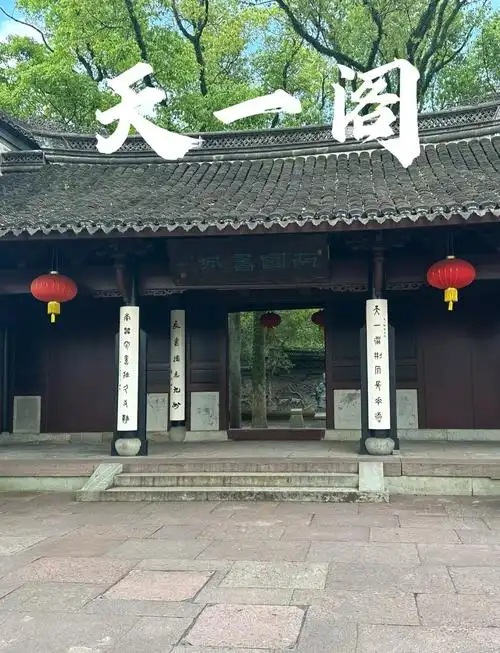 Founded in 1561–1566 by Fan Qin, a Vice Minister of War during the Ming Dynasty, Tianyi Ge predates the Bodleian Library in Oxford by only a few years and surpasses it in continuous private custodianship. The Fan family enforced a strict code: "books must never be divided and never leave the library." For thirteen generations, descendants honored this iron rule, preserving a collection now numbering around 300,000 volumes, including 80,000 rare editions and irreplaceable Ming-era local gazetteers. It is, quite simply, the physical embodiment of a civilization's devotion to the written word.
The name itself reveals a philosophy of preservation: "Heaven creates water, Earth completes it with six." Water conquers fire, so Fan had a reflecting pool dug before the library. The two-story Baoshu Hall ingeniously divides into one room upstairs and six below, a layout believed to echo this cosmological principle. The gables of the Fan residence, with their distinctive horse-head walls, recall the austere splendor of Anhui-style architecture while serving as practical firebreaks, a marriage of beauty and survival strategy reminiscent of medieval European monastic libraries.
Adjacent to the main library, the Mingzhou Stele Forest displays rubbings and carved stones from many dynasties, including a prized version of Wang Xizhi's famous Lantingji Xu calligraphy. Nearby, the Qin Ancestral Hall conceals a breathtaking theatrical stage whose 24 spiraling gilded caisson layers create a dizzying vortex of gold and crimson. A short walk leads to the Mahjong Origin Museum, documenting Ningbo's role as the refining crucible of this quintessentially Chinese game, with its modern global variants like riichi and mahjong solitaire tracing surprising lineages back to this garden.
The site sits at 92 Changchun Road in Haishu District, a 500-meter walk from Exit D of Ximenkou Station on Metro Line 1, or reachable by buses 9, 26, 371, or 512. Admission is 30 yuan, half-price for students and visitors aged 60–69, and free for those 70 and above. Advance booking through the WeChat official account "天一阁博物院" is mandatory. Hours are 8:30 to 17:30 from May through October, closing an hour earlier the rest of the year, with Mondays closed except on national holidays.
Plan a morning visit and allow two to three hours. Enter through the West Gate and follow the natural route: from Dongming Thatched Hall through the Fan Residence to Baoshu Hall, whose interior remains viewable only from outside, then onward to the Zunjing Pavilion and Stele Forest, East Garden's Ming Pool, the Qin Ancestral Hall, and the Mahjong Museum, exiting via the South Gate. Wear comfortable shoes for the stone-flagged paths, and consider renting a multilingual audio guide or booking a guided tour. Photography is forbidden inside Baoshu Hall; silence there is both a courtesy and an echo of the reverence Fan Qin demanded of his heirs.
Founded in 1561–1566 by Fan Qin, a Vice Minister of War during the Ming Dynasty, Tianyi Ge predates the Bodleian Library in Oxford by only a few years and surpasses it in continuous private custodianship. The Fan family enforced a strict code: "books must never be divided and never leave the library." For thirteen generations, descendants honored this iron rule, preserving a collection now numbering around 300,000 volumes, including 80,000 rare editions and irreplaceable Ming-era local gazetteers. It is, quite simply, the physical embodiment of a civilization's devotion to the written word.
The name itself reveals a philosophy of preservation: "Heaven creates water, Earth completes it with six." Water conquers fire, so Fan had a reflecting pool dug before the library. The two-story Baoshu Hall ingeniously divides into one room upstairs and six below, a layout believed to echo this cosmological principle. The gables of the Fan residence, with their distinctive horse-head walls, recall the austere splendor of Anhui-style architecture while serving as practical firebreaks, a marriage of beauty and survival strategy reminiscent of medieval European monastic libraries.
Adjacent to the main library, the Mingzhou Stele Forest displays rubbings and carved stones from many dynasties, including a prized version of Wang Xizhi's famous Lantingji Xu calligraphy. Nearby, the Qin Ancestral Hall conceals a breathtaking theatrical stage whose 24 spiraling gilded caisson layers create a dizzying vortex of gold and crimson. A short walk leads to the Mahjong Origin Museum, documenting Ningbo's role as the refining crucible of this quintessentially Chinese game, with its modern global variants like riichi and mahjong solitaire tracing surprising lineages back to this garden.
The site sits at 92 Changchun Road in Haishu District, a 500-meter walk from Exit D of Ximenkou Station on Metro Line 1, or reachable by buses 9, 26, 371, or 512. Admission is 30 yuan, half-price for students and visitors aged 60–69, and free for those 70 and above. Advance booking through the WeChat official account "天一阁博物院" is mandatory. Hours are 8:30 to 17:30 from May through October, closing an hour earlier the rest of the year, with Mondays closed except on national holidays.
Plan a morning visit and allow two to three hours. Enter through the West Gate and follow the natural route: from Dongming Thatched Hall through the Fan Residence to Baoshu Hall, whose interior remains viewable only from outside, then onward to the Zunjing Pavilion and Stele Forest, East Garden's Ming Pool, the Qin Ancestral Hall, and the Mahjong Museum, exiting via the South Gate. Wear comfortable shoes for the stone-flagged paths, and consider renting a multilingual audio guide or booking a guided tour. Photography is forbidden inside Baoshu Hall; silence there is both a courtesy and an echo of the reverence Fan Qin demanded of his heirs.