CATL New Energy Base
⭐ 5.00
Jiaocheng District, Ningde City, Fujian Province, China
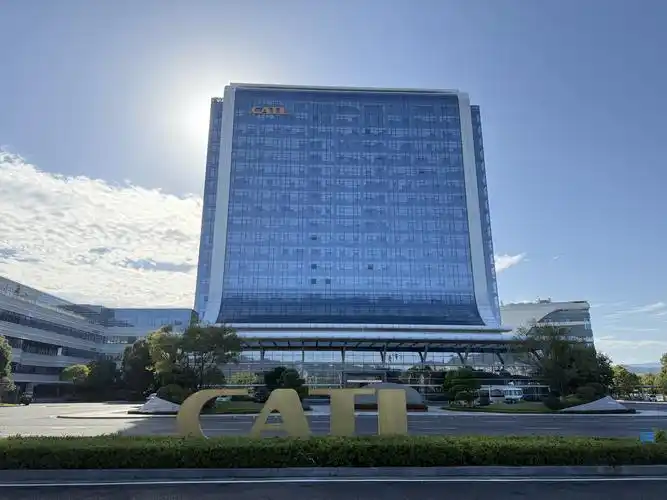 The rise of CATL from a modest Fujian startup in 2011 to a company valued higher than legacy auto giants like Volkswagen and Ford mirrors, in compressed form, the transformative ascent of Detroit's automakers in the early twentieth century or Manchester's mills during the first Industrial Revolution. Ningde now anchors a supply chain whose output rivals the steel production of Pittsburgh in its heyday. Within little more than a decade, this quiet coastal city has become the beating heart of the global shift from combustion engines to electric mobility, making it a pilgrimage site for anyone seeking to understand where the twenty-first-century energy economy is actually being built.
Spread across several interconnected factory districts framing the broad waters of Chijian Lake, the base blends heavy industry with deliberately landscaped natural scenery, an aesthetic ambition reminiscent of Volkswagen's Wolfsburg plant or Tesla's Gigafactory in Nevada. The flagship Lake East facility earned its 2021 Lighthouse Factory designation by integrating artificial intelligence, digital twins, and robotic assembly lines into a single self-optimizing system. Visiting groups traverse elevated glass corridors that overlook portions of the production floor, where robotic arms rhythmically assemble battery cells with a precision and cleanliness that evokes a semiconductor cleanroom more than a traditional factory.
Inside the headquarters, more than 20,000 engineers and scientists pursue incremental breakthroughs in energy density, thermal safety, and cycle longevity, the same trio of challenges that have defined battery research since Alessandro Volta first stacked silver and zinc discs in 1800. CATL's 43,000-plus patents and continuous advances in lithium-iron-phosphate and sodium-ion chemistries have accelerated the global decline of fossil-fuel vehicles. For European visitors especially, touring this facility offers tangible context for understanding why Chinese automakers now dominate markets from Berlin to Bangkok, and why legacy manufacturers in Stuttgart and Wolfsburg are racing to license or co-develop the cells first perfected here.
Access is highly restricted, and prospective visitors should plan at least one month in advance. Applications must be submitted through official CATL channels and include the visiting purpose, group size, and nationalities of participants; approved groups are transported by company shuttle, accompanied throughout, and required to sign a confidentiality agreement. Professional cameras and recording devices are prohibited. A typical approved visit lasts roughly half a day and includes the corporate exhibition hall plus a guided walk through portions of the demonstration line. There are no rides, interactive exhibits, or entertainment elements, the experience is firmly educational and oriented toward industry professionals, academic delegations, and government study tours.
Those unable to secure entry can still engage with CATL's philosophy at the "Time of Ning · Zero-Carbon Space" within Donghu Wetland Park, a demonstration building showcasing carbon-neutral architecture and ecological design. The broader Ningde region compensates generously for any disappointment at the factory gates. Nearby lie the granite spires of Taimu Mountain, often compared to a miniature Huangshan, the celebrated tidal mudflats of Xiapu that draw landscape photographers worldwide, the floating fishing platforms of Sanduao Bay, and the extraordinary river-bed terraces of Baishuiyang. Together with local specialties such as Fuding meatballs and aged white tea, these surroundings transform a strictly industrial pilgrimage into a richly varied coastal journey.
Beyond the industrial spectacle, visiting Ningde places travelers at the meeting point of two great transitions: the global abandonment of the internal combustion engine, and China's emergence as the leading manufacturer of the technologies replacing it. Few sites on earth make this shift as physically visible as a factory floor where, every minute, enough battery cells leave the line to equip several electric cars. For engineers, policy researchers, investors, and simply curious travelers, even the limited glimpse offered by an approved tour delivers a perspective unavailable at any museum or conference hall, a front-row seat to the industrial revolution of our own era.
The rise of CATL from a modest Fujian startup in 2011 to a company valued higher than legacy auto giants like Volkswagen and Ford mirrors, in compressed form, the transformative ascent of Detroit's automakers in the early twentieth century or Manchester's mills during the first Industrial Revolution. Ningde now anchors a supply chain whose output rivals the steel production of Pittsburgh in its heyday. Within little more than a decade, this quiet coastal city has become the beating heart of the global shift from combustion engines to electric mobility, making it a pilgrimage site for anyone seeking to understand where the twenty-first-century energy economy is actually being built.
Spread across several interconnected factory districts framing the broad waters of Chijian Lake, the base blends heavy industry with deliberately landscaped natural scenery, an aesthetic ambition reminiscent of Volkswagen's Wolfsburg plant or Tesla's Gigafactory in Nevada. The flagship Lake East facility earned its 2021 Lighthouse Factory designation by integrating artificial intelligence, digital twins, and robotic assembly lines into a single self-optimizing system. Visiting groups traverse elevated glass corridors that overlook portions of the production floor, where robotic arms rhythmically assemble battery cells with a precision and cleanliness that evokes a semiconductor cleanroom more than a traditional factory.
Inside the headquarters, more than 20,000 engineers and scientists pursue incremental breakthroughs in energy density, thermal safety, and cycle longevity, the same trio of challenges that have defined battery research since Alessandro Volta first stacked silver and zinc discs in 1800. CATL's 43,000-plus patents and continuous advances in lithium-iron-phosphate and sodium-ion chemistries have accelerated the global decline of fossil-fuel vehicles. For European visitors especially, touring this facility offers tangible context for understanding why Chinese automakers now dominate markets from Berlin to Bangkok, and why legacy manufacturers in Stuttgart and Wolfsburg are racing to license or co-develop the cells first perfected here.
Access is highly restricted, and prospective visitors should plan at least one month in advance. Applications must be submitted through official CATL channels and include the visiting purpose, group size, and nationalities of participants; approved groups are transported by company shuttle, accompanied throughout, and required to sign a confidentiality agreement. Professional cameras and recording devices are prohibited. A typical approved visit lasts roughly half a day and includes the corporate exhibition hall plus a guided walk through portions of the demonstration line. There are no rides, interactive exhibits, or entertainment elements, the experience is firmly educational and oriented toward industry professionals, academic delegations, and government study tours.
Those unable to secure entry can still engage with CATL's philosophy at the "Time of Ning · Zero-Carbon Space" within Donghu Wetland Park, a demonstration building showcasing carbon-neutral architecture and ecological design. The broader Ningde region compensates generously for any disappointment at the factory gates. Nearby lie the granite spires of Taimu Mountain, often compared to a miniature Huangshan, the celebrated tidal mudflats of Xiapu that draw landscape photographers worldwide, the floating fishing platforms of Sanduao Bay, and the extraordinary river-bed terraces of Baishuiyang. Together with local specialties such as Fuding meatballs and aged white tea, these surroundings transform a strictly industrial pilgrimage into a richly varied coastal journey.
Beyond the industrial spectacle, visiting Ningde places travelers at the meeting point of two great transitions: the global abandonment of the internal combustion engine, and China's emergence as the leading manufacturer of the technologies replacing it. Few sites on earth make this shift as physically visible as a factory floor where, every minute, enough battery cells leave the line to equip several electric cars. For engineers, policy researchers, investors, and simply curious travelers, even the limited glimpse offered by an approved tour delivers a perspective unavailable at any museum or conference hall, a front-row seat to the industrial revolution of our own era.