Longtan Park
⭐ 3.80
Baoshan City, Yunnan Province, China
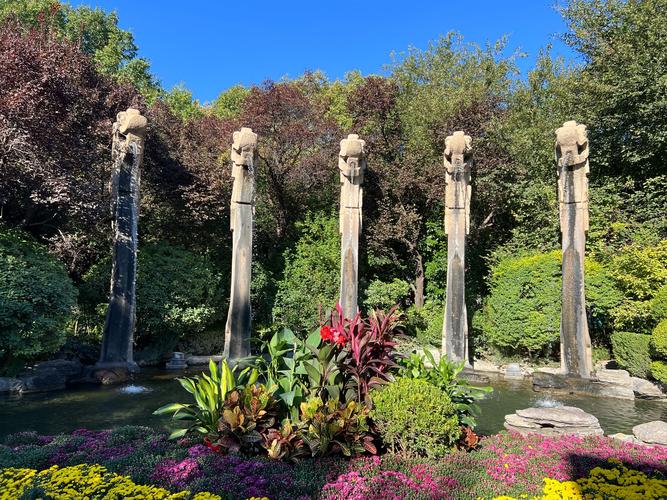 The park's heart is Daci Temple, founded during the Ming Dynasty (1368-1644), the same era as Shakespeare's London and Rembrandt's Netherlands. Known as the "First Ancient Temple of Dian City," it has witnessed over five centuries of Buddhist devotion in this corner of western Yunnan. A 2024 restoration transformed the grounds into a modern scenic area while preserving the temple's spiritual character. The historical name "Dian City" (Dian Cheng) reflects the site's longstanding role as a regional center, comparable to how small cathedral towns dotted medieval Europe.
The park's architectural centerpiece is Wangshan Tingquan Pavilion, a six-winged hexagonal structure rising from a spring-fed pool. Its carved wooden couplets and sweeping eaves echo the aesthetic principles of China's classical gardens, akin to Suzhou's UNESCO-listed retreats, or, in a Western parallel, the ornamental pavilions of Italian Renaissance villas such as those at Villa d'Este. Stone-paved walkways and modest stone bridges connect the spring pool, Bihu Lake, and Sanlong Pavilion, blending understated craftsmanship with the surrounding mountain wilderness.
Spanning roughly 111 acres, the park stretches from Dalan Mountain in the west to the Ku Ke River in the east, with vegetation so dense it forms a natural canopy. Year-round spring flow creates a cooling effect, dropping perceived temperatures by 3-5°C compared to the town below, a welcome respite during Yunnan's humid summers. The mountain paths wind through pine forests and rippling streams, evoking the contemplative walking circuits of English landscape gardens at Stourhead or Studley Royal.
Weekend and summer markets bring the park alive with the aromas of southwestern Yunnan cuisine. Visitors can sample Longtan grilled fish, pounded chicken feet, "sa pie" (a bitter-green salad seasoned with local herbs), and "shuaibaba" rice cakes, alongside cooling treats like rose-flavored ice jelly and locally roasted coffee. The juxtaposition of an ancient Buddhist temple and a bustling food market reflects how traditional Chinese landscapes continue serving as living community spaces, much like historic European abbey towns hosting weekly markets.
Entry is free, with gates typically open from 07:30 to 18:00, though hours extend during summer. The park sits about 5 kilometers from Changning's town center, best reached by taxi, rideshare, or self-drive; navigation apps should be set to "Longtan Park South Gate" or "Main Gate Parking." On-site amenities are minimal, so bring drinking water, sun or rain protection, and mosquito repellent. Aim to visit in early morning for misty lake reflections or late afternoon for golden-hour photography on the boardwalks.
For travelers seeking an authentic slice of rural Yunnan without the crowds of Lijiang or Dali, Longtan Park offers an accessible slice of local life that many international visitors overlook. A half-day itinerary pairs naturally with nearby attractions: the century-old Zhao family ancestral residence, the dramatic Lanshan Silver Waterfall, and a moving local martyrs' cemetery honoring China's revolutionary history. There is no need for lengthy travel to enjoy slow-paced tranquility, fresh mountain air, and the layered history of this unassuming corner of southwestern China, a refreshing reminder that some of the country's most rewarding landscapes lie off the well-worn tourist trail.
The park's heart is Daci Temple, founded during the Ming Dynasty (1368-1644), the same era as Shakespeare's London and Rembrandt's Netherlands. Known as the "First Ancient Temple of Dian City," it has witnessed over five centuries of Buddhist devotion in this corner of western Yunnan. A 2024 restoration transformed the grounds into a modern scenic area while preserving the temple's spiritual character. The historical name "Dian City" (Dian Cheng) reflects the site's longstanding role as a regional center, comparable to how small cathedral towns dotted medieval Europe.
The park's architectural centerpiece is Wangshan Tingquan Pavilion, a six-winged hexagonal structure rising from a spring-fed pool. Its carved wooden couplets and sweeping eaves echo the aesthetic principles of China's classical gardens, akin to Suzhou's UNESCO-listed retreats, or, in a Western parallel, the ornamental pavilions of Italian Renaissance villas such as those at Villa d'Este. Stone-paved walkways and modest stone bridges connect the spring pool, Bihu Lake, and Sanlong Pavilion, blending understated craftsmanship with the surrounding mountain wilderness.
Spanning roughly 111 acres, the park stretches from Dalan Mountain in the west to the Ku Ke River in the east, with vegetation so dense it forms a natural canopy. Year-round spring flow creates a cooling effect, dropping perceived temperatures by 3-5°C compared to the town below, a welcome respite during Yunnan's humid summers. The mountain paths wind through pine forests and rippling streams, evoking the contemplative walking circuits of English landscape gardens at Stourhead or Studley Royal.
Weekend and summer markets bring the park alive with the aromas of southwestern Yunnan cuisine. Visitors can sample Longtan grilled fish, pounded chicken feet, "sa pie" (a bitter-green salad seasoned with local herbs), and "shuaibaba" rice cakes, alongside cooling treats like rose-flavored ice jelly and locally roasted coffee. The juxtaposition of an ancient Buddhist temple and a bustling food market reflects how traditional Chinese landscapes continue serving as living community spaces, much like historic European abbey towns hosting weekly markets.
Entry is free, with gates typically open from 07:30 to 18:00, though hours extend during summer. The park sits about 5 kilometers from Changning's town center, best reached by taxi, rideshare, or self-drive; navigation apps should be set to "Longtan Park South Gate" or "Main Gate Parking." On-site amenities are minimal, so bring drinking water, sun or rain protection, and mosquito repellent. Aim to visit in early morning for misty lake reflections or late afternoon for golden-hour photography on the boardwalks.
For travelers seeking an authentic slice of rural Yunnan without the crowds of Lijiang or Dali, Longtan Park offers an accessible slice of local life that many international visitors overlook. A half-day itinerary pairs naturally with nearby attractions: the century-old Zhao family ancestral residence, the dramatic Lanshan Silver Waterfall, and a moving local martyrs' cemetery honoring China's revolutionary history. There is no need for lengthy travel to enjoy slow-paced tranquility, fresh mountain air, and the layered history of this unassuming corner of southwestern China, a refreshing reminder that some of the country's most rewarding landscapes lie off the well-worn tourist trail.