Shanxi Museum
⭐ 4.80
No. 183, Yingze Street, Xinghualing District, Taiyuan, Shanxi Province, China
 Founded in 1919 as the Shanxi Library and Museum, this institution carries over a century of scholarly heritage before opening its current home in 2005. In scale and ambition it rivals regional European museums such as Madrid's Museo Arqueológico or Vienna's Kunsthistorisches, but its focus is uniquely regional: tracing the rise and fall of the Jin state (the source of "Shanxi" itself) and the cultural forces that shaped northern China. The 650,000-strong collection, with more than 40,000 pieces classified as nationally precious, places it firmly in the front rank of Chinese provincial museums.
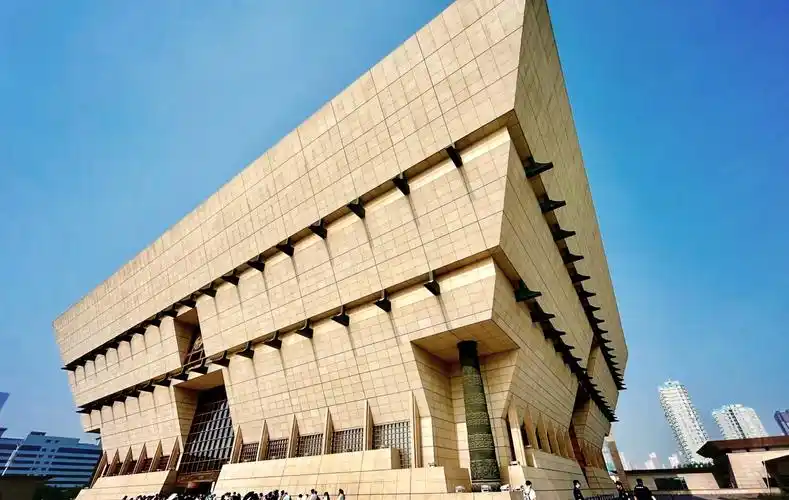
The building itself is a conversation piece. Its silhouette echoes the traditional Shanxi grain storehouse known as a douding, an architectural form found throughout northern China that symbolizes prosperity and abundance. Sprawling across 168 acres along the Fen River, the museum fuses vernacular imagery with contemporary museum design—the curved rooflines and open courtyards recall the dignified proportions of London's British Museum, yet remain unmistakably rooted in the agrarian landscapes of the North China Plain.
The collection's signature pieces span nearly three millennia. The Western Zhou Jinhou Bird Zun, a ritual bronze vessel depicting a phoenix-like bird, dates from the same era that produced the warrior tombs of Mycenae. The Shang dynasty Dragon Gong bears crocodile patterns virtually unknown elsewhere in Chinese art, hinting at long-distance exchange networks comparable to Bronze Age Mediterranean trade. A Han dynasty bronze lamp shaped like a goose swallowing a fish incorporates an ingenious internal filter to capture soot—an environmental innovation roughly contemporary with Roman innovations in glass and hydraulics.
Rather than a conventional chronological sweep, twelve permanent galleries organize the story thematically: "Cradle of Civilization," "Hegemony of Jin State," "Melting Pot of Nations," "Buddhist Legacy," "Cradle of Chinese Opera," and "Shanxi Merchants," among others. This approach allows visitors to grasp the region's role as a meeting point of steppe and agricultural civilizations, a cradle of Chinese opera and Buddhist art, and the homeland of the Shanxi merchant houses—China's counterpart to the Medici of Florence, who dominated the country's financial life from the Ming dynasty onward.
Practical details make visiting straightforward. The museum sits at 13 Binhe West Road in Taiyuan's Wanbailin District, easily reached by metro or taxi. Admission is free, but visitors must reserve in advance through the official WeChat account. Doors open Tuesday through Sunday, 9:00 to 17:00, with extended summer weekend hours until 18:00; the museum closes on Mondays. Chinese and English audio guides are available, and English-speaking docent tours can be arranged on request.
Allocate at least three to four hours, prioritizing the second and third floors, particularly the "Hegemony of Jin State" and "Melting Pot of Nations" halls, where the museum's most spectacular bronzes and ethnographic treasures are displayed. Photography, flash, food, drinks, and selfie sticks are prohibited inside the galleries. Free lockers, wheelchair loans, and a small café are on site. For travelers seeking to understand northern China beyond the Great Wall and the imperial capitals of Xi'an and Beijing, Shanxi Museum offers an indispensable and surprisingly intimate cultural anchor.
Founded in 1919 as the Shanxi Library and Museum, this institution carries over a century of scholarly heritage before opening its current home in 2005. In scale and ambition it rivals regional European museums such as Madrid's Museo Arqueológico or Vienna's Kunsthistorisches, but its focus is uniquely regional: tracing the rise and fall of the Jin state (the source of "Shanxi" itself) and the cultural forces that shaped northern China. The 650,000-strong collection, with more than 40,000 pieces classified as nationally precious, places it firmly in the front rank of Chinese provincial museums.
The building itself is a conversation piece. Its silhouette echoes the traditional Shanxi grain storehouse known as a douding, an architectural form found throughout northern China that symbolizes prosperity and abundance. Sprawling across 168 acres along the Fen River, the museum fuses vernacular imagery with contemporary museum design—the curved rooflines and open courtyards recall the dignified proportions of London's British Museum, yet remain unmistakably rooted in the agrarian landscapes of the North China Plain.
The collection's signature pieces span nearly three millennia. The Western Zhou Jinhou Bird Zun, a ritual bronze vessel depicting a phoenix-like bird, dates from the same era that produced the warrior tombs of Mycenae. The Shang dynasty Dragon Gong bears crocodile patterns virtually unknown elsewhere in Chinese art, hinting at long-distance exchange networks comparable to Bronze Age Mediterranean trade. A Han dynasty bronze lamp shaped like a goose swallowing a fish incorporates an ingenious internal filter to capture soot—an environmental innovation roughly contemporary with Roman innovations in glass and hydraulics.
Rather than a conventional chronological sweep, twelve permanent galleries organize the story thematically: "Cradle of Civilization," "Hegemony of Jin State," "Melting Pot of Nations," "Buddhist Legacy," "Cradle of Chinese Opera," and "Shanxi Merchants," among others. This approach allows visitors to grasp the region's role as a meeting point of steppe and agricultural civilizations, a cradle of Chinese opera and Buddhist art, and the homeland of the Shanxi merchant houses—China's counterpart to the Medici of Florence, who dominated the country's financial life from the Ming dynasty onward.
Practical details make visiting straightforward. The museum sits at 13 Binhe West Road in Taiyuan's Wanbailin District, easily reached by metro or taxi. Admission is free, but visitors must reserve in advance through the official WeChat account. Doors open Tuesday through Sunday, 9:00 to 17:00, with extended summer weekend hours until 18:00; the museum closes on Mondays. Chinese and English audio guides are available, and English-speaking docent tours can be arranged on request.
Allocate at least three to four hours, prioritizing the second and third floors, particularly the "Hegemony of Jin State" and "Melting Pot of Nations" halls, where the museum's most spectacular bronzes and ethnographic treasures are displayed. Photography, flash, food, drinks, and selfie sticks are prohibited inside the galleries. Free lockers, wheelchair loans, and a small café are on site. For travelers seeking to understand northern China beyond the Great Wall and the imperial capitals of Xi'an and Beijing, Shanxi Museum offers an indispensable and surprisingly intimate cultural anchor.