Yongle Palace
⭐ 4.60
Yongle Palace Scenic Area, Ruicheng County, Shanxi Province, China
 Yongle Palace was commissioned in 1247 during the Mongol-led Yuan Dynasty, an era roughly contemporary with the height of European Gothic cathedral building and the early stirrings of the Italian Renaissance. The temple was originally erected near the legendary birthplace of Lü Dongbin, one of the celebrated Eight Immortals of Daoist tradition. Between 1959 and 1965, the entire complex was disassembled and moved stone by stone, beam by beam, to its present site to escape flooding from the new Sanmenxia Dam—a relocation of monumental precision that left the fragile murals completely intact and remains a touchstone achievement in the history of cultural heritage preservation.
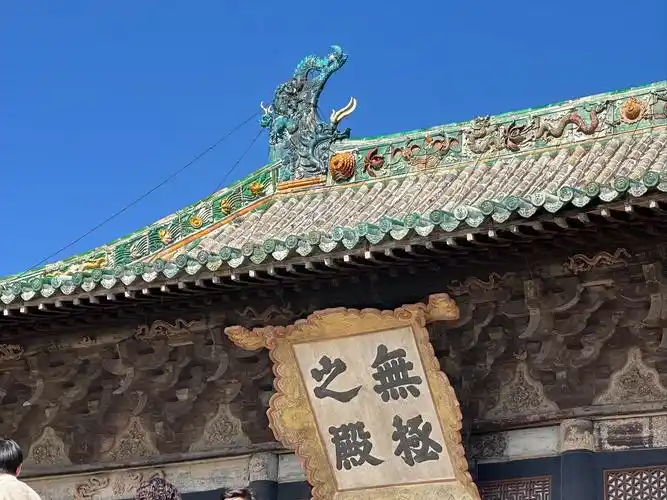
The architectural ensemble follows a traditional north-south axis, comprising four Yuan-era wooden halls—Dragon-Tiger Hall, Three Purities Hall, Lüzu Hall, and Wangzu Hall—fronted by a Qing Dynasty gate. Builders followed the technical prescriptions of the Song dynasty manual "Yingzao Fashi" and the Liao-Jin "reduced pillar" technique, producing soaring interiors that echo the structural logic found in Europe's great medieval tithe barns. The palace also preserves the largest surviving glazed roof ornaments (chiwen) in China, dramatic dragon-fish cresting that catches the mountain light with unmistakable grandeur.
The murals are the soul of Yongle Palace and its global claim to fame, covering exactly 1,005.68 square meters across the halls. The Three Purities Hall's "Court of Heaven" alone contains 286 deities arranged in a sweeping celestial procession—an ensemble that invites comparison with Giotto's Scrovegni Chapel frescoes in Padua, painted within a few decades of the same period. The Lüzu and Wangzu halls unfold the lives of Lü Dongbin and Wang Chongyang as continuous narrative cycles, functioning much like the pictorial storytelling seen in medieval European cathedral sculptures and illuminated manuscripts, but executed in vibrant mineral pigments that have lost none of their brilliance after eight centuries.
Strict conservation rules apply: photography is forbidden inside the halls, visitors must wear shoe covers, flashlights are prohibited, and viewing relies entirely on natural light filtering through the high windows—conditions that lend the murals an almost mystical luminosity reminiscent of candlelit Gothic chapels. Entry costs roughly 30–60 yuan, and the site is open daily from 8:00 to 18:00. Booking a knowledgeable guide in advance is strongly recommended, as the complex Daoist iconography and symbolic color systems reward expert interpretation; without guidance, casual visitors often miss the deeper narrative layers.
Plan a visit of two to three hours, following the central axis in sequence: mountain gate, Dragon-Tiger Hall, Three Purities Hall, Lüzu Hall, Wangzu Hall, the Relocation Memorial Hall, and finally the mural-copying studio, where life-size replicas allow unrestricted photography. Travelers with extra time should continue to the original Yongle Palace site and the nearby Guangrenwang Temple, the oldest surviving Tang Dynasty wooden structure in China—an unheralded architectural treasure that predates Yongle Palace by four centuries and rounds out an unforgettable journey through Shanxi's living history.
Yongle Palace was commissioned in 1247 during the Mongol-led Yuan Dynasty, an era roughly contemporary with the height of European Gothic cathedral building and the early stirrings of the Italian Renaissance. The temple was originally erected near the legendary birthplace of Lü Dongbin, one of the celebrated Eight Immortals of Daoist tradition. Between 1959 and 1965, the entire complex was disassembled and moved stone by stone, beam by beam, to its present site to escape flooding from the new Sanmenxia Dam—a relocation of monumental precision that left the fragile murals completely intact and remains a touchstone achievement in the history of cultural heritage preservation.
The architectural ensemble follows a traditional north-south axis, comprising four Yuan-era wooden halls—Dragon-Tiger Hall, Three Purities Hall, Lüzu Hall, and Wangzu Hall—fronted by a Qing Dynasty gate. Builders followed the technical prescriptions of the Song dynasty manual "Yingzao Fashi" and the Liao-Jin "reduced pillar" technique, producing soaring interiors that echo the structural logic found in Europe's great medieval tithe barns. The palace also preserves the largest surviving glazed roof ornaments (chiwen) in China, dramatic dragon-fish cresting that catches the mountain light with unmistakable grandeur.
The murals are the soul of Yongle Palace and its global claim to fame, covering exactly 1,005.68 square meters across the halls. The Three Purities Hall's "Court of Heaven" alone contains 286 deities arranged in a sweeping celestial procession—an ensemble that invites comparison with Giotto's Scrovegni Chapel frescoes in Padua, painted within a few decades of the same period. The Lüzu and Wangzu halls unfold the lives of Lü Dongbin and Wang Chongyang as continuous narrative cycles, functioning much like the pictorial storytelling seen in medieval European cathedral sculptures and illuminated manuscripts, but executed in vibrant mineral pigments that have lost none of their brilliance after eight centuries.
Strict conservation rules apply: photography is forbidden inside the halls, visitors must wear shoe covers, flashlights are prohibited, and viewing relies entirely on natural light filtering through the high windows—conditions that lend the murals an almost mystical luminosity reminiscent of candlelit Gothic chapels. Entry costs roughly 30–60 yuan, and the site is open daily from 8:00 to 18:00. Booking a knowledgeable guide in advance is strongly recommended, as the complex Daoist iconography and symbolic color systems reward expert interpretation; without guidance, casual visitors often miss the deeper narrative layers.
Plan a visit of two to three hours, following the central axis in sequence: mountain gate, Dragon-Tiger Hall, Three Purities Hall, Lüzu Hall, Wangzu Hall, the Relocation Memorial Hall, and finally the mural-copying studio, where life-size replicas allow unrestricted photography. Travelers with extra time should continue to the original Yongle Palace site and the nearby Guangrenwang Temple, the oldest surviving Tang Dynasty wooden structure in China—an unheralded architectural treasure that predates Yongle Palace by four centuries and rounds out an unforgettable journey through Shanxi's living history.