Jinci Temple
⭐ 4.60
Jinci Scenic Area, Jinci Town, Jinyuan District, Taiyuan City, Shanxi Province, China
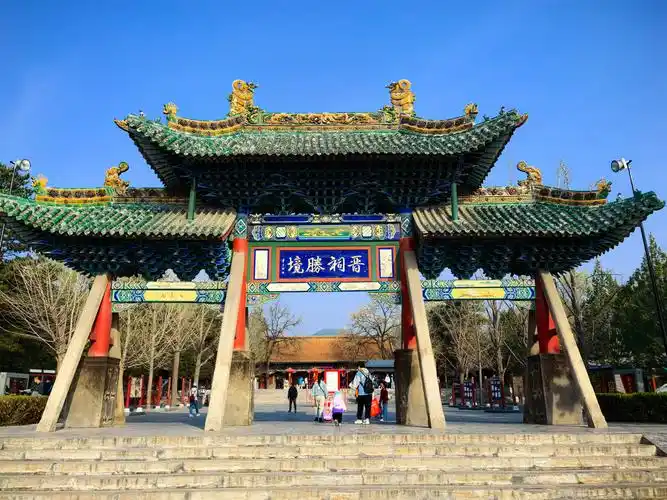 Jinci's origins stretch back to the Northern Wei period (5th–6th century), when it began as a shrine honoring Tang Shuyu, the founding lord of the Jin state—one of the principal powers during China's Spring and Autumn era (roughly contemporary with ancient Athens at its peak). After the Song dynasty, the focus shifted to honoring his mother, and the temple expanded into a royal sanctuary. Designated a national AAAAA scenic site and first-class museum in 2024, it has been continuously restored across the centuries, evolving into a rare fusion of sacred precinct and pleasure garden.
The architecture alone could occupy a full afternoon. The Northern Song Holy Mother Hall, contemporary with the great Norman cathedrals of Europe, stands as a masterpiece of timber engineering: eight carved dragon columns—China's earliest surviving examples—support a roof held together purely by interlocking joinery, without a single nail. The Flying Bridge across Fish Pond is the only known cross-shaped ancient bridge in China, a structural curiosity that the great architect Liang Sicheng compared to finding a Romanesque oddity untouched by time. The Jin dynasty Offering Hall, an airy pavilion of pure mortise-and-tenon construction, represents the pinnacle of Chinese ceremonial design.
Beyond architecture, Jinci holds three cultural wonders of global stature. The Holy Mother Hall shelters 43 Song dynasty painted clay figures, including 33 maidservants whose varied expressions and gestures have been called "the ceiling of Chinese sculpture"—akin in intimacy to the emotional realism of Donatello's terracotta Madonnas. The Zhou Dynasty cypress, planted more than 3,000 years ago, reclines like a dragon over the courtyard, easily rivaling Europe's most venerable oaks in age. The Nanlao Spring, the source of the Jin River, has flowed at a near-constant 17°C for over a millennium, symbolizing the very lifeblood of the region.
The surrounding park is free, while the historic core—the Jinci Museum—costs 80 yuan in high season (April–October) and 65 yuan in low season; visitors over 60 enter free. Opening hours run 8:00–18:00 (high season) and 8:30–17:00 (low season). Reserve in advance via the WeChat account "Jinci Museum." The site lies about 25 km southwest of central Taiyuan, reachable by buses 308, 804, or 856, or by taxi. Budget 2.5 to 3.5 hours and enter through the east gate.
Begin at the Water Mirror Stage, then proceed to the Golden Man Terrace, Duiyue Archway, Offering Hall, Flying Bridge, Holy Mother Hall, the ancient cypress, and finally the Nanlao Spring—a linear route with no backtracking. Hire an official guide or rent an audio device (around 30 yuan); without context, the sculptures and carvings easily lose their meaning. Flash photography and tripods are forbidden inside the Holy Mother Hall, and touching any monument is strictly prohibited. If time allows, combine your visit with the nearby Tianlong Mountain Grottoes, whose Buddhist carvings trace China's religious art from the Northern Wei through the Tang—an equally rewarding complement to Jinci's classical legacy.
Jinci's origins stretch back to the Northern Wei period (5th–6th century), when it began as a shrine honoring Tang Shuyu, the founding lord of the Jin state—one of the principal powers during China's Spring and Autumn era (roughly contemporary with ancient Athens at its peak). After the Song dynasty, the focus shifted to honoring his mother, and the temple expanded into a royal sanctuary. Designated a national AAAAA scenic site and first-class museum in 2024, it has been continuously restored across the centuries, evolving into a rare fusion of sacred precinct and pleasure garden.
The architecture alone could occupy a full afternoon. The Northern Song Holy Mother Hall, contemporary with the great Norman cathedrals of Europe, stands as a masterpiece of timber engineering: eight carved dragon columns—China's earliest surviving examples—support a roof held together purely by interlocking joinery, without a single nail. The Flying Bridge across Fish Pond is the only known cross-shaped ancient bridge in China, a structural curiosity that the great architect Liang Sicheng compared to finding a Romanesque oddity untouched by time. The Jin dynasty Offering Hall, an airy pavilion of pure mortise-and-tenon construction, represents the pinnacle of Chinese ceremonial design.
Beyond architecture, Jinci holds three cultural wonders of global stature. The Holy Mother Hall shelters 43 Song dynasty painted clay figures, including 33 maidservants whose varied expressions and gestures have been called "the ceiling of Chinese sculpture"—akin in intimacy to the emotional realism of Donatello's terracotta Madonnas. The Zhou Dynasty cypress, planted more than 3,000 years ago, reclines like a dragon over the courtyard, easily rivaling Europe's most venerable oaks in age. The Nanlao Spring, the source of the Jin River, has flowed at a near-constant 17°C for over a millennium, symbolizing the very lifeblood of the region.
The surrounding park is free, while the historic core—the Jinci Museum—costs 80 yuan in high season (April–October) and 65 yuan in low season; visitors over 60 enter free. Opening hours run 8:00–18:00 (high season) and 8:30–17:00 (low season). Reserve in advance via the WeChat account "Jinci Museum." The site lies about 25 km southwest of central Taiyuan, reachable by buses 308, 804, or 856, or by taxi. Budget 2.5 to 3.5 hours and enter through the east gate.
Begin at the Water Mirror Stage, then proceed to the Golden Man Terrace, Duiyue Archway, Offering Hall, Flying Bridge, Holy Mother Hall, the ancient cypress, and finally the Nanlao Spring—a linear route with no backtracking. Hire an official guide or rent an audio device (around 30 yuan); without context, the sculptures and carvings easily lose their meaning. Flash photography and tripods are forbidden inside the Holy Mother Hall, and touching any monument is strictly prohibited. If time allows, combine your visit with the nearby Tianlong Mountain Grottoes, whose Buddhist carvings trace China's religious art from the Northern Wei through the Tang—an equally rewarding complement to Jinci's classical legacy.