Porcelain House

⭐ 4.30

No. 72, Chifeng Road, Heping District, Tianjin, China
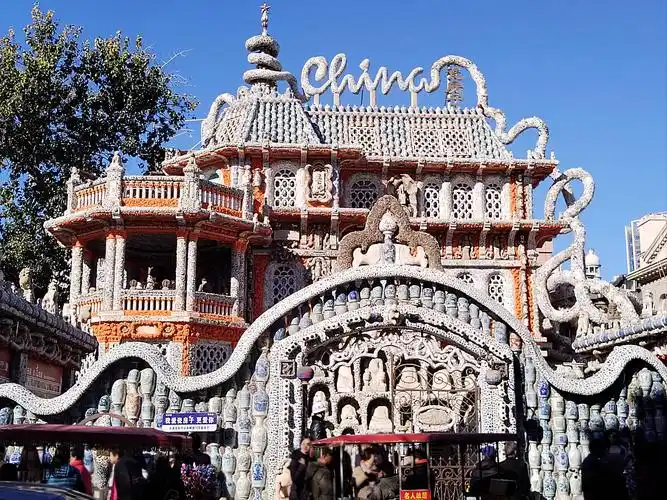
Porcelain House
Tianjin's Porcelain House began life in the early 1900s as a modest French concession residence, built during Europe's Belle Époque when Tianjin—along with Shanghai—hosted foreign settlements where European merchants erected mansions alongside traditional Chinese homes. After a century of varied use, the building was acquired in 2002 by collector Zhang Lianzhi, who embarked on an obsessive decade-long transformation, embedding fragments spanning the Northern Wei Dynasty through the Qing era into every surface. The result recalls the visionary spirit of Antoni Gaudí in Catalonia, where ordinary buildings became extraordinary artistic statements. The exterior's "Peace Wall" incorporates 635 antique porcelain vases arranged vertically up the façade, their cobalt-blue glazes catching sunlight like scattered sapphires. Crowning the structure, a 768-meter dragon-and-lion frieze in Ming-dynasty sacrificial-red porcelain coils across the rooftop—an oriental cousin to the ceramic-adorned Modernisme facades of Barcelona. Inside, the staircase walls depict fragments of Song-dynasty scroll scenes rendered entirely in ancient porcelain shards, while a fourth-floor atrium cradles a towering Song-era vat ringed by imperial-quality plates. Beyond spectacle, the Porcelain House functions as both museum and manifesto. Its ground-floor colonnade displays 28 stone Buddhist figures dating from the Northern Wei through Ming dynasties, their weathered serenity juxtaposed against the swirling French-style coffered ceiling above. By fusing sacred sculpture, imperial Ming wares, and Beaux-Arts architecture under one roof, Zhang created a structure comparable in ambition to a three-dimensional Fabergé egg—where every centimeter tells a story of Chinese craft traditions stretching back to antiquity. Located at 72 Chifeng Road in central Heping District, the Porcelain House sits within walking distance of two metro stations: Yingkoudao and Anshan Road. Admission tickets are available on-site or via major travel apps, with guided tours offered for deeper context. Allow at least one hour for a thorough visit, and note that some interior sections prohibit photography. The attraction scores 4.3 out of 5 on major review platforms, reflecting broad appeal despite being lesser-known than Beijing's Forbidden City. For Western travelers, the Porcelain House offers something no European landmark can replicate: an immersive encounter with Chinese ceramic history embedded directly into architecture itself. Combine it with a stroll through nearby Wudadao, where dozens of European-style villas from the concession era remain beautifully preserved—together they paint a vivid portrait of cross-cultural exchange. Visit during off-peak hours to avoid queues, wear comfortable shoes for tight stairways, and bring curiosity rather than expectations of conventional museum displays. This is art that demands to be felt, not merely observed.

Traveler reviews

This morning I checked out a viral spot in Tianjin—the Porcelain House (pic 1). It's a 3A scenic spot at No. 72 Chifeng Road in Heping District, a building wrapped in ancient porcelain pieces and shards. It was originally a four-story French-style mansion, once the residence of Huang Rongliang, a diplomat in modern Chinese history. After liberation it changed hands several times, until a private entrepreneur bought it at the start of this century. He covered the whole thing in antique porcelain pieces to create the eye-catching "Porcelain House"—you gotta admit, the guy really thought outside the box (pic 2). Aside from the whole building (pic 3) and exterior walls (pic 4), even the indoor walls and pillars (pic 5) and the ceiling (pic 6) are plastered with vases and shards. They say the whole renovation use...
⭐ 4 · Sage Expand
A French mansion dressed up in porcelain, ancient Chinese ceramics colliding with European architecture to create this wonderfully weird beauty. It catches the light and sparkles in the sun, and you can feel the obsessive detail poured in by Zhang Lia...
⭐ 4 · Avery Expand