Tianjin Eye
⭐ 4.20
Tanggu Street, Binhai New Area, Tianjin, China
 Opened in 2008 on the eve of the Beijing Olympics, the Tianjin Eye was conceived as the centerpiece of a sweeping urban-renewal initiative along the Hai River, transforming what had been a fading industrial port into a polished international city. Tianjin itself carries deep historical weight: from the 1860 Opium Wars it was forced open to foreign trade, spawning concession districts that still retain their European flavor—remnants of British, French, and Italian quarters that lend the city its unique cosmopolitan character, much as Shanghai's Bund does. The wheel's opening was a symbolic punctuation on this journey from colonial outpost to contemporary showcase.
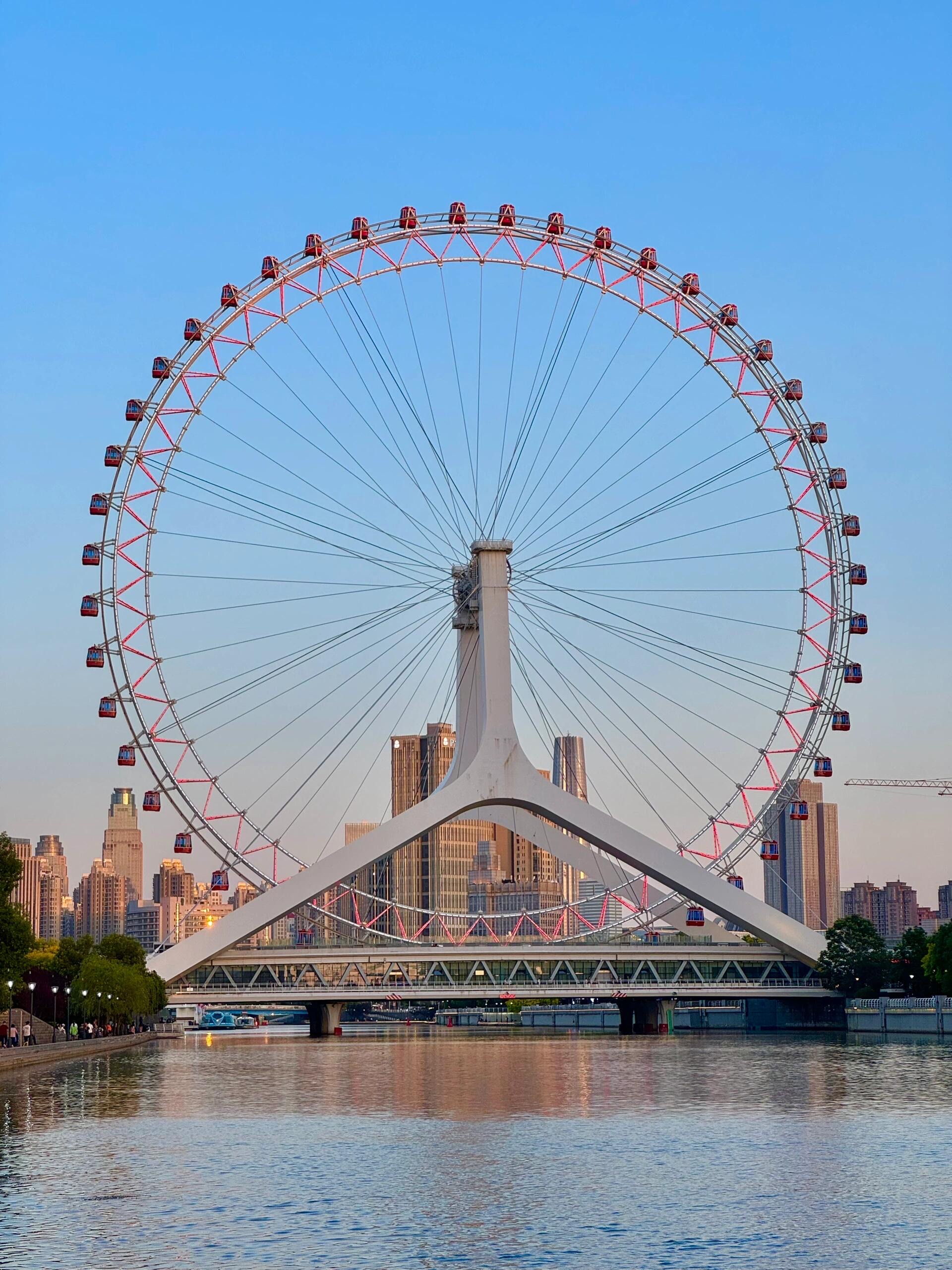
Architecturally, the wheel is a true global rarity. Its 110-meter diameter places it among the larger observation wheels worldwide—though shorter than the London Eye's 135 meters, it arguably rivals it in visual drama because of its remarkable perch on a functioning road bridge. Each of its 48 fully transparent, air-conditioned capsules accommodates eight passengers, offering unobstructed sightlines in every direction. Engineers had to design the entire structure so the rotating wheel would not interfere with the bridge's load-bearing function, making it a singular feat of civil engineering that has earned admiration from architects worldwide.
Culturally, the Tianjin Eye has transcended its origins as a tourist attraction to become a defining emblem of the city. It features prominently in municipal branding, postage stamps, tourism campaigns, and Chinese film productions. After dark, its luminous display reflects off the Hai River, harmonizing with the illuminated riverside facades of nearby European heritage buildings to create a romantic tableau that has made the spot a favorite proposal venue. For photographers, the interplay of glowing wheel, river reflections, and historic architecture offers compositions rarely matched elsewhere in Asia.
Practical planning is essential for a smooth visit. The wheel operates Tuesday through Sunday from 9:30 a.m. to 10:00 p.m., with ticket scanning ending at 9:00 p.m.; on Mondays it opens only after 6:00 p.m. Day tickets cost 90 yuan and night tickets 138 yuan, with half-price concessions for children and seniors, while private cabins run 400 yuan for groups of up to five. Crucially, tickets must be reserved one to three days in advance through the official WeChat account "天津之眼摩天轮"—no walk-up sales are available at the site, a detail that catches many foreign visitors off guard.
For the optimal experience, arrive about half an hour before sunset to board; the full rotation takes 28 to 30 minutes, perfectly timed to watch daylight fade and city lights flicker on. The nearest metro stop is Beiyunhe Station on Line 6, a five-minute walk from Exit D. Those wishing to skip the queue entirely should head instead to the nearby Jingang Bridge or the riverfront promenade, both of which offer spectacular, unobstructed views of the wheel at no cost—an ideal vantage for capturing that quintessential Tianjin photograph.
Beyond the wheel itself, the surrounding Hai River waterfront invites exploration. A leisurely stroll along the embankments reveals striking contrasts: century-old European consulates and warehouses repurposed as cafés and galleries stand within sight of sleek modern towers. Few cities blend such layered histories so visibly, and the Tianjin Eye—watching silently from above—serves as the perfect vantage from which to appreciate this remarkable fusion of East and West, past and present.
Opened in 2008 on the eve of the Beijing Olympics, the Tianjin Eye was conceived as the centerpiece of a sweeping urban-renewal initiative along the Hai River, transforming what had been a fading industrial port into a polished international city. Tianjin itself carries deep historical weight: from the 1860 Opium Wars it was forced open to foreign trade, spawning concession districts that still retain their European flavor—remnants of British, French, and Italian quarters that lend the city its unique cosmopolitan character, much as Shanghai's Bund does. The wheel's opening was a symbolic punctuation on this journey from colonial outpost to contemporary showcase.
Architecturally, the wheel is a true global rarity. Its 110-meter diameter places it among the larger observation wheels worldwide—though shorter than the London Eye's 135 meters, it arguably rivals it in visual drama because of its remarkable perch on a functioning road bridge. Each of its 48 fully transparent, air-conditioned capsules accommodates eight passengers, offering unobstructed sightlines in every direction. Engineers had to design the entire structure so the rotating wheel would not interfere with the bridge's load-bearing function, making it a singular feat of civil engineering that has earned admiration from architects worldwide.
Culturally, the Tianjin Eye has transcended its origins as a tourist attraction to become a defining emblem of the city. It features prominently in municipal branding, postage stamps, tourism campaigns, and Chinese film productions. After dark, its luminous display reflects off the Hai River, harmonizing with the illuminated riverside facades of nearby European heritage buildings to create a romantic tableau that has made the spot a favorite proposal venue. For photographers, the interplay of glowing wheel, river reflections, and historic architecture offers compositions rarely matched elsewhere in Asia.
Practical planning is essential for a smooth visit. The wheel operates Tuesday through Sunday from 9:30 a.m. to 10:00 p.m., with ticket scanning ending at 9:00 p.m.; on Mondays it opens only after 6:00 p.m. Day tickets cost 90 yuan and night tickets 138 yuan, with half-price concessions for children and seniors, while private cabins run 400 yuan for groups of up to five. Crucially, tickets must be reserved one to three days in advance through the official WeChat account "天津之眼摩天轮"—no walk-up sales are available at the site, a detail that catches many foreign visitors off guard.
For the optimal experience, arrive about half an hour before sunset to board; the full rotation takes 28 to 30 minutes, perfectly timed to watch daylight fade and city lights flicker on. The nearest metro stop is Beiyunhe Station on Line 6, a five-minute walk from Exit D. Those wishing to skip the queue entirely should head instead to the nearby Jingang Bridge or the riverfront promenade, both of which offer spectacular, unobstructed views of the wheel at no cost—an ideal vantage for capturing that quintessential Tianjin photograph.
Beyond the wheel itself, the surrounding Hai River waterfront invites exploration. A leisurely stroll along the embankments reveals striking contrasts: century-old European consulates and warehouses repurposed as cafés and galleries stand within sight of sleek modern towers. Few cities blend such layered histories so visibly, and the Tianjin Eye—watching silently from above—serves as the perfect vantage from which to appreciate this remarkable fusion of East and West, past and present.