Meiwan Park
⭐ 4.50
Meiwan Park, Nanhu District, Jiaxing, Zhejiang Province, China
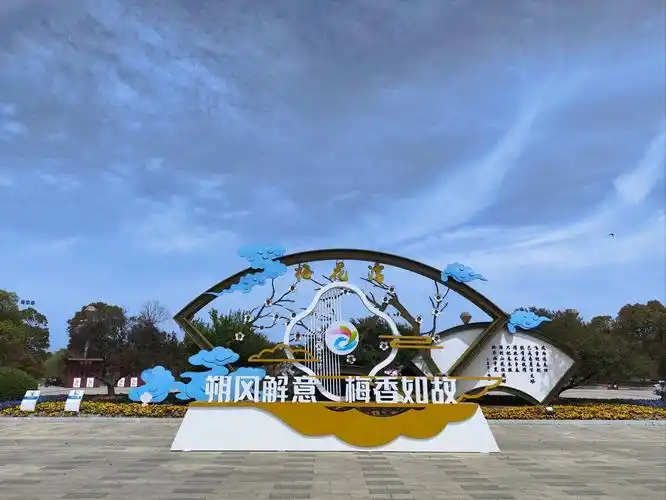 Meiwan takes its name from the plum blossoms that once carpeted this stretch south of Jiaxing's old walled city during the Ming dynasty. By the late Qing and early Republic period, the area had evolved into a thriving merchant quarter where officials and gentry built elegant waterside residences. The district preserves a tangible record of Jiaxing's transition from a traditional Jiangnan watertown to a modernizing city—a transformation echoing the urban shifts seen in cities like Bruges or Amsterdam in the same era. Today, the surviving lane houses, ancestral halls, and waterside quays form one of the most authentic windows into Jiangnan life outside the better-known water towns of Suzhou and Wuzhen.
The architectural ensemble follows the classic Jiangnan "street-in-front, canal-behind" layout, with whitewashed walls, slate-grey tiled roofs, and the upturned eaves that distinguish southern Chinese vernacular architecture. Cobbled flagstone lanes thread between low-slung courtyard houses, while stone footbridges span the slow-moving waters of the Huancheng Canal. Think of the human scale of a Tuscan hill town or a Provençal village, transplanted to the Yangtze delta. As evening falls, vermilion lanterns swing above the waterways, lending the district a softly theatrical glow that has become a favorite among photographers seeking the quieter face of Jiangnan.
Meiwan's cultural weight far exceeds its modest footprint. The most celebrated figure is Zhu Shenghao (1912–1944), the scholar whose Chinese translations of Shakespeare remain the standard editions used across the Sinophone world—a literary feat comparable to Schlegel's German Shakespeare or the Arden edition in English. Equally poignant is the former refuge of Kim Koo, the Korean independence leader who sheltered here during Japan's colonial rule, linking this quiet lane to twentieth-century liberation movements across East Asia. The district also preserves the residence of Chu Fucheng, a noted Republican-era democrat, completing a trio of figures whose lives spanned literature, politics, and revolution.
The district is freely open around the clock, with no entrance fee, tickets, or advance reservation required—simply walk in. Buses 93, 15, and 25 stop at "Meiwan Street," while drivers can use nearby parking lots. An important tip: navigation apps should be searched for "Meiwan Street," not "Meiwan Park," to avoid confusion with the unrelated Meili Park in Wangdian town. Most celebrity residence museums close between 16:30 and 17:00, so plan those visits earlier in the day, while the outdoor lanes and canal walks remain accessible at any hour.
The golden hours here are 17:00 to 20:00, when lantern light reflects off the canal and crowds thin; early risers will find the lanes nearly deserted between 07:00 and 09:00, ideal for unobstructed photography. A recommended route is to enter from the South Gate, work through the celebrity residences, then follow the canal walkway before sampling snacks at the Nanmen Tout food street. With more time, the historic Yuehe (Moon River) district and South Lake—where the Chinese Communist Party was founded in 1921—lie within easy walking or taxi distance, making Meiwan an excellent anchor for a full Jiaxing day.
Meiwan takes its name from the plum blossoms that once carpeted this stretch south of Jiaxing's old walled city during the Ming dynasty. By the late Qing and early Republic period, the area had evolved into a thriving merchant quarter where officials and gentry built elegant waterside residences. The district preserves a tangible record of Jiaxing's transition from a traditional Jiangnan watertown to a modernizing city—a transformation echoing the urban shifts seen in cities like Bruges or Amsterdam in the same era. Today, the surviving lane houses, ancestral halls, and waterside quays form one of the most authentic windows into Jiangnan life outside the better-known water towns of Suzhou and Wuzhen.
The architectural ensemble follows the classic Jiangnan "street-in-front, canal-behind" layout, with whitewashed walls, slate-grey tiled roofs, and the upturned eaves that distinguish southern Chinese vernacular architecture. Cobbled flagstone lanes thread between low-slung courtyard houses, while stone footbridges span the slow-moving waters of the Huancheng Canal. Think of the human scale of a Tuscan hill town or a Provençal village, transplanted to the Yangtze delta. As evening falls, vermilion lanterns swing above the waterways, lending the district a softly theatrical glow that has become a favorite among photographers seeking the quieter face of Jiangnan.
Meiwan's cultural weight far exceeds its modest footprint. The most celebrated figure is Zhu Shenghao (1912–1944), the scholar whose Chinese translations of Shakespeare remain the standard editions used across the Sinophone world—a literary feat comparable to Schlegel's German Shakespeare or the Arden edition in English. Equally poignant is the former refuge of Kim Koo, the Korean independence leader who sheltered here during Japan's colonial rule, linking this quiet lane to twentieth-century liberation movements across East Asia. The district also preserves the residence of Chu Fucheng, a noted Republican-era democrat, completing a trio of figures whose lives spanned literature, politics, and revolution.
The district is freely open around the clock, with no entrance fee, tickets, or advance reservation required—simply walk in. Buses 93, 15, and 25 stop at "Meiwan Street," while drivers can use nearby parking lots. An important tip: navigation apps should be searched for "Meiwan Street," not "Meiwan Park," to avoid confusion with the unrelated Meili Park in Wangdian town. Most celebrity residence museums close between 16:30 and 17:00, so plan those visits earlier in the day, while the outdoor lanes and canal walks remain accessible at any hour.
The golden hours here are 17:00 to 20:00, when lantern light reflects off the canal and crowds thin; early risers will find the lanes nearly deserted between 07:00 and 09:00, ideal for unobstructed photography. A recommended route is to enter from the South Gate, work through the celebrity residences, then follow the canal walkway before sampling snacks at the Nanmen Tout food street. With more time, the historic Yuehe (Moon River) district and South Lake—where the Chinese Communist Party was founded in 1921—lie within easy walking or taxi distance, making Meiwan an excellent anchor for a full Jiaxing day.