Eastern Qing Tombs
⭐ 4.20
Eastern Qing Tombs, Zunhua City, Tangshan, Hebei Province, China
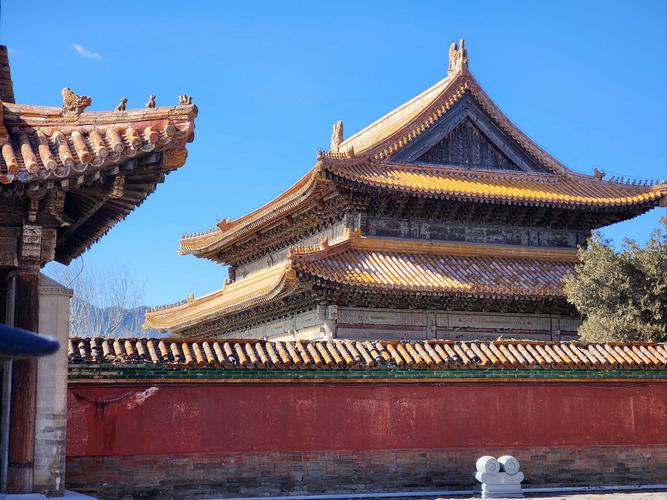 Constructed beginning in 1661 and developed over 247 years, the Eastern Qing Tombs span the dramatic arc of China's last dynasty, from its consolidation under Shunzhi through its heyday under Qianlong to its twilight years under Cixi. Built roughly two centuries after Versailles was transformed into a royal palace, this funerary ensemble rivals Europe's grandest royal necropolises—such as the Escorial near Madrid or Peterhof's tomb complex near St. Petersburg—in sheer ambition. As the last great imperial burial ground of a Chinese dynasty, the complex offers tangible evidence of the ritual protocols that structured Chinese royal life for over two millennia.
The necropolis unfolds along a five-kilometer Sacred Way anchored against the southern slopes of Changrui Mountain, an axial layout comparable in spirit to the processional avenues of Versailles or the approach to Rome's Appian Way. Fifteen burial compounds—five for emperors, four for empresses, five for imperial consorts, and one for a princess—step up the hillside in hierarchical tiers. At the threshold stand eighteen pairs of stone guardian animals and officials, each more than life-sized, flanked by ornate Dragon and Phoenix spirit gates. The forested mountain backdrop, draped in ancient pines, lends a solemnity akin to the Habsburg crypts beneath Vienna's Capuchin Church.
The most spectacular artistic treasure lies deep within Qianlong's Underground Palace, the only subterranean chamber in the Qing necropolis entirely sheathed in Buddhist imagery. More than a thousand Buddhist figures and Sanskrit sutras cover every wall and ceiling, transforming the crypt into what scholars call a "Buddhist Hall Beneath the Earth." Compared to the sculptural density of European Baroque churches like Prague's St. Nicholas, the effect here is compressed and intense—visitors descend through several chambers, each more lavishly carved than the last. It is the only tomb in the complex whose underground palace is regularly open to visitors.
Empress Dowager Cixi's Dingdong Tomb pushes Qing funerary luxury to its gilded zenith. Its Hall of Imperial Favor was constructed around precious huanghuali rosewood, and every beam, bracket, and painted surface gleams with genuine gold leaf. Most striking is the marble ramp stone, carved with an unprecedented composition of "Phoenix Suppressing Dragon"—a symbolic inversion reflecting Cixi's extraordinary grip on power during her son's reign. The opulence rivals that of any European royal interior, from the Hall of Mirrors at Versailles to the Gold Cabinet at St. Petersburg's Catherine Palace, yet it carries a uniquely Chinese political resonance.
The site is a National 5A Scenic Area, easily reached by car to "Eastern Qing Tombs Visitor Service Center," roughly 125 kilometers east of Beijing. Public transport requires a transfer in Zunhua and is time-consuming. A combined ticket costs about 108 yuan, plus a mandatory sightseeing bus (30 yuan), essential since distances between tombs are considerable. Allow four to six hours for highlights, or a full day for a relaxed pace. Hiring a guide or renting an audio device is strongly recommended to decode the symbolism. Photography is prohibited in the underground palaces, where temperatures hover around 16°C year-round—bring a light jacket and sturdy walking shoes.
For travelers tracing the final chapter of imperial China, the Eastern Qing Tombs deliver an experience unmatched elsewhere in the country. Few sites in the world let you trace the rise, maturity, and decline of an entire dynasty through a single architectural ensemble spanning nearly 250 years. Whether your interest is Buddhist art, Qing political history, imperial ritual, or simply monumental scenery, the tombs reward curiosity with layers of meaning. Combine a visit with nearby Great Wall sections or a Beijing extension for an unforgettable journey through China's last imperial epoch.
Constructed beginning in 1661 and developed over 247 years, the Eastern Qing Tombs span the dramatic arc of China's last dynasty, from its consolidation under Shunzhi through its heyday under Qianlong to its twilight years under Cixi. Built roughly two centuries after Versailles was transformed into a royal palace, this funerary ensemble rivals Europe's grandest royal necropolises—such as the Escorial near Madrid or Peterhof's tomb complex near St. Petersburg—in sheer ambition. As the last great imperial burial ground of a Chinese dynasty, the complex offers tangible evidence of the ritual protocols that structured Chinese royal life for over two millennia.
The necropolis unfolds along a five-kilometer Sacred Way anchored against the southern slopes of Changrui Mountain, an axial layout comparable in spirit to the processional avenues of Versailles or the approach to Rome's Appian Way. Fifteen burial compounds—five for emperors, four for empresses, five for imperial consorts, and one for a princess—step up the hillside in hierarchical tiers. At the threshold stand eighteen pairs of stone guardian animals and officials, each more than life-sized, flanked by ornate Dragon and Phoenix spirit gates. The forested mountain backdrop, draped in ancient pines, lends a solemnity akin to the Habsburg crypts beneath Vienna's Capuchin Church.
The most spectacular artistic treasure lies deep within Qianlong's Underground Palace, the only subterranean chamber in the Qing necropolis entirely sheathed in Buddhist imagery. More than a thousand Buddhist figures and Sanskrit sutras cover every wall and ceiling, transforming the crypt into what scholars call a "Buddhist Hall Beneath the Earth." Compared to the sculptural density of European Baroque churches like Prague's St. Nicholas, the effect here is compressed and intense—visitors descend through several chambers, each more lavishly carved than the last. It is the only tomb in the complex whose underground palace is regularly open to visitors.
Empress Dowager Cixi's Dingdong Tomb pushes Qing funerary luxury to its gilded zenith. Its Hall of Imperial Favor was constructed around precious huanghuali rosewood, and every beam, bracket, and painted surface gleams with genuine gold leaf. Most striking is the marble ramp stone, carved with an unprecedented composition of "Phoenix Suppressing Dragon"—a symbolic inversion reflecting Cixi's extraordinary grip on power during her son's reign. The opulence rivals that of any European royal interior, from the Hall of Mirrors at Versailles to the Gold Cabinet at St. Petersburg's Catherine Palace, yet it carries a uniquely Chinese political resonance.
The site is a National 5A Scenic Area, easily reached by car to "Eastern Qing Tombs Visitor Service Center," roughly 125 kilometers east of Beijing. Public transport requires a transfer in Zunhua and is time-consuming. A combined ticket costs about 108 yuan, plus a mandatory sightseeing bus (30 yuan), essential since distances between tombs are considerable. Allow four to six hours for highlights, or a full day for a relaxed pace. Hiring a guide or renting an audio device is strongly recommended to decode the symbolism. Photography is prohibited in the underground palaces, where temperatures hover around 16°C year-round—bring a light jacket and sturdy walking shoes.
For travelers tracing the final chapter of imperial China, the Eastern Qing Tombs deliver an experience unmatched elsewhere in the country. Few sites in the world let you trace the rise, maturity, and decline of an entire dynasty through a single architectural ensemble spanning nearly 250 years. Whether your interest is Buddhist art, Qing political history, imperial ritual, or simply monumental scenery, the tombs reward curiosity with layers of meaning. Combine a visit with nearby Great Wall sections or a Beijing extension for an unforgettable journey through China's last imperial epoch.