Gogol Street
⭐ 4.50
Gogol Street, Nangang District, Harbin City, Heilongjiang Province, China
 Gogol Street was laid out in 1901, the same year that the Chinese Eastern Railway (CER) — Russia's answer to a Trans-Siberian shortcut through Manchuria — transformed a quiet fishing settlement into a booming international port. Originally called New Commercial Street, the avenue was later renamed Yizhou Street and then Fendou Road before reclaiming its current name in 2003, honoring the Russian satirist Nikolai Gogol. Walking here is to retrace the footsteps of Russian engineers, Jewish merchants, and Japanese diplomats who shaped Northeast Asia's most cosmopolitan pre-war city.
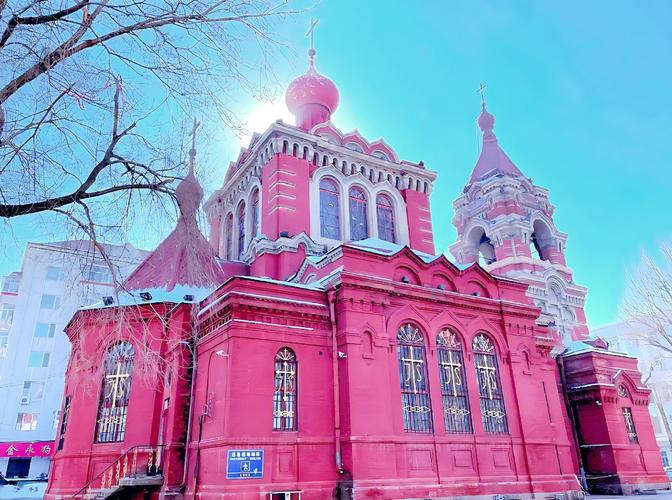
The street is essentially an open-air museum of early-twentieth-century European architecture. The red-brick St. Alexei Church, with its silver-gray domes and elegant bell tower, recalls a smaller cousin of Moscow's Cathedral of Christ the Saviour rendered in provincial Baroque — a hallmark of Russian Orthodox design transplanted to the Far East. The 1908 Churin Company headquarters glows in pale ochre Art Nouveau, its curved façade echoing the Vienna Secession movement of Olbrich and Klimt. Nearby stand the weathered former Japanese Consulate and the old Asia Cinema, layered remnants of the city's tangled colonial past.
Churin Company, founded in 1867 and a fixture here for over a century, remains the soul of the street. Its smoked red sausage, fermented bread drink (kvass), and massive dark Russian loaves are the edible icons of Harbin's Russian heritage, sold today much as they were a hundred years ago. The Fendou Food Market continues this tradition with cured meats and local preserves, while family-run Russian restaurants and Soviet-style cafés line the way. Compared with Central Avenue's tourist bustle, Gogol Street preserves the everyday rhythm of old Harbin — quieter, warmer, and unmistakably lived-in.
The avenue is free and open to all, with no entrance fee, and deserves two to three unhurried hours. Take Metro Line 1 to Yidayiyuan Station to reach the north end, then walk southward along the tree-lined route. Evenings are magical, when building façades light up against the dark sky — photographers should bring a tripod. Note that St. Alexei Church's interior is generally closed to visitors; admire its domes from outside. Comfortable shoes are essential, as some original cobblestones still surface between asphalt patches.
What makes Gogol Street irresistible is its sense of quiet authenticity: it feels less like a stage set and more like a working neighborhood where the past still answers the door. Pair it with the leafy Children's Park and Majiagou River banks to the east, or continue to the brightly painted India Street nearby, for a satisfying half-day circuit. For travelers who know St. Petersburg, Prague, or Vienna, this is Harbin's gentler, less-touristed echo — a place where European heritage survived the twentieth century intact, tucked behind China's northeastern frontier.
Gogol Street was laid out in 1901, the same year that the Chinese Eastern Railway (CER) — Russia's answer to a Trans-Siberian shortcut through Manchuria — transformed a quiet fishing settlement into a booming international port. Originally called New Commercial Street, the avenue was later renamed Yizhou Street and then Fendou Road before reclaiming its current name in 2003, honoring the Russian satirist Nikolai Gogol. Walking here is to retrace the footsteps of Russian engineers, Jewish merchants, and Japanese diplomats who shaped Northeast Asia's most cosmopolitan pre-war city.
The street is essentially an open-air museum of early-twentieth-century European architecture. The red-brick St. Alexei Church, with its silver-gray domes and elegant bell tower, recalls a smaller cousin of Moscow's Cathedral of Christ the Saviour rendered in provincial Baroque — a hallmark of Russian Orthodox design transplanted to the Far East. The 1908 Churin Company headquarters glows in pale ochre Art Nouveau, its curved façade echoing the Vienna Secession movement of Olbrich and Klimt. Nearby stand the weathered former Japanese Consulate and the old Asia Cinema, layered remnants of the city's tangled colonial past.
Churin Company, founded in 1867 and a fixture here for over a century, remains the soul of the street. Its smoked red sausage, fermented bread drink (kvass), and massive dark Russian loaves are the edible icons of Harbin's Russian heritage, sold today much as they were a hundred years ago. The Fendou Food Market continues this tradition with cured meats and local preserves, while family-run Russian restaurants and Soviet-style cafés line the way. Compared with Central Avenue's tourist bustle, Gogol Street preserves the everyday rhythm of old Harbin — quieter, warmer, and unmistakably lived-in.
The avenue is free and open to all, with no entrance fee, and deserves two to three unhurried hours. Take Metro Line 1 to Yidayiyuan Station to reach the north end, then walk southward along the tree-lined route. Evenings are magical, when building façades light up against the dark sky — photographers should bring a tripod. Note that St. Alexei Church's interior is generally closed to visitors; admire its domes from outside. Comfortable shoes are essential, as some original cobblestones still surface between asphalt patches.
What makes Gogol Street irresistible is its sense of quiet authenticity: it feels less like a stage set and more like a working neighborhood where the past still answers the door. Pair it with the leafy Children's Park and Majiagou River banks to the east, or continue to the brightly painted India Street nearby, for a satisfying half-day circuit. For travelers who know St. Petersburg, Prague, or Vienna, this is Harbin's gentler, less-touristed echo — a place where European heritage survived the twentieth century intact, tucked behind China's northeastern frontier.