Harbin Grand Theatre
⭐ 4.60
Intersection of Gogol Street and Songhua River Avenue, Nangang District, Harbin City, Heilongjiang Province, China
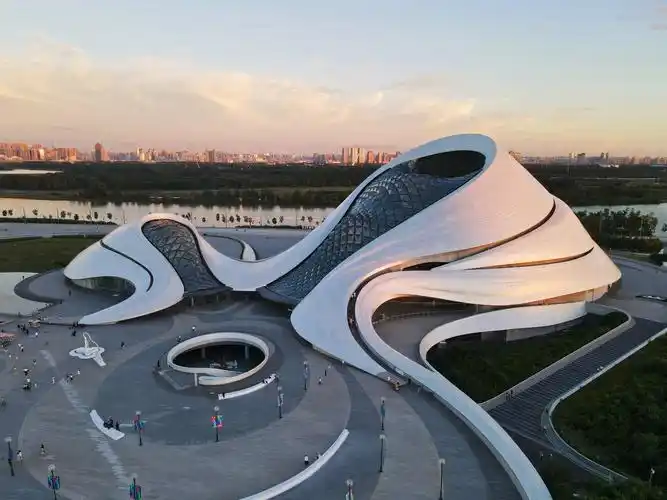 The Harbin Grand Theatre marks a pivotal moment in 21st-century Chinese architecture, joining a global conversation about biomimetic design pioneered by figures like Frank Gehry and Zaha Hadid. Ma Yansong, who became the first Chinese architect to design a project selected for the Venice Biennale's main exhibition, drew the building's fluid, snow-covered silhouette directly from the surrounding mudflats of the Songhua River. Opened in 2016, it represents a generation of Chinese designers no longer imitating European templates but exporting a distinctly East Asian aesthetic to the world stage—a shift comparable to how Alvar Aalto once redefined Nordic architecture through pure, organic forms.
The structure's exterior is a breathtaking exercise in parametric design. Its double-curved aluminum facade stretches across roughly 72,000 square meters, undulating like a silk scarf caught mid-breeze or a ridge of wind-sculpted snow. Inside, the warmth of hand-finished ash wood paneling softens the futuristic shell, creating a tactile contrast reminiscent of the cabin-lined halls of the Berlin Philharmonie. Natural light filters through carefully angled openings, ensuring that even visitors without tickets can experience the building as a luminous sculpture during the day and a glowing lantern at dusk.
This is a working cultural institution as much as an architectural showpiece. The 1,600-seat grand hall and 400-seat recital room host everything from Russian touring operas and Sichuan opera to symphony concerts and contemporary dance. Critics rank its acoustics among the finest worldwide—a 2017 jury awarded it ArchDaily's title of Best Cultural Building, and another panel honored it as the World's Best Concert Hall, praising its ability to deliver crystalline, unamplified sound to every corner of the auditorium. No wonder Russian, Japanese, and European orchestras have added it to their tour circuits.
Visiting requires a simple digital dance. The exterior grounds and surrounding wetland boardwalks remain open to the public for free at any hour—ideal for photographers chasing the golden light of evening, when the building's aluminum skin reflects the sunset like a frozen wave. To step inside or ascend the spiraling outer staircase to the rooftop observation deck (where views stretch across the Songhua to the distant spires of Saint Sophia Cathedral), visitors must reserve a free slot via the theatre's official WeChat account. Performance tickets are sold separately through the website; evening shows on weekends sell out weeks in advance.
The smart plan is to pair your visit with Sun Island, a ten-minute walk away, and the Siberian Tiger Park further east—forming a satisfying day that mixes architecture, nature, and wildlife. Arrive mid-morning to tour the interior before the crowds, then return at dusk when the wetlands glow behind the theatre's silver curves. Summer, when lotus flowers bloom along the boardwalk and the surrounding forests offer cool shade, is the loveliest season by far. Wear solid colors for portrait shots against the building's complex geometry, and bring a light jacket for the chilly performance halls and air-conditioned interiors.
[DETAILED]
Continue. The Harbin Grand Theatre marks a pivotal moment in 21st-century Chinese architecture, joining a global conversation about biomimetic design pioneered by figures like Frank Gehry and Zaha Hadid. Ma Yansong, who became the first Chinese architect to design a project selected for the Venice Biennale's main exhibition, drew the building's fluid, snow-covered silhouette directly from the surrounding mudflats of the Songhua River. Opened in 2016, it represents a generation of Chinese designers no longer imitating European templates but exporting a distinctly East Asian aesthetic to the world stage—a shift comparable to how Alvar Aalto once redefined Nordic architecture through pure, organic forms.</mm:think>[BRIEF]
Rising from the wetlands of the Songhua River's northern bank, the Harbin Grand Theatre is one of China's most photographed contemporary landmarks. Designed by Ma Yansong and his Beijing-based firm MAD Architects, the silver, ribbon-like structure draws its silhouette from the drifting forms of northern snowscapes and meandering riverbanks. Within its walls hides a 1,600-seat opera hall acclaimed for its extraordinary acoustics—a venue where sound travels as purely as it does inside Vienna's Musikverein. Whether you come for a Tchaikovsky symphony, a ballet, or simply to admire the dramatic curves mirrored in the wetlands, the theatre offers a bold vision of modern Chinese cultural ambition.
[DETAILED]
The Harbin Grand Theatre marks a pivotal moment in 21st-century Chinese architecture, joining a global conversation about biomimetic design pioneered by figures like Frank Gehry and Zaha Hadid. Ma Yansong, who became the first Chinese architect to design a project selected for the Venice Biennale's main exhibition, drew the building's fluid, snow-covered silhouette directly from the surrounding mudflats of the Songhua River. Opened in 2016, it represents a generation of Chinese designers no longer imitating European templates but exporting a distinctly East Asian aesthetic to the world stage—a shift comparable to how Alvar Aalto once redefined Nordic architecture through pure, organic forms.
The structure's exterior is a breathtaking exercise in parametric design. Its double-curved aluminum facade stretches across roughly 72,000 square meters, undulating like a silk scarf caught mid-breeze or a ridge of wind-sculpted snow. Inside, the warmth of hand-finished ash wood paneling softens the futuristic shell, creating a tactile contrast reminiscent of the cabin-lined halls of the Berlin Philharmonie. Natural light filters through carefully angled openings, ensuring that even visitors without tickets can experience the building as a luminous sculpture during the day and a glowing lantern at dusk.
This is a working cultural institution as much as an architectural showpiece. The 1,600-seat grand hall and 400-seat recital room host everything from Russian touring operas and Sichuan opera to symphony concerts and contemporary dance. Critics rank its acoustics among the finest worldwide—a 2017 jury awarded it ArchDaily's title of Best Cultural Building, and another panel honored it as the World's Best Concert Hall, praising its ability to deliver crystalline, unamplified sound to every corner of the auditorium. No wonder Russian, Japanese, and European orchestras have added it to their tour circuits.
Visiting requires a simple digital dance. The exterior grounds and surrounding wetland boardwalks remain open to the public for free at any hour—ideal for photographers chasing the golden light of evening, when the building's aluminum skin reflects the sunset like a frozen wave. To step inside or ascend the spiraling outer staircase to the rooftop observation deck (where views stretch across the Songhua to the distant onion domes of Saint Sophia Cathedral), visitors must reserve a free slot via the theatre's official WeChat account. Performance tickets are sold separately through the website; evening shows on weekends sell out weeks in advance.
The smart plan is to pair your visit with Sun Island, a ten-minute walk away, and the Siberian Tiger Park further east—forming a satisfying day that mixes architecture, nature, and wildlife. Arrive mid-morning to tour the interior before the crowds, then return at dusk when the wetlands glow behind the theatre's silver curves. Summer, when lotus flowers bloom along the boardwalk and the surrounding forests offer cool shade, is the loveliest season by far. Wear solid colors for portrait shots against the building's complex geometry, and bring a light jacket for the chilly performance halls and air-conditioned interiors.
The Harbin Grand Theatre marks a pivotal moment in 21st-century Chinese architecture, joining a global conversation about biomimetic design pioneered by figures like Frank Gehry and Zaha Hadid. Ma Yansong, who became the first Chinese architect to design a project selected for the Venice Biennale's main exhibition, drew the building's fluid, snow-covered silhouette directly from the surrounding mudflats of the Songhua River. Opened in 2016, it represents a generation of Chinese designers no longer imitating European templates but exporting a distinctly East Asian aesthetic to the world stage—a shift comparable to how Alvar Aalto once redefined Nordic architecture through pure, organic forms.
The structure's exterior is a breathtaking exercise in parametric design. Its double-curved aluminum facade stretches across roughly 72,000 square meters, undulating like a silk scarf caught mid-breeze or a ridge of wind-sculpted snow. Inside, the warmth of hand-finished ash wood paneling softens the futuristic shell, creating a tactile contrast reminiscent of the cabin-lined halls of the Berlin Philharmonie. Natural light filters through carefully angled openings, ensuring that even visitors without tickets can experience the building as a luminous sculpture during the day and a glowing lantern at dusk.
This is a working cultural institution as much as an architectural showpiece. The 1,600-seat grand hall and 400-seat recital room host everything from Russian touring operas and Sichuan opera to symphony concerts and contemporary dance. Critics rank its acoustics among the finest worldwide—a 2017 jury awarded it ArchDaily's title of Best Cultural Building, and another panel honored it as the World's Best Concert Hall, praising its ability to deliver crystalline, unamplified sound to every corner of the auditorium. No wonder Russian, Japanese, and European orchestras have added it to their tour circuits.
Visiting requires a simple digital dance. The exterior grounds and surrounding wetland boardwalks remain open to the public for free at any hour—ideal for photographers chasing the golden light of evening, when the building's aluminum skin reflects the sunset like a frozen wave. To step inside or ascend the spiraling outer staircase to the rooftop observation deck (where views stretch across the Songhua to the distant spires of Saint Sophia Cathedral), visitors must reserve a free slot via the theatre's official WeChat account. Performance tickets are sold separately through the website; evening shows on weekends sell out weeks in advance.
The smart plan is to pair your visit with Sun Island, a ten-minute walk away, and the Siberian Tiger Park further east—forming a satisfying day that mixes architecture, nature, and wildlife. Arrive mid-morning to tour the interior before the crowds, then return at dusk when the wetlands glow behind the theatre's silver curves. Summer, when lotus flowers bloom along the boardwalk and the surrounding forests offer cool shade, is the loveliest season by far. Wear solid colors for portrait shots against the building's complex geometry, and bring a light jacket for the chilly performance halls and air-conditioned interiors.
[DETAILED]
Continue. The Harbin Grand Theatre marks a pivotal moment in 21st-century Chinese architecture, joining a global conversation about biomimetic design pioneered by figures like Frank Gehry and Zaha Hadid. Ma Yansong, who became the first Chinese architect to design a project selected for the Venice Biennale's main exhibition, drew the building's fluid, snow-covered silhouette directly from the surrounding mudflats of the Songhua River. Opened in 2016, it represents a generation of Chinese designers no longer imitating European templates but exporting a distinctly East Asian aesthetic to the world stage—a shift comparable to how Alvar Aalto once redefined Nordic architecture through pure, organic forms.</mm:think>[BRIEF]
Rising from the wetlands of the Songhua River's northern bank, the Harbin Grand Theatre is one of China's most photographed contemporary landmarks. Designed by Ma Yansong and his Beijing-based firm MAD Architects, the silver, ribbon-like structure draws its silhouette from the drifting forms of northern snowscapes and meandering riverbanks. Within its walls hides a 1,600-seat opera hall acclaimed for its extraordinary acoustics—a venue where sound travels as purely as it does inside Vienna's Musikverein. Whether you come for a Tchaikovsky symphony, a ballet, or simply to admire the dramatic curves mirrored in the wetlands, the theatre offers a bold vision of modern Chinese cultural ambition.
[DETAILED]
The Harbin Grand Theatre marks a pivotal moment in 21st-century Chinese architecture, joining a global conversation about biomimetic design pioneered by figures like Frank Gehry and Zaha Hadid. Ma Yansong, who became the first Chinese architect to design a project selected for the Venice Biennale's main exhibition, drew the building's fluid, snow-covered silhouette directly from the surrounding mudflats of the Songhua River. Opened in 2016, it represents a generation of Chinese designers no longer imitating European templates but exporting a distinctly East Asian aesthetic to the world stage—a shift comparable to how Alvar Aalto once redefined Nordic architecture through pure, organic forms.
The structure's exterior is a breathtaking exercise in parametric design. Its double-curved aluminum facade stretches across roughly 72,000 square meters, undulating like a silk scarf caught mid-breeze or a ridge of wind-sculpted snow. Inside, the warmth of hand-finished ash wood paneling softens the futuristic shell, creating a tactile contrast reminiscent of the cabin-lined halls of the Berlin Philharmonie. Natural light filters through carefully angled openings, ensuring that even visitors without tickets can experience the building as a luminous sculpture during the day and a glowing lantern at dusk.
This is a working cultural institution as much as an architectural showpiece. The 1,600-seat grand hall and 400-seat recital room host everything from Russian touring operas and Sichuan opera to symphony concerts and contemporary dance. Critics rank its acoustics among the finest worldwide—a 2017 jury awarded it ArchDaily's title of Best Cultural Building, and another panel honored it as the World's Best Concert Hall, praising its ability to deliver crystalline, unamplified sound to every corner of the auditorium. No wonder Russian, Japanese, and European orchestras have added it to their tour circuits.
Visiting requires a simple digital dance. The exterior grounds and surrounding wetland boardwalks remain open to the public for free at any hour—ideal for photographers chasing the golden light of evening, when the building's aluminum skin reflects the sunset like a frozen wave. To step inside or ascend the spiraling outer staircase to the rooftop observation deck (where views stretch across the Songhua to the distant onion domes of Saint Sophia Cathedral), visitors must reserve a free slot via the theatre's official WeChat account. Performance tickets are sold separately through the website; evening shows on weekends sell out weeks in advance.
The smart plan is to pair your visit with Sun Island, a ten-minute walk away, and the Siberian Tiger Park further east—forming a satisfying day that mixes architecture, nature, and wildlife. Arrive mid-morning to tour the interior before the crowds, then return at dusk when the wetlands glow behind the theatre's silver curves. Summer, when lotus flowers bloom along the boardwalk and the surrounding forests offer cool shade, is the loveliest season by far. Wear solid colors for portrait shots against the building's complex geometry, and bring a light jacket for the chilly performance halls and air-conditioned interiors.