Saint Sophia Cathedral
⭐ 4.20
Sophia Cathedral, Nangang District, Harbin City, Heilongjiang Province, China
 Harbin's St. Sophia Cathedral has a surprisingly global backstory. Construction began in 1907 as a modest timber chapel for Russian engineers building the Chinese Eastern Railway, part of the same tsarist imperial project that once threatened British India and reshaped Manchuria's economy. Funds dried up in 1909, but the congregation—now swelled by White Russian refugees fleeing the Bolshevik Revolution—funded its 1932 reconstruction into a grand brick cathedral. Closed during the Cultural Revolution in 1966 and left to decay for three decades, it was painstakingly restored in 1996 and reopened as a secular museum the following year.
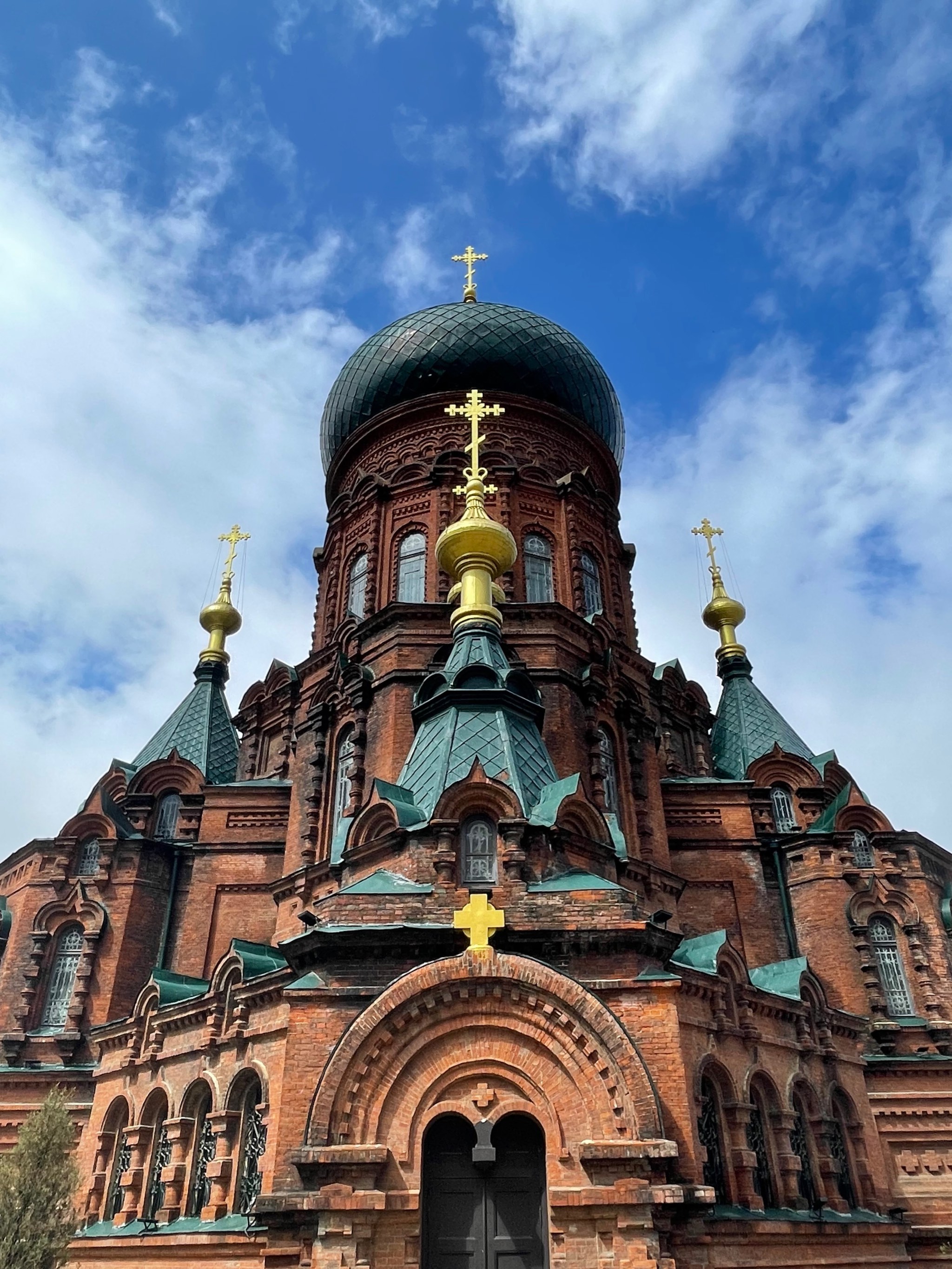
Architecturally, the cathedral borrows directly from Muscovite and Byzantine traditions familiar to visitors who know St. Basil's in Red Square or Istanbul's smaller Orthodox churches. Standing 53 meters tall on a compact 721-square-meter footprint, the structure is built from exposed red brick ornamented with arcaded blind arches, carved crosses, and intricate relief work. The famous dark-green onion dome—often compared to the spires of Prague's Baroque churches—rises above a drum topped with a gilded cross, while flanking tent-roofed towers complete a dramatic, layered silhouette. Inside, the surviving cross-in-square plan, arched arcades, and fragmentary wall paintings preserve a distinctly Russo-Byzantine aesthetic rarely seen outside Eastern Europe.
The cathedral's cultural weight far exceeds its modest museum footprint. Designated a nationally protected heritage site in 1996 and listed among China's first "20th-Century Architectural Heritage" properties in 2016, it has become the defining image of Harbin's "Moscow of the East" identity. Where the nearby Central Street feels like a slice of Paris and the Songhua River embankments recall Volga-side promenades, St. Sophia anchors the city's claim to be the meeting point of Slavic, Jewish, Japanese, and Chinese cultures in the early 20th century—a living monument to a vanished cosmopolitan era.
Practical planning is straightforward. The cathedral sits in Daoli District's Sophia Square, which is open and free around the clock; entering the interior exhibition hall requires a ticket in the ¥15–25 range, and the museum typically operates 8:30 a.m.–9:00 p.m. daily except Mondays (hours may shift seasonally, so verify on site or by phone). The nearest metro stop is Shangzhi Street on Line 2, about a ten-minute walk, and parking in the surrounding streets is notoriously tight—public transport is strongly recommended.
Photography enthusiasts should aim for the soft golden light of early morning (around 6:30–8:30 a.m.) or the blue hour just after sunset (roughly 5:00–7:00 p.m., varying with season), when the dome glows against warm skies. Three classic vantage points stand out: the full frontal shot from the square's central axis, the mirrored reflection in the southeastern fountain pool, and the framed view through the side arched gateway. The interior galleries can be comfortably absorbed in 30–45 minutes, making it easy to pair the cathedral with a half-day walking loop that continues along Central Street, past the Flood Control Memorial Tower, and down to the frozen Songhua River waterfront in winter.
Harbin's St. Sophia Cathedral has a surprisingly global backstory. Construction began in 1907 as a modest timber chapel for Russian engineers building the Chinese Eastern Railway, part of the same tsarist imperial project that once threatened British India and reshaped Manchuria's economy. Funds dried up in 1909, but the congregation—now swelled by White Russian refugees fleeing the Bolshevik Revolution—funded its 1932 reconstruction into a grand brick cathedral. Closed during the Cultural Revolution in 1966 and left to decay for three decades, it was painstakingly restored in 1996 and reopened as a secular museum the following year.
Architecturally, the cathedral borrows directly from Muscovite and Byzantine traditions familiar to visitors who know St. Basil's in Red Square or Istanbul's smaller Orthodox churches. Standing 53 meters tall on a compact 721-square-meter footprint, the structure is built from exposed red brick ornamented with arcaded blind arches, carved crosses, and intricate relief work. The famous dark-green onion dome—often compared to the spires of Prague's Baroque churches—rises above a drum topped with a gilded cross, while flanking tent-roofed towers complete a dramatic, layered silhouette. Inside, the surviving cross-in-square plan, arched arcades, and fragmentary wall paintings preserve a distinctly Russo-Byzantine aesthetic rarely seen outside Eastern Europe.
The cathedral's cultural weight far exceeds its modest museum footprint. Designated a nationally protected heritage site in 1996 and listed among China's first "20th-Century Architectural Heritage" properties in 2016, it has become the defining image of Harbin's "Moscow of the East" identity. Where the nearby Central Street feels like a slice of Paris and the Songhua River embankments recall Volga-side promenades, St. Sophia anchors the city's claim to be the meeting point of Slavic, Jewish, Japanese, and Chinese cultures in the early 20th century—a living monument to a vanished cosmopolitan era.
Practical planning is straightforward. The cathedral sits in Daoli District's Sophia Square, which is open and free around the clock; entering the interior exhibition hall requires a ticket in the ¥15–25 range, and the museum typically operates 8:30 a.m.–9:00 p.m. daily except Mondays (hours may shift seasonally, so verify on site or by phone). The nearest metro stop is Shangzhi Street on Line 2, about a ten-minute walk, and parking in the surrounding streets is notoriously tight—public transport is strongly recommended.
Photography enthusiasts should aim for the soft golden light of early morning (around 6:30–8:30 a.m.) or the blue hour just after sunset (roughly 5:00–7:00 p.m., varying with season), when the dome glows against warm skies. Three classic vantage points stand out: the full frontal shot from the square's central axis, the mirrored reflection in the southeastern fountain pool, and the framed view through the side arched gateway. The interior galleries can be comfortably absorbed in 30–45 minutes, making it easy to pair the cathedral with a half-day walking loop that continues along Central Street, past the Flood Control Memorial Tower, and down to the frozen Songhua River waterfront in winter.