Xianyang Beidu Site
⭐ 2.50
Beidu Subdistrict, Weicheng District, Xianyang City, Shaanxi Province, China
 Roughly contemporary with the early Roman Empire, the Western Han dynasty (206 BCE – 9 CE) shaped imperial China the way Augustus's Rome shaped the Mediterranean. Xiao He and Cao Can were the bureaucratic geniuses behind Liu Bang, the dynasty's founding emperor—comparable to Cicero and Fabius Maximus for Rome. After the Qin collapse, their administrative foresight turned a rebel army into a functioning empire. Xiao He managed logistics and codified law; Cao Can, who succeeded him as chancellor, faithfully continued his policies. The Chinese still quote "Xiao's rules, Cao follows" to praise effective continuity in governance—much as English-speakers might invoke the tradition of peaceful transfer of power.
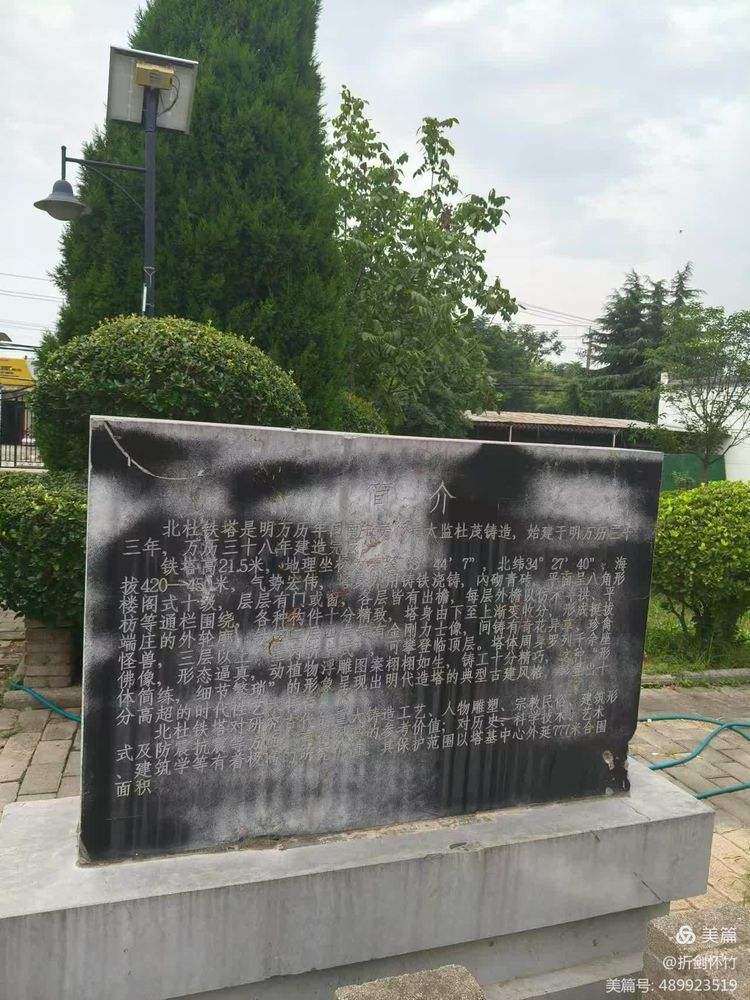
The two tombs lie east-west of each other on the Wei River plain, their earthen mounds rising 16 and 13 meters—about the height of a five-story building. Surrounding them, the 97-mu (16-acre) ecological park is dotted with cherry and maple trees, a sculpture evoking the famous idiom, and a stone relief quoting Sima Qian's Shiji (Records of the Grand Historian). Three kilometers away, the Ming pagoda soars to 33 meters across ten octagonal tiers, every surface cast in solid iron and studded with more than a thousand Buddhist figures and guardian warriors. A brick core provides structural stability. The craftsmen who poured it in 1590 achieved a feat of metallurgy that pre-dates the Industrial Revolution by two centuries.
These two sites fill gaps that no museum can. The tombs are among the very few surviving examples of high-ranking Han official burials, giving archaeologists rare physical evidence of how the men who shaped one of history's longest-enduring civilizations were laid to rest. The iron pagoda is one of China's largest and earliest iron Buddhist pagodas—an extraordinary survival given that four centuries of weather have tested every joint and seam. Locals nickname it the "Eastern Eiffel Tower," though it actually predates Gustave Eiffel's 1889 masterpiece by nearly three centuries and weighs considerably more.
The memorial park is open 24 hours and entirely free, with no reservation required and no on-site guides. Expect a quiet, almost empty atmosphere—broad lawns, walking paths, and seasonal color from spring blossoms and autumn maples. The pagoda is a nationally protected monument, and access has tightened in recent years: visitors can usually walk around the exterior, but interior climbing via a narrow brick staircase is no longer consistently permitted. Neither site has shops, restaurants, or public transit; a taxi or rented car from central Xi'an is essential. The drive takes about 45 minutes.
For travelers who have already queued for hours at the Terracotta Warriors and the city walls, Xianyang offers a far more contemplative reward. Here you can stand beside two-thousand-year-old imperial tombs without another visitor in sight, then drive a few minutes to inspect a Ming-dynasty metalwork wonder that European foundries would not match for centuries. The combination is rare anywhere in the world—ancient political legacy and pre-industrial craftsmanship side by side, both still standing, both still free, both waiting quietly at the edge of one of China's oldest cities.
Roughly contemporary with the early Roman Empire, the Western Han dynasty (206 BCE – 9 CE) shaped imperial China the way Augustus's Rome shaped the Mediterranean. Xiao He and Cao Can were the bureaucratic geniuses behind Liu Bang, the dynasty's founding emperor—comparable to Cicero and Fabius Maximus for Rome. After the Qin collapse, their administrative foresight turned a rebel army into a functioning empire. Xiao He managed logistics and codified law; Cao Can, who succeeded him as chancellor, faithfully continued his policies. The Chinese still quote "Xiao's rules, Cao follows" to praise effective continuity in governance—much as English-speakers might invoke the tradition of peaceful transfer of power.
The two tombs lie east-west of each other on the Wei River plain, their earthen mounds rising 16 and 13 meters—about the height of a five-story building. Surrounding them, the 97-mu (16-acre) ecological park is dotted with cherry and maple trees, a sculpture evoking the famous idiom, and a stone relief quoting Sima Qian's Shiji (Records of the Grand Historian). Three kilometers away, the Ming pagoda soars to 33 meters across ten octagonal tiers, every surface cast in solid iron and studded with more than a thousand Buddhist figures and guardian warriors. A brick core provides structural stability. The craftsmen who poured it in 1590 achieved a feat of metallurgy that pre-dates the Industrial Revolution by two centuries.
These two sites fill gaps that no museum can. The tombs are among the very few surviving examples of high-ranking Han official burials, giving archaeologists rare physical evidence of how the men who shaped one of history's longest-enduring civilizations were laid to rest. The iron pagoda is one of China's largest and earliest iron Buddhist pagodas—an extraordinary survival given that four centuries of weather have tested every joint and seam. Locals nickname it the "Eastern Eiffel Tower," though it actually predates Gustave Eiffel's 1889 masterpiece by nearly three centuries and weighs considerably more.
The memorial park is open 24 hours and entirely free, with no reservation required and no on-site guides. Expect a quiet, almost empty atmosphere—broad lawns, walking paths, and seasonal color from spring blossoms and autumn maples. The pagoda is a nationally protected monument, and access has tightened in recent years: visitors can usually walk around the exterior, but interior climbing via a narrow brick staircase is no longer consistently permitted. Neither site has shops, restaurants, or public transit; a taxi or rented car from central Xi'an is essential. The drive takes about 45 minutes.
For travelers who have already queued for hours at the Terracotta Warriors and the city walls, Xianyang offers a far more contemplative reward. Here you can stand beside two-thousand-year-old imperial tombs without another visitor in sight, then drive a few minutes to inspect a Ming-dynasty metalwork wonder that European foundries would not match for centuries. The combination is rare anywhere in the world—ancient political legacy and pre-industrial craftsmanship side by side, both still standing, both still free, both waiting quietly at the edge of one of China's oldest cities.