Weicheng Morning Rain Scenic Area
⭐ 3.80
Weicheng District, Xianyang City, Shaanxi Province, China
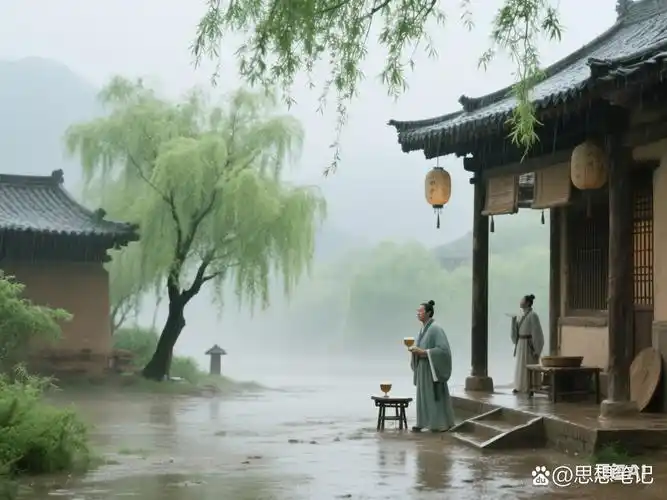 Weicheng—"Wei City"—takes its name from its position north of the Wei River, a label in use since the Qin and Han dynasties when this crossing served as the gateway west from the imperial capital Chang'an. Much as Venice anchored Mediterranean commerce, Xianyang was the eastern terminus of the Silk Road for over three millennia, carrying merchants, monks, and diplomats between civilizations. It was here, in the 8th century, that Tang poet Wang Wei sent his friend Yuan Er westward, immortalizing the spot in "Seeing Yuan Er Off to Anxi"—one of China's most quoted farewell poems.
The old quarter retains its Ming-Qing street grid of grey-brick lanes and dark-tiled rooftops with upswept eaves, evoking the atmosphere of a Tuscan hill town or a Bavarian old quarter. Phoenix Terrace, a Ming-era structure, anchors the district alongside the Confucian Temple and Anguo Monastery. The Qingwei Tower rises above the lanes like a Venetian campanile, rewarding visitors with sweeping views across the meandering Wei River toward the Qinling Mountains. A covered bridge spans the water, its silhouette mirrored in the lake below—particularly magical at dusk when illuminated.
Poetry serves as the thread weaving the site together. Wang Wei's lines about morning rain and light dust still describe the mood visitors encounter today. The Ancient Ferry Museum, a AAA-rated site and branch of a National First-Class Museum, displays three millennia of ferry artifacts alongside striking Tang-dynasty figurines of foreign merchants—visual evidence of cosmopolitan Chang'an. Modern touches like 3D projections and robot guides bring the Silk Road narrative vividly to life, transforming an archaeological site into an immersive journey through time.
The Ancient Ferry Museum is free but requires advance booking; passport holders can register on-site. Daily visitor numbers are limited, so early arrival is wise. The Qingwei Tower and old streets are open all day without tickets. From Xi'an, Xianyang lies roughly 30 km away—about 40 minutes by car, metro, or bus. The bridge lighting display begins at dusk, while surrounding Xianyang Lake ecological walkways remain free and accessible. Comfortable walking shoes are essential, as are sun protection and insect repellent in warmer months.
Visit at dawn after a rain (6–9 a.m.), when the air feels damp and luminous—precisely the atmosphere Wang Wei described. If rivers are high, watch where the Wei meets its tributary at the bridge: a rare "clear-versus-muddy" confluence documented since antiquity. After exploring, lose yourself in the old streets' Shaanxi flavors—biangbiang noodles, lamb paomo, and roujiamo (often called "Chinese hamburgers"). Occasional folk performances like the ox-drum procession add theatrical color, completing an afternoon where poetry, history, and everyday Chinese life converge beautifully.
Weicheng—"Wei City"—takes its name from its position north of the Wei River, a label in use since the Qin and Han dynasties when this crossing served as the gateway west from the imperial capital Chang'an. Much as Venice anchored Mediterranean commerce, Xianyang was the eastern terminus of the Silk Road for over three millennia, carrying merchants, monks, and diplomats between civilizations. It was here, in the 8th century, that Tang poet Wang Wei sent his friend Yuan Er westward, immortalizing the spot in "Seeing Yuan Er Off to Anxi"—one of China's most quoted farewell poems.
The old quarter retains its Ming-Qing street grid of grey-brick lanes and dark-tiled rooftops with upswept eaves, evoking the atmosphere of a Tuscan hill town or a Bavarian old quarter. Phoenix Terrace, a Ming-era structure, anchors the district alongside the Confucian Temple and Anguo Monastery. The Qingwei Tower rises above the lanes like a Venetian campanile, rewarding visitors with sweeping views across the meandering Wei River toward the Qinling Mountains. A covered bridge spans the water, its silhouette mirrored in the lake below—particularly magical at dusk when illuminated.
Poetry serves as the thread weaving the site together. Wang Wei's lines about morning rain and light dust still describe the mood visitors encounter today. The Ancient Ferry Museum, a AAA-rated site and branch of a National First-Class Museum, displays three millennia of ferry artifacts alongside striking Tang-dynasty figurines of foreign merchants—visual evidence of cosmopolitan Chang'an. Modern touches like 3D projections and robot guides bring the Silk Road narrative vividly to life, transforming an archaeological site into an immersive journey through time.
The Ancient Ferry Museum is free but requires advance booking; passport holders can register on-site. Daily visitor numbers are limited, so early arrival is wise. The Qingwei Tower and old streets are open all day without tickets. From Xi'an, Xianyang lies roughly 30 km away—about 40 minutes by car, metro, or bus. The bridge lighting display begins at dusk, while surrounding Xianyang Lake ecological walkways remain free and accessible. Comfortable walking shoes are essential, as are sun protection and insect repellent in warmer months.
Visit at dawn after a rain (6–9 a.m.), when the air feels damp and luminous—precisely the atmosphere Wang Wei described. If rivers are high, watch where the Wei meets its tributary at the bridge: a rare "clear-versus-muddy" confluence documented since antiquity. After exploring, lose yourself in the old streets' Shaanxi flavors—biangbiang noodles, lamb paomo, and roujiamo (often called "Chinese hamburgers"). Occasional folk performances like the ox-drum procession add theatrical color, completing an afternoon where poetry, history, and everyday Chinese life converge beautifully.