Xianyang Old Street
⭐ 3.80
Xianyang Old Street, Qindu District, Xianyang City, Shaanxi Province, China
 Xianyang served as the capital of China's first unified empire under Qin Shi Huang (221 BCE)—a contemporary of Rome's founding era—and the surrounding Guanzhong plain remained imperial heartland for centuries. The Old Street, however, took shape in the Ming dynasty, founded in 1371 during the Hongwu Emperor's reign, roughly a century after the Black Death reshaped European cities. Within its 1.06 square kilometers, thirty lanes preserve a Ming-era rectangular grid, much as Bruges or York still retain their medieval footprints. Designated a national-level night-culture tourism zone in 2023, the district bridges two millennia of imperial history with the living mercantile traditions of the Guanzhong plain.
The streetscape is anchored by a Ming-Qing architectural ensemble that recalls the timber-framed guildhalls of old European trading towns. The Phoenix Terrace, a raised pavilion dating to the Ming era, offers elevated views of surrounding rooftops—comparable to climbing a Renaissance bell tower in Florence. The Qingwei Tower stands as a reminder of the Wei River's former role as a busy grain-shipping corridor, much like the Hanseatic warehouses along the Rhine. Down at street level, bluestone paving and tilting eaves-frame houses create a layered tableau reminiscent of a Jiangnan water town, yet unmistakably Shaanxi in character.
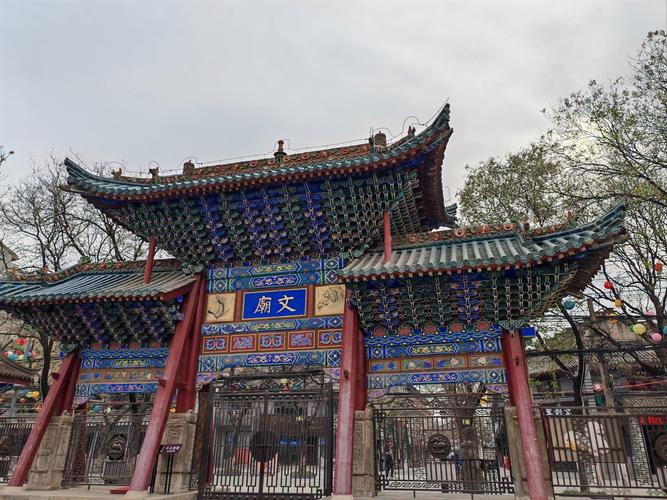
Xianyang Old Street functions as a living museum where Confucian ritual, folk performance, and contemporary café culture coexist. The Xianyang Museum, housed in the original Confucian Temple, safeguards one of China's most remarkable finds: 3,000 painted terracotta warriors from a Western Han imperial tomb—anticipating the famous Qin army by nearly a century. By evening, the lanes fill with costumed Qin-dynasty parades, Shaanxi opera excerpts, and acoustic folk sets, transforming stone walls into a stage. Artisan workshops and craft-coffee bars sit side-by-side, letting visitors move from incense-scented altars to third-wave espresso in a single block.
The district is open around the clock and admission is free. From Xi'an, take Metro Line 1 to Baimahe Station (Exit D) and walk 15 to 20 minutes to the Gudu Corridor Bridge over the Wei River. The Xianyang Museum requires a free ID-based reservation, closes Mondays, and stops entry at 16:30. The Corridor Bridge and the photogenic Fuyuan Alley—often called Xianyang's answer to Chongqing's cliffside Hongya Cave—light up after 17:00, with the densest performance schedule on weekends. Allow three to four hours; comfortable flat shoes are essential for the cobbled lanes, and a light jacket helps near the river at dusk.
Xianyang Old Street rewards travelers seeking an unscripted slice of Shaanxi after the crowds of Xi'an's city walls have thinned. It is one of the few places where you can eat a steaming bowl of hand-pulled biangbiang noodles inside a 600-year-old building, then watch sunset paint the Wei River from a pavilion inspired by Tang-dynasty design. Pair the visit with a half-day at the Western Han imperial tombs or Yangling Mausoleum for a deeper Qin-Han arc, or extend into a lantern-lit evening cruise on Xianyang Lake. For anyone tracing China's origins beyond the well-trodden Terracotta Warriors route, this old quarter is the most atmospheric gateway.
Xianyang served as the capital of China's first unified empire under Qin Shi Huang (221 BCE)—a contemporary of Rome's founding era—and the surrounding Guanzhong plain remained imperial heartland for centuries. The Old Street, however, took shape in the Ming dynasty, founded in 1371 during the Hongwu Emperor's reign, roughly a century after the Black Death reshaped European cities. Within its 1.06 square kilometers, thirty lanes preserve a Ming-era rectangular grid, much as Bruges or York still retain their medieval footprints. Designated a national-level night-culture tourism zone in 2023, the district bridges two millennia of imperial history with the living mercantile traditions of the Guanzhong plain.
The streetscape is anchored by a Ming-Qing architectural ensemble that recalls the timber-framed guildhalls of old European trading towns. The Phoenix Terrace, a raised pavilion dating to the Ming era, offers elevated views of surrounding rooftops—comparable to climbing a Renaissance bell tower in Florence. The Qingwei Tower stands as a reminder of the Wei River's former role as a busy grain-shipping corridor, much like the Hanseatic warehouses along the Rhine. Down at street level, bluestone paving and tilting eaves-frame houses create a layered tableau reminiscent of a Jiangnan water town, yet unmistakably Shaanxi in character.
Xianyang Old Street functions as a living museum where Confucian ritual, folk performance, and contemporary café culture coexist. The Xianyang Museum, housed in the original Confucian Temple, safeguards one of China's most remarkable finds: 3,000 painted terracotta warriors from a Western Han imperial tomb—anticipating the famous Qin army by nearly a century. By evening, the lanes fill with costumed Qin-dynasty parades, Shaanxi opera excerpts, and acoustic folk sets, transforming stone walls into a stage. Artisan workshops and craft-coffee bars sit side-by-side, letting visitors move from incense-scented altars to third-wave espresso in a single block.
The district is open around the clock and admission is free. From Xi'an, take Metro Line 1 to Baimahe Station (Exit D) and walk 15 to 20 minutes to the Gudu Corridor Bridge over the Wei River. The Xianyang Museum requires a free ID-based reservation, closes Mondays, and stops entry at 16:30. The Corridor Bridge and the photogenic Fuyuan Alley—often called Xianyang's answer to Chongqing's cliffside Hongya Cave—light up after 17:00, with the densest performance schedule on weekends. Allow three to four hours; comfortable flat shoes are essential for the cobbled lanes, and a light jacket helps near the river at dusk.
Xianyang Old Street rewards travelers seeking an unscripted slice of Shaanxi after the crowds of Xi'an's city walls have thinned. It is one of the few places where you can eat a steaming bowl of hand-pulled biangbiang noodles inside a 600-year-old building, then watch sunset paint the Wei River from a pavilion inspired by Tang-dynasty design. Pair the visit with a half-day at the Western Han imperial tombs or Yangling Mausoleum for a deeper Qin-Han arc, or extend into a lantern-lit evening cruise on Xianyang Lake. For anyone tracing China's origins beyond the well-trodden Terracotta Warriors route, this old quarter is the most atmospheric gateway.