Qindu District Museum
⭐ 3.20
Qindu District, Xianyang, Shaanxi, China
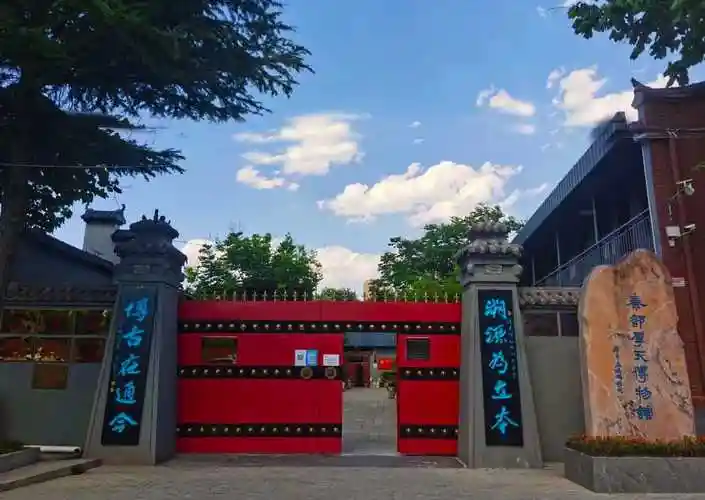 The Xianyang Museum occupies territory central to imperial China. Xianyang served as capital of the Qin Empire (221–206 BCE), whose terracotta legions near modern Xi'an astonish the world today. After Qin's collapse, the Han dynasty (206 BCE–220 CE) made neighboring Chang'an its seat, with Xianyang as a vital satellite along the Wei River. The region later flourished under Tang emperors (618–907 CE), when Chang'an became the world's largest city—a cosmopolitan metropolis rivaling Constantinople and Baghdad in size and influence. This layered history makes Xianyang a peer to Rome, where successive empires left overlapping archaeological strata across the modern landscape.
The main building, the Wenmiao or Confucian Temple Museum, occupies a Ming dynasty (1368–1644) imperial academy constructed during the Hongwu reign. The complex follows traditional Chinese sacred architecture along a strict north-south axis: a lingxing gate at the entrance, a ceremonial archery hall (jimen), and the grand Dacheng Hall at the rear. It ranks among the better-preserved prefectural-level Confucian temples in northwest China—smaller in scale than Beijing's Temple of Confucius but comparable in dignity. The second branch, the Gudu Ferry Site Museum, recreates the ancient Wei River crossing through scale models and multimedia displays.
The collection of over 20,000 artifacts offers tangible evidence of imperial Chinese craftsmanship at its zenith. Western Han polychrome warriors—painted ceramic soldiers from a nearby tomb—echo the famous Qin terracotta army yet display livelier pigments and individualized features. Masterpieces such as the gold-and-silver inlaid bronze ding (ritual cauldron) and the jade "Flying Horse" amulet represent technical achievements rivaling Roman cameo work or Hellenistic goldsmithing. Together, these treasures illuminate trade along the Silk Road and the formative decades of imperial China, when Chinese silk, bronze, and jade flowed westward to Rome and Parthia.
Admission is free but requires advance registration with a real name. Foreign visitors should book through the museum's WeChat account using passport details, or register in person at the service desk with their original passport. Both branches—the Wenmiao Museum at 53 Zhongshan Street and the Gudu Ferry Museum on Weiyang East Road—are open Tuesday through Sunday, 9:00 a.m. to 5:00 p.m. (last entry 4:30 p.m.); they close on Mondays. The two sites lie roughly a ten-minute walk apart. For current special exhibitions and English-language guided tours, call 029-33231998 in advance.
Arrive when doors open at 9:00 a.m. Begin on the second floor of the Wenmiao Museum, where the Western Han warrior array and Qin civilization exhibits unfold along a one-way route through roughly two hours of displays. Continue past the gold-inlaid bronzes and Tang tri-color ceramics before walking ten minutes to the Gudu branch, which adds about forty minutes with its multimedia ferry reconstruction. Volunteer guides serve groups of five or more at no charge. Travelers seeking the human stories behind China's rise will find every dynasty from Warring States through Tang represented here—often literally within the museum's own archaeological layers.
The Xianyang Museum occupies territory central to imperial China. Xianyang served as capital of the Qin Empire (221–206 BCE), whose terracotta legions near modern Xi'an astonish the world today. After Qin's collapse, the Han dynasty (206 BCE–220 CE) made neighboring Chang'an its seat, with Xianyang as a vital satellite along the Wei River. The region later flourished under Tang emperors (618–907 CE), when Chang'an became the world's largest city—a cosmopolitan metropolis rivaling Constantinople and Baghdad in size and influence. This layered history makes Xianyang a peer to Rome, where successive empires left overlapping archaeological strata across the modern landscape.
The main building, the Wenmiao or Confucian Temple Museum, occupies a Ming dynasty (1368–1644) imperial academy constructed during the Hongwu reign. The complex follows traditional Chinese sacred architecture along a strict north-south axis: a lingxing gate at the entrance, a ceremonial archery hall (jimen), and the grand Dacheng Hall at the rear. It ranks among the better-preserved prefectural-level Confucian temples in northwest China—smaller in scale than Beijing's Temple of Confucius but comparable in dignity. The second branch, the Gudu Ferry Site Museum, recreates the ancient Wei River crossing through scale models and multimedia displays.
The collection of over 20,000 artifacts offers tangible evidence of imperial Chinese craftsmanship at its zenith. Western Han polychrome warriors—painted ceramic soldiers from a nearby tomb—echo the famous Qin terracotta army yet display livelier pigments and individualized features. Masterpieces such as the gold-and-silver inlaid bronze ding (ritual cauldron) and the jade "Flying Horse" amulet represent technical achievements rivaling Roman cameo work or Hellenistic goldsmithing. Together, these treasures illuminate trade along the Silk Road and the formative decades of imperial China, when Chinese silk, bronze, and jade flowed westward to Rome and Parthia.
Admission is free but requires advance registration with a real name. Foreign visitors should book through the museum's WeChat account using passport details, or register in person at the service desk with their original passport. Both branches—the Wenmiao Museum at 53 Zhongshan Street and the Gudu Ferry Museum on Weiyang East Road—are open Tuesday through Sunday, 9:00 a.m. to 5:00 p.m. (last entry 4:30 p.m.); they close on Mondays. The two sites lie roughly a ten-minute walk apart. For current special exhibitions and English-language guided tours, call 029-33231998 in advance.
Arrive when doors open at 9:00 a.m. Begin on the second floor of the Wenmiao Museum, where the Western Han warrior array and Qin civilization exhibits unfold along a one-way route through roughly two hours of displays. Continue past the gold-inlaid bronzes and Tang tri-color ceramics before walking ten minutes to the Gudu branch, which adds about forty minutes with its multimedia ferry reconstruction. Volunteer guides serve groups of five or more at no charge. Travelers seeking the human stories behind China's rise will find every dynasty from Warring States through Tang represented here—often literally within the museum's own archaeological layers.