Qishui River Wetland Park
⭐ 3.60
Qishui River Wetland Park, Qindu District, Xianyang, Shaanxi Province, China
 The park's spiritual centre is Houji Square, named for the Shang-dynasty ancestor revered as the founding teacher of Chinese agriculture—a figure whose role in taming grain cultivation parallels the mythic place of Demeter in Greek tradition or Ceres in Roman mythology. Around the square, a procession of carved farmers and tiled agricultural scenes traces the rise of Zhou-era farming culture, while scattered steles preserve poems once read by Emperor Taizong of Tang, a ruler contemporary with Charlemagne. Together these monuments turn a wetland into a walking timeline of Chinese civilisation.
Nature takes the lead around Qishui and Ju Lakes, where twin islets are linked by a dragon-arched bridge in a graceful "Seven Bridges, Four Bays" layout reminiscent of classical European estate gardens, though rendered in distinctly Jiangnan style. Curving boardwalks and fishing rocks invite lingering, while kingfishers, egrets, and herons now nest along the reedy shores—a recovery made possible by extensive wetland rehabilitation. The flat, breezy expanse is a rare sight of open water in a region better known for its arid loess landscapes.
Architecturally, the designers have created a cultural dialogue between the rugged Guanzhong heartland and the silk-smooth water towns south of the Yangtze. The Jiangnan-themed Jiangyuan Water Town extension—with its whitewashed walls, charcoal-grey tiles, and arched footbridges—feels like a transplanted slice of Suzhou, while modern light columns and neon accents at Houji Square bridge old and new. The park's showpiece is its 2,000-square-metre musical fountain, the largest in western Shaanxi, where after dark water jets pirouette in sync with music and coloured lights.
The deeper significance lies in how the site has been reclaimed. Once a silted stretch of the ancient Qishui River, it has been reborn through ecological engineering into a model of rural cultural tourism. By folding farming heritage, Tang military memory, and local folk identity into a single landscape, the park demonstrates how China is reimagining its historic waterways as accessible public space—free for all, unlike many celebrated gardens such as Suzhou's Humble Administrator's Garden, which charge entry.
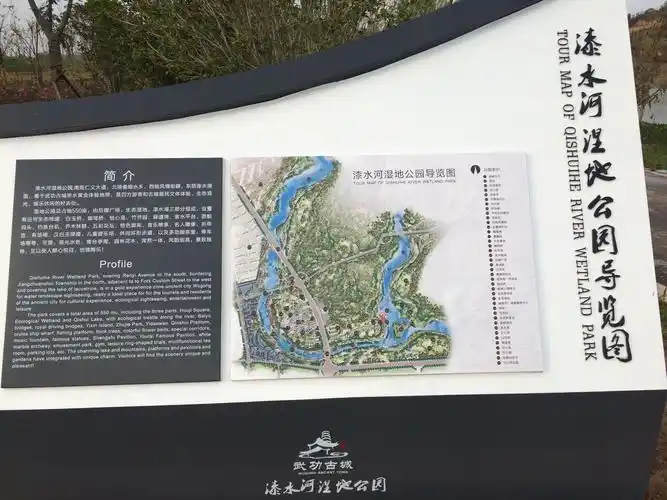
Practicalities make visiting straightforward. The park sits in the northeast of Wugong Town, Wugong County, bordering the Jiangyuan Water Town to the north and Renyi Avenue to the south. From central Xianyang it is roughly a one-hour self-drive (around 75 km), with ample parking; public buses also connect via Wugong County. Spring and autumn bring the most comfortable temperatures, while summer visitors should bring sunscreen and mosquito repellent. Fountain performances are scheduled in the evening, so confirm show times on arrival.
For a satisfying visit, follow the suggested two- to three-hour loop: enter at the south gate, explore Houji Square, drift along the ecological boardwalk through the "Seven Bridges, Four Bays" stretch, cross to the lake islets, and finish in the Jiangnan-inspired Jiangyuan quarter. The park is well suited to families with children, casual strollers, and keen photographers, and pairs easily with nearby sites such as the Suwu Memorial Hall and Meiyang Pass for a half-day cultural excursion through one of China's most storied agricultural regions.
The park's spiritual centre is Houji Square, named for the Shang-dynasty ancestor revered as the founding teacher of Chinese agriculture—a figure whose role in taming grain cultivation parallels the mythic place of Demeter in Greek tradition or Ceres in Roman mythology. Around the square, a procession of carved farmers and tiled agricultural scenes traces the rise of Zhou-era farming culture, while scattered steles preserve poems once read by Emperor Taizong of Tang, a ruler contemporary with Charlemagne. Together these monuments turn a wetland into a walking timeline of Chinese civilisation.
Nature takes the lead around Qishui and Ju Lakes, where twin islets are linked by a dragon-arched bridge in a graceful "Seven Bridges, Four Bays" layout reminiscent of classical European estate gardens, though rendered in distinctly Jiangnan style. Curving boardwalks and fishing rocks invite lingering, while kingfishers, egrets, and herons now nest along the reedy shores—a recovery made possible by extensive wetland rehabilitation. The flat, breezy expanse is a rare sight of open water in a region better known for its arid loess landscapes.
Architecturally, the designers have created a cultural dialogue between the rugged Guanzhong heartland and the silk-smooth water towns south of the Yangtze. The Jiangnan-themed Jiangyuan Water Town extension—with its whitewashed walls, charcoal-grey tiles, and arched footbridges—feels like a transplanted slice of Suzhou, while modern light columns and neon accents at Houji Square bridge old and new. The park's showpiece is its 2,000-square-metre musical fountain, the largest in western Shaanxi, where after dark water jets pirouette in sync with music and coloured lights.
The deeper significance lies in how the site has been reclaimed. Once a silted stretch of the ancient Qishui River, it has been reborn through ecological engineering into a model of rural cultural tourism. By folding farming heritage, Tang military memory, and local folk identity into a single landscape, the park demonstrates how China is reimagining its historic waterways as accessible public space—free for all, unlike many celebrated gardens such as Suzhou's Humble Administrator's Garden, which charge entry.
Practicalities make visiting straightforward. The park sits in the northeast of Wugong Town, Wugong County, bordering the Jiangyuan Water Town to the north and Renyi Avenue to the south. From central Xianyang it is roughly a one-hour self-drive (around 75 km), with ample parking; public buses also connect via Wugong County. Spring and autumn bring the most comfortable temperatures, while summer visitors should bring sunscreen and mosquito repellent. Fountain performances are scheduled in the evening, so confirm show times on arrival.
For a satisfying visit, follow the suggested two- to three-hour loop: enter at the south gate, explore Houji Square, drift along the ecological boardwalk through the "Seven Bridges, Four Bays" stretch, cross to the lake islets, and finish in the Jiangnan-inspired Jiangyuan quarter. The park is well suited to families with children, casual strollers, and keen photographers, and pairs easily with nearby sites such as the Suwu Memorial Hall and Meiyang Pass for a half-day cultural excursion through one of China's most storied agricultural regions.