Zhouling Scenic Area
⭐ 2.50
Zhouling Scenic Area, Weicheng District, Xianyang City, Shaanxi Province, China
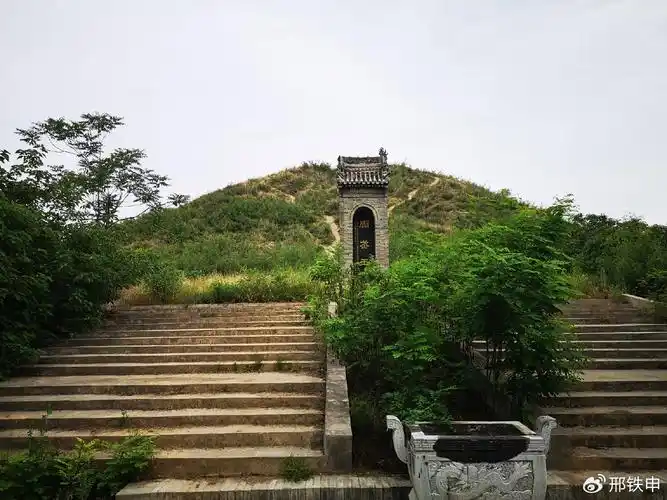 Zhouling's story is one of mistaken identity finally corrected by modern archaeology. For over a millennium the twin mounds were worshipped as the tombs of King Wen and King Wu, founders of the Western Zhou dynasty around 1000 BCE. Twentieth-century fieldwork examining tomb geometry, eaves-tile fragments, and boundary moats proved they actually belong to King Huiwen and King Daowu of Qin, rulers who died in the 4th and early 3rd centuries BCE during the Warring States era. This redating parallels European debates over Trojan War sites or Egyptian pharaonic identifications, showing how scientific archaeology keeps rewriting legendary history.
The two pyramid-shaped rammed-earth mounds, set north and south of each other, are modest in scale compared with the colossal tumuli of Han and Tang emperors nearby. What they lack in size they make up for in atmosphere: more than two thousand ancient cypresses, planted across many centuries, lend a green, reverent canopy. The auxiliary ensemble includes a Song-dynasty sacrificial hall, a Ming-era ritual stage, and a stone archway. A covered gallery of forty-plus stone steles preserves inscriptions in seal, clerical, and regular scripts, justifying the "Little Forest of Steles" epithet.
The site's enduring "Zhouling Sacrificial Ritual" has been inscribed on Shaanxi's intangible cultural heritage list, perpetuating a worship tradition that began in the Song dynasty even though the tombs are now re-attributed. Scholars prize the steles for both their calligraphy and the historical records of imperial offerings they contain. Zhouling also serves as a tangible reference point for understanding how imperial tomb protocols evolved from Qin through the Han and Tang, bridging the celebrated mausoleums of Han Wudi and Tang Taizong that lie within easy touring distance.
The scenic area sits roughly ten kilometers east of central Xianyang; no metro serves it, so renting a car or arranging a taxi is essential. Entry costs only 15 yuan, with discounts for students, seniors, and other ID holders, and the gates welcome visitors year-round. Allow 30 to 60 minutes for the walk through the mound precincts, the stele gallery, and the old buildings. Be aware that English signage is minimal and on-site multimedia is limited, so a translation app is highly advisable.
The months of April through June and September through October offer the mildest weather, when the ancient cypresses look their most photogenic. The site combines easily with a full Xianyang circuit: the Xianyang Museum's celebrated Qin ceramics, the grand Qianling of Emperor Gaozong and Empress Wu Zetian, and the Zhaoling of Tang Taizong are all within an hour's drive, allowing travelers to grasp the sweep of Chinese imperial burial architecture across more than a millennium.
Zhouling rewards those seeking the quieter, less choreographed side of central China's imperial heritage, far from the crowds at Xi'an's Terracotta Warriors. The grounds carry a sober dignity; visitors are asked to stay respectful, refraining from climbing the mounds or touching the steles. Come ready to slow down, listen to the wind in the cypresses, and watch a thousand-year-old misidentification quietly yield to evidence—an experience as thought-provoking as it is peaceful.
Zhouling's story is one of mistaken identity finally corrected by modern archaeology. For over a millennium the twin mounds were worshipped as the tombs of King Wen and King Wu, founders of the Western Zhou dynasty around 1000 BCE. Twentieth-century fieldwork examining tomb geometry, eaves-tile fragments, and boundary moats proved they actually belong to King Huiwen and King Daowu of Qin, rulers who died in the 4th and early 3rd centuries BCE during the Warring States era. This redating parallels European debates over Trojan War sites or Egyptian pharaonic identifications, showing how scientific archaeology keeps rewriting legendary history.
The two pyramid-shaped rammed-earth mounds, set north and south of each other, are modest in scale compared with the colossal tumuli of Han and Tang emperors nearby. What they lack in size they make up for in atmosphere: more than two thousand ancient cypresses, planted across many centuries, lend a green, reverent canopy. The auxiliary ensemble includes a Song-dynasty sacrificial hall, a Ming-era ritual stage, and a stone archway. A covered gallery of forty-plus stone steles preserves inscriptions in seal, clerical, and regular scripts, justifying the "Little Forest of Steles" epithet.
The site's enduring "Zhouling Sacrificial Ritual" has been inscribed on Shaanxi's intangible cultural heritage list, perpetuating a worship tradition that began in the Song dynasty even though the tombs are now re-attributed. Scholars prize the steles for both their calligraphy and the historical records of imperial offerings they contain. Zhouling also serves as a tangible reference point for understanding how imperial tomb protocols evolved from Qin through the Han and Tang, bridging the celebrated mausoleums of Han Wudi and Tang Taizong that lie within easy touring distance.
The scenic area sits roughly ten kilometers east of central Xianyang; no metro serves it, so renting a car or arranging a taxi is essential. Entry costs only 15 yuan, with discounts for students, seniors, and other ID holders, and the gates welcome visitors year-round. Allow 30 to 60 minutes for the walk through the mound precincts, the stele gallery, and the old buildings. Be aware that English signage is minimal and on-site multimedia is limited, so a translation app is highly advisable.
The months of April through June and September through October offer the mildest weather, when the ancient cypresses look their most photogenic. The site combines easily with a full Xianyang circuit: the Xianyang Museum's celebrated Qin ceramics, the grand Qianling of Emperor Gaozong and Empress Wu Zetian, and the Zhaoling of Tang Taizong are all within an hour's drive, allowing travelers to grasp the sweep of Chinese imperial burial architecture across more than a millennium.
Zhouling rewards those seeking the quieter, less choreographed side of central China's imperial heritage, far from the crowds at Xi'an's Terracotta Warriors. The grounds carry a sober dignity; visitors are asked to stay respectful, refraining from climbing the mounds or touching the steles. Come ready to slow down, listen to the wind in the cypresses, and watch a thousand-year-old misidentification quietly yield to evidence—an experience as thought-provoking as it is peaceful.