Xianyang Palace Ruins
⭐ 3.80
Xianyang Palace Ruins, Weicheng Street, Weicheng District, Xianyang City, Shaanxi Province, China
 **A Roman-Scale Capital in the East**
Founded in the mid-Warring States period and expanded after Duke Xiao moved the Qin capital here in 350 BCE, Xianyang Palace reached its zenith under Qin Shi Huang, who from these halls completed his conquest of the rival states in 221 BCE, founding an empire of more than 50 million people. Compare it to Rome's Palatine Hill: like the imperial palaces atop the Palatine, Xianyang projected absolute authority through sheer scale. In 206 BCE, however, the triumphant Xiang Yu torched the palace, reducing the sprawling capital to ash—a fate shared by Nero's Domus Aurea after Roman civil wars.
**Architecture: Earth as Power**
What survives today is humbler but profoundly evocative. Three colossal rammed-earth (hangtu) platforms rise several meters above the surrounding plain, their layered construction clearly visible. This "high-platform" style—elevating the ruler symbolically closer to the heavens—parallels the ziggurats of ancient Mesopotamia or the terraced temples of Mesoamerica, though the Qin builders achieved it with compacted yellow earth rather than stone or brick. Visitors walk designated paths that skirt the foundations, allowing close inspection of the stratigraphy of empire.
**Inside the Museum: "Central Hub of the Great Qin"**
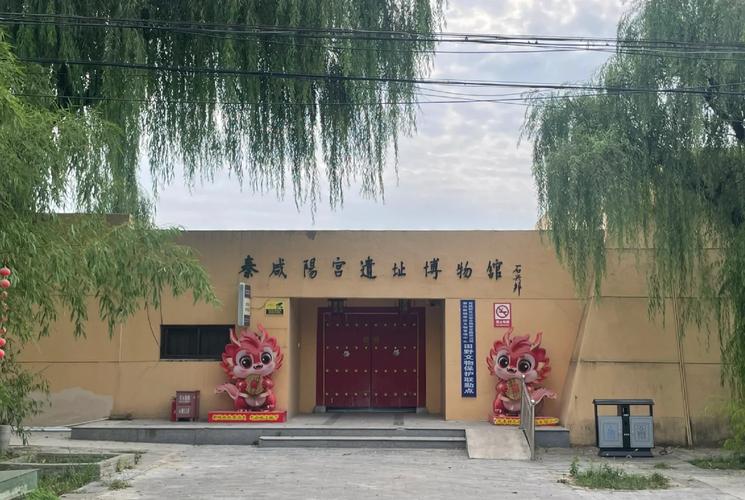
The squat, trapezoidal museum building mirrors the silhouette of a traditional Chinese granary, a fitting form for an archaeological storehouse. Its permanent exhibition, "Central Hub, Unified Realm," translates Qin urban planning into digestible panels, scale models, and original artifacts: roof tiles stamped with imperial insignia, fragments of wall paintings, stone chimes, jade ornaments, and bronze edicts. The galleries remain cool and quiet—an ideal space to absorb 2,200 years of history without the crowds of the Terracotta site 30 kilometers east.
**Practicalities for the Foreign Visitor**
Admission is free, but bring your passport for real-name registration at the entrance. Opening hours run 9:30 a.m. to 5:00 p.m., with last entry at 4:30 p.m.; the site closes on Tuesdays except during Chinese public holidays. Crucially, no English audio guides exist on-site, so download an offline translation app or, better, arrange a Chinese-speaking guide through your hotel in advance. The ruins forbid climbing, drones, and any marking of the surfaces—treat the earthworks as you would the stones of Stonehenge.
**Why Make the Detour**
Most travelers rush from Xi'an to the Terracotta Warriors and back, bypassing this quieter site. Doing so misses a key piece of the puzzle: the warriors were built to guard a tomb, but Xianyang Palace is where the imperial vision was actually conceived and administered. Standing on the silent platforms, with the Wei River gleaming beyond the fields and the modern skyline of Xianyang in the distance, you grasp the geographic logic of the Qin empire—and why controlling this bend of the river meant controlling China.
**Timing and Logistics**
Spring and autumn bring the most comfortable weather; summers can be brutally hot and winters bitterly cold on the exposed site. Public transit is impractical, so arrange a taxi or rideshare from Xi'an (about 30 minutes depending on traffic) or from the airport. Combine your visit with the Shaanxi History Museum's Qin-Han branch, only 1.5 to 2 kilometers away, to see related artifacts under glass before confronting the raw foundations themselves.
**A Roman-Scale Capital in the East**
Founded in the mid-Warring States period and expanded after Duke Xiao moved the Qin capital here in 350 BCE, Xianyang Palace reached its zenith under Qin Shi Huang, who from these halls completed his conquest of the rival states in 221 BCE, founding an empire of more than 50 million people. Compare it to Rome's Palatine Hill: like the imperial palaces atop the Palatine, Xianyang projected absolute authority through sheer scale. In 206 BCE, however, the triumphant Xiang Yu torched the palace, reducing the sprawling capital to ash—a fate shared by Nero's Domus Aurea after Roman civil wars.
**Architecture: Earth as Power**
What survives today is humbler but profoundly evocative. Three colossal rammed-earth (hangtu) platforms rise several meters above the surrounding plain, their layered construction clearly visible. This "high-platform" style—elevating the ruler symbolically closer to the heavens—parallels the ziggurats of ancient Mesopotamia or the terraced temples of Mesoamerica, though the Qin builders achieved it with compacted yellow earth rather than stone or brick. Visitors walk designated paths that skirt the foundations, allowing close inspection of the stratigraphy of empire.
**Inside the Museum: "Central Hub of the Great Qin"**
The squat, trapezoidal museum building mirrors the silhouette of a traditional Chinese granary, a fitting form for an archaeological storehouse. Its permanent exhibition, "Central Hub, Unified Realm," translates Qin urban planning into digestible panels, scale models, and original artifacts: roof tiles stamped with imperial insignia, fragments of wall paintings, stone chimes, jade ornaments, and bronze edicts. The galleries remain cool and quiet—an ideal space to absorb 2,200 years of history without the crowds of the Terracotta site 30 kilometers east.
**Practicalities for the Foreign Visitor**
Admission is free, but bring your passport for real-name registration at the entrance. Opening hours run 9:30 a.m. to 5:00 p.m., with last entry at 4:30 p.m.; the site closes on Tuesdays except during Chinese public holidays. Crucially, no English audio guides exist on-site, so download an offline translation app or, better, arrange a Chinese-speaking guide through your hotel in advance. The ruins forbid climbing, drones, and any marking of the surfaces—treat the earthworks as you would the stones of Stonehenge.
**Why Make the Detour**
Most travelers rush from Xi'an to the Terracotta Warriors and back, bypassing this quieter site. Doing so misses a key piece of the puzzle: the warriors were built to guard a tomb, but Xianyang Palace is where the imperial vision was actually conceived and administered. Standing on the silent platforms, with the Wei River gleaming beyond the fields and the modern skyline of Xianyang in the distance, you grasp the geographic logic of the Qin empire—and why controlling this bend of the river meant controlling China.
**Timing and Logistics**
Spring and autumn bring the most comfortable weather; summers can be brutally hot and winters bitterly cold on the exposed site. Public transit is impractical, so arrange a taxi or rideshare from Xi'an (about 30 minutes depending on traffic) or from the airport. Combine your visit with the Shaanxi History Museum's Qin-Han branch, only 1.5 to 2 kilometers away, to see related artifacts under glass before confronting the raw foundations themselves.