The Museum of Qin Terracotta Warriors and Horses
⭐ 4.70
Qin Shi Huang Mausoleum and Terracotta Army Museum, Lintong District, Xianyang City, Shaanxi Province, China
 Construction began in 246 BCE, when Ying Zheng, the future First Emperor, was just thirteen years old. By the time the works finished thirty-nine years later, the same ruler had unified warring China under the Qin dynasty in 221 BCE—a feat comparable in scale and ambition to Rome's later imperial consolidation. The clay army guarding him was discovered by accident in March 1974, when farmers digging a well near the tomb punched through the roof of Pit One. UNESCO inscribed the site on its World Heritage List in 1987, and scholars now regard it as the defining find of twentieth-century archaeology.
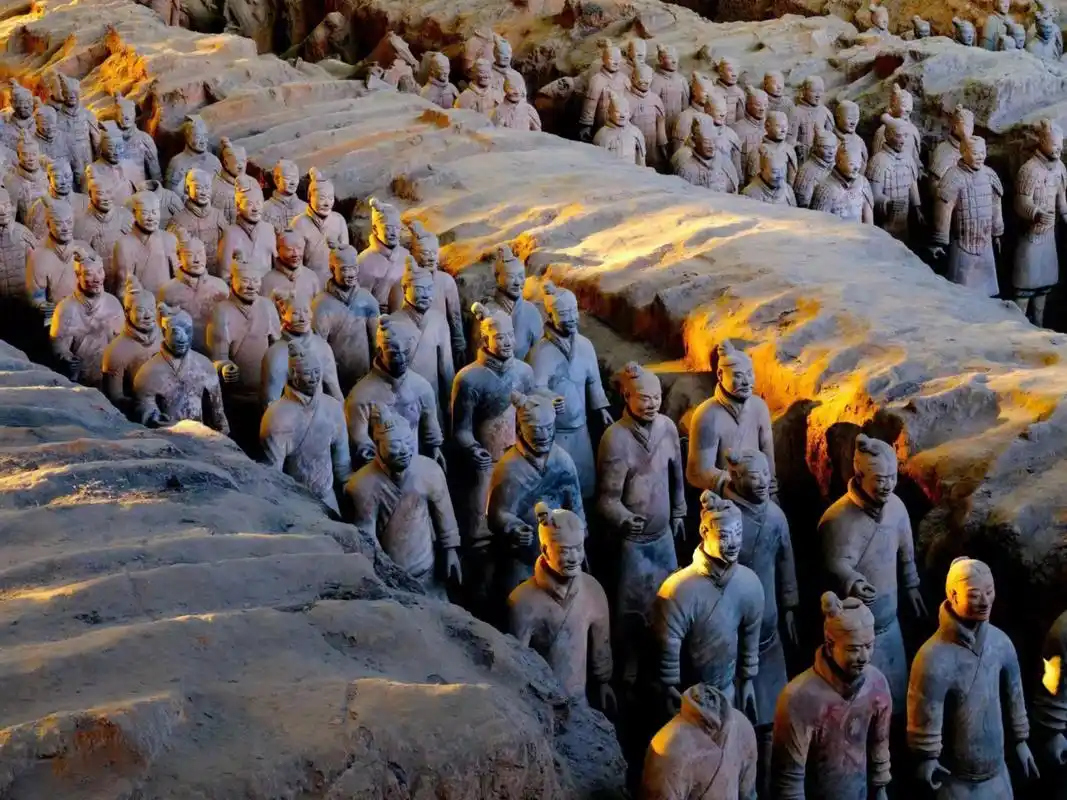
The on-site museum is organized around three excavated pits. Pit One is the showstopper—an aircraft-hangar-sized chamber of roughly 14,000 square meters where long, earthen ranks of infantry and charioteers stretch to the back wall. Pit Two is the tacticians' favorite: a mixed force of crossbowmen, cavalry, charioteers, and infantry arranged in a complex, battle-ready formation. Tiny but prestigious, Pit Three served as the army's command post, yielding only officer and honor-guard figurines. A complimentary shuttle bus links these pits to Lishan Garden, the landscaped grounds around the unexcavated royal burial mound.
What distinguishes the Terracotta Army from any European counterpart is the obsessive individuality of its figures. No two of the thousands of faces appear alike, making these works closer in spirit to ancient Roman portraiture than to monumental warfare sculpture, yet achieved through fired clay rather than chiseled marble. The project also testifies to Qin mastery of metallurgy, kiln technology, and pigment chemistry: many figures originally blazed with vivid polychrome paint. Two bronze chariots unearthed nearby, rightly nicknamed the Crown of Bronze, rival the finest Etruscan and Greek castings of the Mediterranean world.
For travelers steeped in the Greco-Roman and Egyptian worlds, the Terracotta Army delivers a rare, equally breathtaking encounter with a parallel civilization. Looking into these faces is the closest thing to meeting the ordinary soldiers, scribes, and craftsmen who built ancient China—an intimacy that Egyptian tombs and Roman ruins, for all their grandeur, seldom provide. Few sites on earth convey such an immediate, visceral sense of a vanished empire. Pair the visit with a climb up nearby Mount Hua or an evening stroll through Xi'an's lantern-lit Muslim Quarter for a complete Shaanxi experience.
The site lies approximately 35 km east of central Xi'an. From March 16 to November 15 (peak season) it is open 8:30 a.m. to 5:00 p.m.; in low season (November 16 to March 15) hours shorten to 8:30 a.m. to 4:30 p.m. Admission costs 150 RMB in peak season and 120 RMB in low season, with a combined ticket covering both the pits and the Lishan Garden. The most reliable transit is Metro Line 9 to Huaqingchi Station followed by a connecting bus, while a dedicated tourist coach also runs direct from central Xi'an for visitors who prefer a one-seat ride.
Book tickets only via the official website or official WeChat account, and allow at least three to four hours for a thorough visit. Strongly consider hiring an official museum guide or renting an audio device; without context the pits read more as a crowd of statues than as a three-thousand-strong military document. Arrive right at opening on a weekday morning to beat the tour-bus crush, wear sturdy non-slip shoes since pit floors are dusty and uneven, and carry water. Disregard touts peddling "cheap one-day tours" near the entrance, which typically involve commission-driven shopping stops that consume the day.
Construction began in 246 BCE, when Ying Zheng, the future First Emperor, was just thirteen years old. By the time the works finished thirty-nine years later, the same ruler had unified warring China under the Qin dynasty in 221 BCE—a feat comparable in scale and ambition to Rome's later imperial consolidation. The clay army guarding him was discovered by accident in March 1974, when farmers digging a well near the tomb punched through the roof of Pit One. UNESCO inscribed the site on its World Heritage List in 1987, and scholars now regard it as the defining find of twentieth-century archaeology.
The on-site museum is organized around three excavated pits. Pit One is the showstopper—an aircraft-hangar-sized chamber of roughly 14,000 square meters where long, earthen ranks of infantry and charioteers stretch to the back wall. Pit Two is the tacticians' favorite: a mixed force of crossbowmen, cavalry, charioteers, and infantry arranged in a complex, battle-ready formation. Tiny but prestigious, Pit Three served as the army's command post, yielding only officer and honor-guard figurines. A complimentary shuttle bus links these pits to Lishan Garden, the landscaped grounds around the unexcavated royal burial mound.
What distinguishes the Terracotta Army from any European counterpart is the obsessive individuality of its figures. No two of the thousands of faces appear alike, making these works closer in spirit to ancient Roman portraiture than to monumental warfare sculpture, yet achieved through fired clay rather than chiseled marble. The project also testifies to Qin mastery of metallurgy, kiln technology, and pigment chemistry: many figures originally blazed with vivid polychrome paint. Two bronze chariots unearthed nearby, rightly nicknamed the Crown of Bronze, rival the finest Etruscan and Greek castings of the Mediterranean world.
For travelers steeped in the Greco-Roman and Egyptian worlds, the Terracotta Army delivers a rare, equally breathtaking encounter with a parallel civilization. Looking into these faces is the closest thing to meeting the ordinary soldiers, scribes, and craftsmen who built ancient China—an intimacy that Egyptian tombs and Roman ruins, for all their grandeur, seldom provide. Few sites on earth convey such an immediate, visceral sense of a vanished empire. Pair the visit with a climb up nearby Mount Hua or an evening stroll through Xi'an's lantern-lit Muslim Quarter for a complete Shaanxi experience.
The site lies approximately 35 km east of central Xi'an. From March 16 to November 15 (peak season) it is open 8:30 a.m. to 5:00 p.m.; in low season (November 16 to March 15) hours shorten to 8:30 a.m. to 4:30 p.m. Admission costs 150 RMB in peak season and 120 RMB in low season, with a combined ticket covering both the pits and the Lishan Garden. The most reliable transit is Metro Line 9 to Huaqingchi Station followed by a connecting bus, while a dedicated tourist coach also runs direct from central Xi'an for visitors who prefer a one-seat ride.
Book tickets only via the official website or official WeChat account, and allow at least three to four hours for a thorough visit. Strongly consider hiring an official museum guide or renting an audio device; without context the pits read more as a crowd of statues than as a three-thousand-strong military document. Arrive right at opening on a weekday morning to beat the tour-bus crush, wear sturdy non-slip shoes since pit floors are dusty and uneven, and carry water. Disregard touts peddling "cheap one-day tours" near the entrance, which typically involve commission-driven shopping stops that consume the day.