Ulanfu Memorial Hall
⭐ 3.80
Hohhot, Inner Mongolia, China
 Ulanfu (1906–1988) was one of the most consequential Chinese political figures of the twentieth century and a rare ethnic Mongol to rise to Vice President of the People's Republic. A Soviet-trained Communist who first took up arms against Japanese occupation in the 1930s, he later became the founding chairman of the Inner Mongolia Autonomous Region in 1947—a model of regional autonomy later echoed, in some ways, by autonomous arrangements seen across post-colonial Asia. The memorial opened on December 23, 1992, with its name calligraphed by former President Yang Shangkun. For Western visitors, the experience offers comparable historical weight to the Lenin Mausoleum in Moscow or Ho Chi Minh's stilt house in Hanoi—places where the personality of a nation-builder is preserved as living political memory.
The architecture itself rewards a closer look. Designed to merge Mongolian motifs—subtle references to the ger (yurt) and steppe symbolism—with the imposing, somewhat minimalist vocabulary of post-1949 Chinese monumentalism, the complex spans some 30,000 square meters. A central white-marble seated statue of Ulanfu by sculptor Li Renzheng anchors the main hall, flanked by relief panels depicting key revolutionary episodes. Beyond the main building, a ceremonial square, flag-raising platform, and classical paifang (memorial archway) create a contemplative procession route reminiscent of European war-memorial layouts such as those at Verdun or Treptower Park in Berlin.
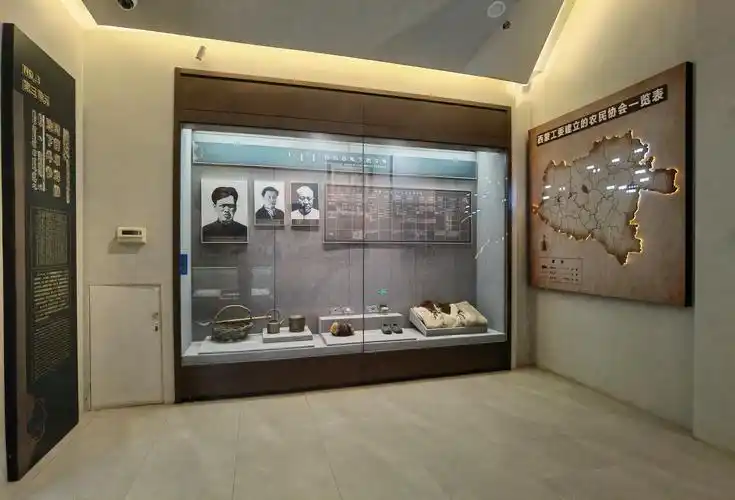
Inside, the collections are modest in size but rich in substance: some 160 artifacts, dozens of original documents, and 305 historical photographs trace Ulanfu's path from a Tumed Banner shepherd-boy to national statesman. Nine exhibition rooms unfold in six thematic sections covering his revolutionary struggle, leadership of the Inner Mongolian autonomy movement, and lifelong advocacy for the Communist Party's ethnic-minority policies. Glass cases hold faded military uniforms, hand-written letters, and gifts from visiting foreign delegations, allowing visitors to engage with Chinese revolutionary history on a human, tangible scale. The tone throughout is solemn and reverential, very much in the tradition of state-sanctioned patriotic museums.
Beyond its biographical mission, the memorial functions as a multi-purpose civic site: a base for national patriotic education, ethnic-unity promotion, national defense instruction, and even anti-corruption awareness programs. School groups and Party members are frequent visitors, and the atmosphere carries the earnest gravity of, say, the Yasukuni Memorial or Ireland's GPO Witness History in Dublin—places where national mythology is actively maintained. For Western travelers, this provides rare insight into how contemporary China constructs, curates, and communicates the heroic narrative of its frontier regions. It is also a meaningful stop for those interested in Mongolian identity within the modern Chinese state.
Practically speaking, the memorial is approachable and visitor-friendly. It lies at 26 Xinhua West Street in the Huimin (Muslim) District, reachable by city bus, with free parking outside. Admission is free, but you must register with a passport or ID card. Opening hours run Tuesday through Sunday from 9:00 a.m. to 5:00 p.m., with last entry at 4:30 p.m.; it closes on Mondays except during national holidays. Free guided tours are available, with advance booking by phone required for groups (call 0471-3953990 to confirm opening status before you travel). Allow 90 minutes to two hours and follow the suggested route: main hall, themed exhibition rooms, then the outdoor memorial square.
A few courtesies will smooth your visit. Photography is permitted inside the exhibition halls but flash must be switched off—no tripods, selfie sticks, or touching of display cases. Smoking, eating, drinking, and loud conversation are prohibited throughout, and visitors in improper attire may be turned away at the door. Mornings are quieter and recommended for those wanting a more contemplative experience. Pack a light layer in cooler months, as the central hall can feel chilly. And finally, do combine your visit with a walk through the surrounding park and an afternoon in the nearby historic Muslim Quarter, where Mongolian-Moslem (Hui) culinary traditions offer a delicious counterpoint to a morning spent amid solemn history.
Ulanfu (1906–1988) was one of the most consequential Chinese political figures of the twentieth century and a rare ethnic Mongol to rise to Vice President of the People's Republic. A Soviet-trained Communist who first took up arms against Japanese occupation in the 1930s, he later became the founding chairman of the Inner Mongolia Autonomous Region in 1947—a model of regional autonomy later echoed, in some ways, by autonomous arrangements seen across post-colonial Asia. The memorial opened on December 23, 1992, with its name calligraphed by former President Yang Shangkun. For Western visitors, the experience offers comparable historical weight to the Lenin Mausoleum in Moscow or Ho Chi Minh's stilt house in Hanoi—places where the personality of a nation-builder is preserved as living political memory.
The architecture itself rewards a closer look. Designed to merge Mongolian motifs—subtle references to the ger (yurt) and steppe symbolism—with the imposing, somewhat minimalist vocabulary of post-1949 Chinese monumentalism, the complex spans some 30,000 square meters. A central white-marble seated statue of Ulanfu by sculptor Li Renzheng anchors the main hall, flanked by relief panels depicting key revolutionary episodes. Beyond the main building, a ceremonial square, flag-raising platform, and classical paifang (memorial archway) create a contemplative procession route reminiscent of European war-memorial layouts such as those at Verdun or Treptower Park in Berlin.
Inside, the collections are modest in size but rich in substance: some 160 artifacts, dozens of original documents, and 305 historical photographs trace Ulanfu's path from a Tumed Banner shepherd-boy to national statesman. Nine exhibition rooms unfold in six thematic sections covering his revolutionary struggle, leadership of the Inner Mongolian autonomy movement, and lifelong advocacy for the Communist Party's ethnic-minority policies. Glass cases hold faded military uniforms, hand-written letters, and gifts from visiting foreign delegations, allowing visitors to engage with Chinese revolutionary history on a human, tangible scale. The tone throughout is solemn and reverential, very much in the tradition of state-sanctioned patriotic museums.
Beyond its biographical mission, the memorial functions as a multi-purpose civic site: a base for national patriotic education, ethnic-unity promotion, national defense instruction, and even anti-corruption awareness programs. School groups and Party members are frequent visitors, and the atmosphere carries the earnest gravity of, say, the Yasukuni Memorial or Ireland's GPO Witness History in Dublin—places where national mythology is actively maintained. For Western travelers, this provides rare insight into how contemporary China constructs, curates, and communicates the heroic narrative of its frontier regions. It is also a meaningful stop for those interested in Mongolian identity within the modern Chinese state.
Practically speaking, the memorial is approachable and visitor-friendly. It lies at 26 Xinhua West Street in the Huimin (Muslim) District, reachable by city bus, with free parking outside. Admission is free, but you must register with a passport or ID card. Opening hours run Tuesday through Sunday from 9:00 a.m. to 5:00 p.m., with last entry at 4:30 p.m.; it closes on Mondays except during national holidays. Free guided tours are available, with advance booking by phone required for groups (call 0471-3953990 to confirm opening status before you travel). Allow 90 minutes to two hours and follow the suggested route: main hall, themed exhibition rooms, then the outdoor memorial square.
A few courtesies will smooth your visit. Photography is permitted inside the exhibition halls but flash must be switched off—no tripods, selfie sticks, or touching of display cases. Smoking, eating, drinking, and loud conversation are prohibited throughout, and visitors in improper attire may be turned away at the door. Mornings are quieter and recommended for those wanting a more contemplative experience. Pack a light layer in cooler months, as the central hall can feel chilly. And finally, do combine your visit with a walk through the surrounding park and an afternoon in the nearby historic Muslim Quarter, where Mongolian-Moslem (Hui) culinary traditions offer a delicious counterpoint to a morning spent amid solemn history.