Tomb of Wang Zhaojun
⭐ 3.50
Manhan Mountain, Horinger County, Hohhot City, Inner Mongolia Autonomous Region, China
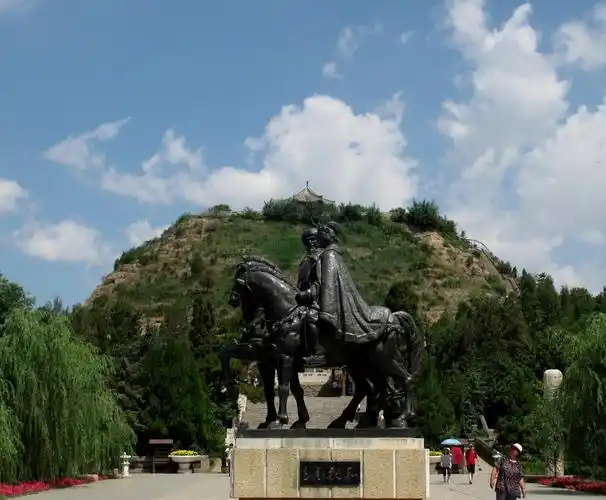 **A Tomb Born of Diplomacy, Not Sorrow**
The tomb commemorates Wang Zhaojun (c. 52–15 BC), a Han Dynasty palace lady who, in 33 BC, voluntarily married the Xiongnu Chanhui Chanyu to seal a peace accord between the Han Empire and the steppe confederation. Her journey westward is often compared in scale and symbolism to the Roman tradition of marrying daughters into allied barbarian kingdoms—think of the Visigothic unions in late antiquity—but here the narrative celebrates diplomacy rather than doom. Locally known as the "Green Mound" because its grasses stay verdant while surrounding plains turn yellow in autumn, the site has been venerated for over two millennia and was placed on China's sixth national list of protected cultural relics in 2013. It is, in essence, a Stonehenge-scale monument to a marriage that helped define Inner Asia.
**An Ancient Tumulus with Modern Architectural Counterparts**
The mound itself is a classic Han-era truncated-pyramid earthen tomb, hand-tamped to roughly 33 meters tall and covering more than 13,000 square meters—dimensions that earn it the nickname "Premier Mausoleum Beyond the Great Wall." Flanking a 400-meter spirit path are six pairs of stone guardian figures and a wall of stelae inscribed through the centuries. At its base sits a prize-winning semi-underground exhibition hall whose low, earth-covered profile deliberately echoes the tumulus above, a design gesture reminiscent of how modern Scandinavian museums are tucked into landscapes to honor rather than dominate them.
**Two Museums That Anchor the Experience**
What elevates a visit here is the unique double-museum within the grounds: the world's only systematic museum dedicated to Xiongnu civilization—complete with bronze artifacts, nomadic weaponry, and reconstructions of steppe life—and China's sole gallery tracing more than 800 marriage-alliance events across Chinese history. Oil paintings, sculptures, and multimedia installations dramatize Zhaojun's departure from Chang'an, reframing the legend as a founding story of ethnic integration rather than feminine tragedy. Together they offer a panoramic argument that China's identity has always been plural, a thesis Western visitors familiar with debates over multiculturalism will find resonant.
**Planning Your Visit**
The complex sits in Hohhot's Yuquan District along Zhaojun Road, beside the Dahei River, about 21.5 kilometers south of the city center—roughly a 40-minute drive. Buses 44, 107, and 209 serve the site, and free parking is available on-site. Hours run 9:00 to 17:00 (last entry 16:30), extended to 18:00 in summer, with a ticket price of around 65 RMB. The museum closes on Tuesdays except during national holidays, and advance reservations are required.
**Why It Belongs on Your Inner Mongolia Itinerary**
Allow 2.5 to three hours and follow the recommended route: museum halls first, then the stone-lined spirit path, finally the climb to the summit where, on clear days, the Yin Mountains unfurl across the southern horizon. Hire a guide or rent an audio device—without one, the layered symbolism is easily missed. Bring sunscreen and a light jacket (the summit is windy), and consider pairing the visit with Hohhot's old Da Zhao Temple for a complete day tracing the city's Han, Mongol, and Tibetan Buddhist heritage.
**A Tomb Born of Diplomacy, Not Sorrow**
The tomb commemorates Wang Zhaojun (c. 52–15 BC), a Han Dynasty palace lady who, in 33 BC, voluntarily married the Xiongnu Chanhui Chanyu to seal a peace accord between the Han Empire and the steppe confederation. Her journey westward is often compared in scale and symbolism to the Roman tradition of marrying daughters into allied barbarian kingdoms—think of the Visigothic unions in late antiquity—but here the narrative celebrates diplomacy rather than doom. Locally known as the "Green Mound" because its grasses stay verdant while surrounding plains turn yellow in autumn, the site has been venerated for over two millennia and was placed on China's sixth national list of protected cultural relics in 2013. It is, in essence, a Stonehenge-scale monument to a marriage that helped define Inner Asia.
**An Ancient Tumulus with Modern Architectural Counterparts**
The mound itself is a classic Han-era truncated-pyramid earthen tomb, hand-tamped to roughly 33 meters tall and covering more than 13,000 square meters—dimensions that earn it the nickname "Premier Mausoleum Beyond the Great Wall." Flanking a 400-meter spirit path are six pairs of stone guardian figures and a wall of stelae inscribed through the centuries. At its base sits a prize-winning semi-underground exhibition hall whose low, earth-covered profile deliberately echoes the tumulus above, a design gesture reminiscent of how modern Scandinavian museums are tucked into landscapes to honor rather than dominate them.
**Two Museums That Anchor the Experience**
What elevates a visit here is the unique double-museum within the grounds: the world's only systematic museum dedicated to Xiongnu civilization—complete with bronze artifacts, nomadic weaponry, and reconstructions of steppe life—and China's sole gallery tracing more than 800 marriage-alliance events across Chinese history. Oil paintings, sculptures, and multimedia installations dramatize Zhaojun's departure from Chang'an, reframing the legend as a founding story of ethnic integration rather than feminine tragedy. Together they offer a panoramic argument that China's identity has always been plural, a thesis Western visitors familiar with debates over multiculturalism will find resonant.
**Planning Your Visit**
The complex sits in Hohhot's Yuquan District along Zhaojun Road, beside the Dahei River, about 21.5 kilometers south of the city center—roughly a 40-minute drive. Buses 44, 107, and 209 serve the site, and free parking is available on-site. Hours run 9:00 to 17:00 (last entry 16:30), extended to 18:00 in summer, with a ticket price of around 65 RMB. The museum closes on Tuesdays except during national holidays, and advance reservations are required.
**Why It Belongs on Your Inner Mongolia Itinerary**
Allow 2.5 to three hours and follow the recommended route: museum halls first, then the stone-lined spirit path, finally the climb to the summit where, on clear days, the Yin Mountains unfurl across the southern horizon. Hire a guide or rent an audio device—without one, the layered symbolism is easily missed. Bring sunscreen and a light jacket (the summit is windy), and consider pairing the visit with Hohhot's old Da Zhao Temple for a complete day tracing the city's Han, Mongol, and Tibetan Buddhist heritage.