Badachu Park
⭐ 4.80
No. 3, Badachu Road, Shijingshan District, Beijing, China
 Badachu Park takes its name from the eight remarkably preserved Buddhist temples that have occupied these western Beijing hills since the Sui and Tang dynasties (roughly 6th–10th centuries CE). This makes the complex contemporaneous with Europe's early medieval monasteries, such as those founded by Benedictine monks in Italy and Ireland. Walk the clockwise path from temple one to temple eight, and you'll trace a thousand years of religious devotion, with each monastery cascading up the slopes like a procession of stone reliquaries set against dense woodland—much like Italy's Sanctuary of Monte Sacro, though in a distinctly Chinese architectural idiom.
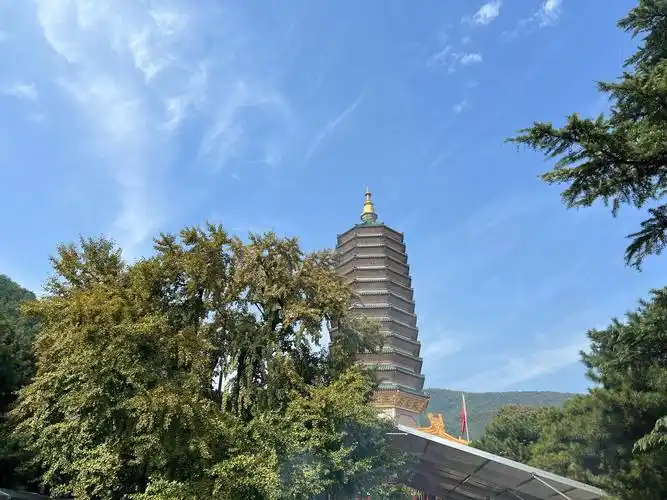
The spiritual heart of the park is Ling Guang Temple, the second monastery on the trail, which safeguards one of only two sacred tooth relics of Shakyamuni Buddha known to exist in the world. The other resides in Kandy, Sri Lanka, making this site a pilgrimage destination of immense global significance. The imposing relic pagoda, constructed in 1964 to enshrine the tooth, draws worshippers and curious travelers alike. Expect fragrant incense, devotees chanting sutras, and a deeply atmospheric serenity that evokes the contemplative mystique of Tibet's most sacred sites.
Beyond Ling Guang, four other temples merit special attention. Dabeisi Temple houses a stunning collection of 18 Arhat statues carved during the Yuan dynasty by the legendary sculptor Liu Yuan—figurative work that parallels the emotional intensity of late Gothic religious sculpture in Europe. Zhengguo Temple, the oldest of the eight, dates to the Tang dynasty and stands as one of Beijing's most ancient religious structures, predating the city's later imperial monuments. A 600-year-old Chinese pistache tree guards its entrance, while the mysterious Secret Demon Cliff nearby adds a touch of legend to the landscape.
The natural setting is as compelling as the cultural heritage. The park's 332 hectares boast over 95% forest coverage, with the highest peak reaching 498 meters. The air is rich with negative oxygen ions, earning it the nickname "natural oxygen bar." Twelve scenic spots shift with the seasons, but the undisputed highlight is late October through early November, when the mountainside erupts in crimson and gold—autumn foliage comparable to Vermont's sugar maples or Switzerland's Engadin Valley. Spring brings apricot blossoms, while winter offers crystalline snowscapes over the temple rooftops.
Practical details make Badachu refreshingly accessible. Entry costs only 10 yuan, and the park opens daily from 6:00 AM to 6:30 PM. Most visitors follow the main temple circuit in 3–4 hours, ascending gently from the front gate. Those seeking easier travel can ride the cable car up and toboggan slide down—a surprisingly fun addition that families especially enjoy. Wear sturdy flat shoes with good grip, bring mosquito repellent in summer, and pack a light raincoat. Before setting out, check that the cable car and slide are operational, as maintenance occasionally suspends service.
Ultimately, Badachu offers something rare in modern Beijing: a place where imperial-era spiritual heritage, ancient craftsmanship, and pristine mountain ecology converge within easy reach of the capital. Few cities of ten million residents can claim such a tranquil haven, and at this price point, it remains one of the best-kept secrets among seasoned travelers. Combine it with a visit to the nearby Fahai Temple's Ming-dynasty frescoes for a full day of cultural immersion in Beijing's western hills.
Badachu Park takes its name from the eight remarkably preserved Buddhist temples that have occupied these western Beijing hills since the Sui and Tang dynasties (roughly 6th–10th centuries CE). This makes the complex contemporaneous with Europe's early medieval monasteries, such as those founded by Benedictine monks in Italy and Ireland. Walk the clockwise path from temple one to temple eight, and you'll trace a thousand years of religious devotion, with each monastery cascading up the slopes like a procession of stone reliquaries set against dense woodland—much like Italy's Sanctuary of Monte Sacro, though in a distinctly Chinese architectural idiom.
The spiritual heart of the park is Ling Guang Temple, the second monastery on the trail, which safeguards one of only two sacred tooth relics of Shakyamuni Buddha known to exist in the world. The other resides in Kandy, Sri Lanka, making this site a pilgrimage destination of immense global significance. The imposing relic pagoda, constructed in 1964 to enshrine the tooth, draws worshippers and curious travelers alike. Expect fragrant incense, devotees chanting sutras, and a deeply atmospheric serenity that evokes the contemplative mystique of Tibet's most sacred sites.
Beyond Ling Guang, four other temples merit special attention. Dabeisi Temple houses a stunning collection of 18 Arhat statues carved during the Yuan dynasty by the legendary sculptor Liu Yuan—figurative work that parallels the emotional intensity of late Gothic religious sculpture in Europe. Zhengguo Temple, the oldest of the eight, dates to the Tang dynasty and stands as one of Beijing's most ancient religious structures, predating the city's later imperial monuments. A 600-year-old Chinese pistache tree guards its entrance, while the mysterious Secret Demon Cliff nearby adds a touch of legend to the landscape.
The natural setting is as compelling as the cultural heritage. The park's 332 hectares boast over 95% forest coverage, with the highest peak reaching 498 meters. The air is rich with negative oxygen ions, earning it the nickname "natural oxygen bar." Twelve scenic spots shift with the seasons, but the undisputed highlight is late October through early November, when the mountainside erupts in crimson and gold—autumn foliage comparable to Vermont's sugar maples or Switzerland's Engadin Valley. Spring brings apricot blossoms, while winter offers crystalline snowscapes over the temple rooftops.
Practical details make Badachu refreshingly accessible. Entry costs only 10 yuan, and the park opens daily from 6:00 AM to 6:30 PM. Most visitors follow the main temple circuit in 3–4 hours, ascending gently from the front gate. Those seeking easier travel can ride the cable car up and toboggan slide down—a surprisingly fun addition that families especially enjoy. Wear sturdy flat shoes with good grip, bring mosquito repellent in summer, and pack a light raincoat. Before setting out, check that the cable car and slide are operational, as maintenance occasionally suspends service.
Ultimately, Badachu offers something rare in modern Beijing: a place where imperial-era spiritual heritage, ancient craftsmanship, and pristine mountain ecology converge within easy reach of the capital. Few cities of ten million residents can claim such a tranquil haven, and at this price point, it remains one of the best-kept secrets among seasoned travelers. Combine it with a visit to the nearby Fahai Temple's Ming-dynasty frescoes for a full day of cultural immersion in Beijing's western hills.