Mutianyu Great Wall

⭐ 4.80

Mutianyu Village, Bohai Town, Huairou District, Beijing, China
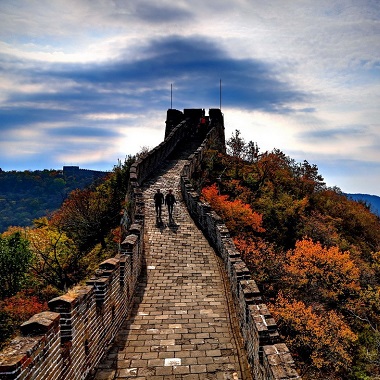
Mutianyu Great Wall
Built in 1368, the very year the Ming Dynasty rose to power, Mutianyu was once a critical bulwark defending the imperial capital of Beijing from Mongol incursions north of the Yanshan range. Its strategic importance echoes the role played by medieval European frontier castles like Carcassonne or the Habsburg fortresses along the Austro-Ottoman border, where stone walls held back entire empires. Though battered by six centuries of weather and warfare, the original Ming-era brickwork survives largely intact, making Mutianyu one of the most valuable open-air archives of medieval Chinese military architecture anywhere in the world. What truly distinguishes Mutianyu from other Great Wall sections is its remarkable architectural concentration. Twenty watchtowers line the open stretch, but the showstopper is Zhengguan Tai, a unique triple-tower complex arranged in a three-pointed "pin" configuration unseen anywhere else along the Wall's 21,000 kilometres. Equally unusual are the twin-faced crenellations, allowing defenders to fight on both sides of the parapet, a feature reminiscent of European double-curtain walls like those at Beaumaris Castle. The result is a fortress system that fuses stunning aesthetics with razor-sharp tactical ingenuity. Beyond martial grandeur, Mutianyu carries deep cultural resonance as a symbol of national endurance and identity, recognised by UNESCO since 1987 as part of the Great Wall World Heritage Site. Yet it is the surrounding ecosystem that surprises first-time visitors: oak and chestnut forests cloak the hillsides in spring blossoms, summer canopy, fiery autumn maples, and winter snow. This remarkable harmony between human monument and natural landscape has earned Mutianyu the nickname "Green Great Wall," a quality no European fortification can quite match. Practical planning is straightforward. Admission costs 40 RMB per person and must be booked online with a real-name reservation; the site operates daily including Mondays, from 7:30 a.m. to 5:30 p.m., with a new night-tourism programme running from 5:30 to 9:00 p.m. in 2025. Enclosed cable cars and an exhilarating toboggan slide cost around 100 RMB per ride. From central Beijing, drivers should take the Jingcheng Expressway to Exit 13, or hop on a direct tourist shuttle from the city. The classic route takes visitors from the north gate by cable car to Tower 14, then on foot westward to Tower 20 at the panoramic "Hero Slope," returning the same way in roughly two and a half hours. The smartest advice? Pack sturdy non-slip shoes, a windproof jacket, sunscreen, water, and high-energy snacks, since on-mountain dining is limited and pricey. Autumn, particularly late October through early November, transforms the ridges into a riot of crimson and gold that rivals New England's famed fall foliage, though layered against the silhouette of the Wall. Whether you are a history buff, a photographer, or simply seeking that once-in-a-lifetime climb, Mutianyu delivers a Wall experience far more memorable, and far less crowded, than the postcards suggest.

Traveler reviews

Often called the most beautiful section of the Great Wall — lush forested mountains with the wall snaking along the ridgeline, and way fewer crowds than Badaling. The signature twin-tower connected pass with its distinctive double-sided battlements is truly unique. T...
⭐ 5 · Hayden Cruz Expand
Mutianyu Great Wall is known as the "outstanding section among the ten-thousand-li Great Wall." The forest here is lush and the wall snakes through the green mountains—genuinely beautiful scenery. Compared to Badaling, there are far fewer tourists, the slopes are much gentler, and you can take the cable car or try the toboggan slide, making it easy for visitors of all ages. The watchtowers are packed densely alo...
⭐ 5 · Hayden Cruz Expand