Taihao Mausoleum
⭐ 4.20
Taihao Mausoleum Scenic Area, Zhoukou, Henan Province, China
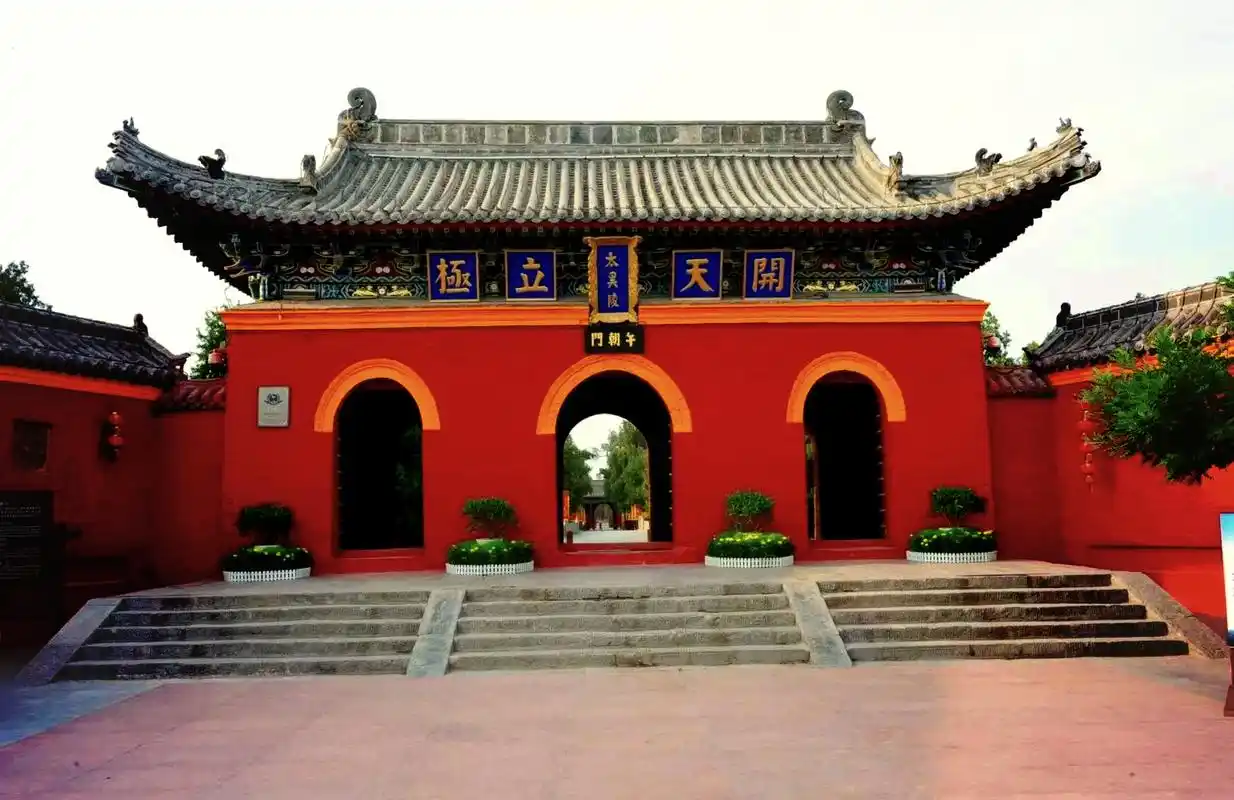 The Taihao Mausoleum honors Fuxi, a mythic ruler comparable to legendary founders of other ancient civilizations, much as Romulus gave Rome its origin story. While Rome was traditionally founded in 753 BCE, Fuxi is placed roughly 5,000 years earlier, making him the oldest cultural ancestor in the Chinese pantheon. The current structures date to 1436 CE, around the same era as the great late-medieval cathedrals of northern Europe, yet they commemorate a figure far older than any Western monarch. The site originated as a Spring and Autumn period shrine and was successively rebuilt under the Ming and Qing emperors.
The complex stretches 750 meters along a sacred north-south axis, passing through a series of ceremonial gates—the Wuchao, Xiantian, and Taiji—before reaching the soaring Tongtian and Xianren halls. Unlike the cruciform plans of European cathedrals, this layout traces the Earlier Heaven Eight Trigrams, the cosmic diagram attributed to Fuxi himself, turning the entire complex into a three-dimensional map of his philosophical system. The tomb mound rises 13.5 meters in the distinctive "round above, square below" form, embodying ancient Chinese cosmology, a configuration unique among China's imperial mausoleums.
Fuxi is credited with inventing the eight trigrams that formed the I Ching (Book of Changes), the foundational text of Chinese philosophy, alongside marriage, fishing, and writing itself. His sister-wife Nüwa, who mended the heavens in myth, is enshrined beside him. The annual Fuxi Sacrificial Ceremony, inscribed on China's national intangible heritage list in 2006, draws enormous crowds. The February temple fair once set a Guinness World Record of 825,000 visitors in a single day, surpassing attendance at most Western religious festivals.
The grounds harbor remarkable ancient cypress groves, including the curiously shaped "Ear Cypress," whose burl resembles a human ear, and the "Hundred Embrace Cypress," where cypress and sandalwood trees have grown intertwined for centuries. The Solitary Beauty Garden showcases uniquely sculpted pines found nowhere else in China. Combined with the adjacent Long Lake National Wetland Park, where lotus blooms carpet the water in August, the mausoleum offers a tranquil natural counterpoint to its solemn spiritual atmosphere.
Admission is 40 yuan, with opening hours from 8:00 to 17:00. From Zhoukou city center, take bus 10 or 11 to the Taihao Ling stop, a journey of roughly 38 minutes by car (28 km). Free incense is provided at the entrance. Comfortable walking shoes are essential, as the full visit covers considerable ground, typically 2.5 to 3 hours along the central axis. Visitors are asked to maintain a quiet, respectful demeanor within the tomb precinct.
For travelers seeking deeper meaning beyond China's more famous landmarks, Taihao Mausoleum offers an experience akin to visiting Delphi in Greece or the great prehistoric sites of Britain. Arrive at opening to avoid the midday heat and crowds, explore the surrounding cultural street for Huaiyang clay figurines (a charming intangible heritage craft), and consider an evening lakeside stroll. Few places allow visitors to stand at what is, in cultural terms, the very cradle of Chinese civilization.
The Taihao Mausoleum honors Fuxi, a mythic ruler comparable to legendary founders of other ancient civilizations, much as Romulus gave Rome its origin story. While Rome was traditionally founded in 753 BCE, Fuxi is placed roughly 5,000 years earlier, making him the oldest cultural ancestor in the Chinese pantheon. The current structures date to 1436 CE, around the same era as the great late-medieval cathedrals of northern Europe, yet they commemorate a figure far older than any Western monarch. The site originated as a Spring and Autumn period shrine and was successively rebuilt under the Ming and Qing emperors.
The complex stretches 750 meters along a sacred north-south axis, passing through a series of ceremonial gates—the Wuchao, Xiantian, and Taiji—before reaching the soaring Tongtian and Xianren halls. Unlike the cruciform plans of European cathedrals, this layout traces the Earlier Heaven Eight Trigrams, the cosmic diagram attributed to Fuxi himself, turning the entire complex into a three-dimensional map of his philosophical system. The tomb mound rises 13.5 meters in the distinctive "round above, square below" form, embodying ancient Chinese cosmology, a configuration unique among China's imperial mausoleums.
Fuxi is credited with inventing the eight trigrams that formed the I Ching (Book of Changes), the foundational text of Chinese philosophy, alongside marriage, fishing, and writing itself. His sister-wife Nüwa, who mended the heavens in myth, is enshrined beside him. The annual Fuxi Sacrificial Ceremony, inscribed on China's national intangible heritage list in 2006, draws enormous crowds. The February temple fair once set a Guinness World Record of 825,000 visitors in a single day, surpassing attendance at most Western religious festivals.
The grounds harbor remarkable ancient cypress groves, including the curiously shaped "Ear Cypress," whose burl resembles a human ear, and the "Hundred Embrace Cypress," where cypress and sandalwood trees have grown intertwined for centuries. The Solitary Beauty Garden showcases uniquely sculpted pines found nowhere else in China. Combined with the adjacent Long Lake National Wetland Park, where lotus blooms carpet the water in August, the mausoleum offers a tranquil natural counterpoint to its solemn spiritual atmosphere.
Admission is 40 yuan, with opening hours from 8:00 to 17:00. From Zhoukou city center, take bus 10 or 11 to the Taihao Ling stop, a journey of roughly 38 minutes by car (28 km). Free incense is provided at the entrance. Comfortable walking shoes are essential, as the full visit covers considerable ground, typically 2.5 to 3 hours along the central axis. Visitors are asked to maintain a quiet, respectful demeanor within the tomb precinct.
For travelers seeking deeper meaning beyond China's more famous landmarks, Taihao Mausoleum offers an experience akin to visiting Delphi in Greece or the great prehistoric sites of Britain. Arrive at opening to avoid the midday heat and crowds, explore the surrounding cultural street for Huaiyang clay figurines (a charming intangible heritage craft), and consider an evening lakeside stroll. Few places allow visitors to stand at what is, in cultural terms, the very cradle of Chinese civilization.