Nanyang Jade Carving City
⭐ 2.00
Northwest side of the intersection of Zhongjing Road and Guangwu Road, Wancheng District, Nanyang City, Henan Province, China
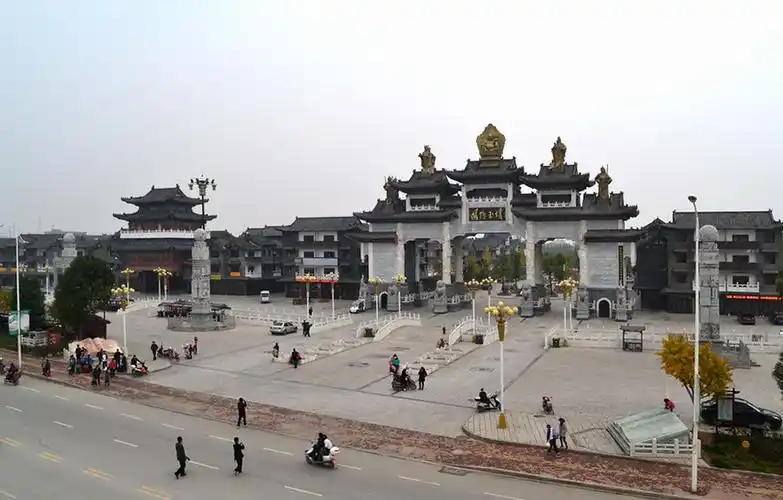 Nanyang's jade-working tradition stretches back to the Neolithic era, when miners first quarried the famous green-and-cream Dushan jade from local hillsides. Long before European guilds refined Bohemian crystal or Venetian glassblowers perfected their art on Murano, Chinese artisans were shaping jade into ritual vessels and ornaments. Today, Zhenping County channels more than 80 percent of China's jade processing and trade, making it the Florence or Idar-Oberstein of the Asian gem world.
Sprawling across roughly 1,300 acres, the complex blends Ming-Qing inspired merchant arcades with classical Chinese garden design. Meandering covered walkways, artificial lakes, and willow-lined canals create a stage-set atmosphere reminiscent of historic trade quarters such as Istanbul's Grand Bazaar. The layout transforms a working commercial center into a genuinely atmospheric cultural landscape.
The centerpiece is the China Jade Culture Museum, whose galleries trace the evolution of jade carving from Neolithic axes and Shang-dynasty ritual blades to contemporary masterworks. Multilingual audio guides make the collection accessible to non-Chinese speakers, while more than a thousand sculptures scattered through the grounds illustrate techniques still practiced in nearby workshops.
A sensible route begins in the museum to build context, then moves through the fine jade galleries to watch artisans at work, before continuing to the rough-stone trading zone. Late afternoon is magical: lantern-lit pavilions reflect off the riverfront park, evoking a Tang-dynasty night market. Allow three to four hours to absorb both the cultural displays and the lively commerce.
Entry is free, but visitors should treat the site as a market first and a museum second. Stick to small souvenir pieces unless you are a serious collector, and always buy from vendors offering national certification papers—bargain-basement "finds" are rarely what they seem. From central Nanyang, the park is a 40–50 minute drive; taxis or rental cars are the most practical option, as public buses run infrequently.
What truly sets this place apart is its living continuity. Few destinations let you trace a single craft from ancient quarry to modern boutique, surrounded by the same landscapes that have shaped it for thousands of years—a quiet, jade-colored echo of the Silk Road's commercial soul.
Nanyang's jade-working tradition stretches back to the Neolithic era, when miners first quarried the famous green-and-cream Dushan jade from local hillsides. Long before European guilds refined Bohemian crystal or Venetian glassblowers perfected their art on Murano, Chinese artisans were shaping jade into ritual vessels and ornaments. Today, Zhenping County channels more than 80 percent of China's jade processing and trade, making it the Florence or Idar-Oberstein of the Asian gem world.
Sprawling across roughly 1,300 acres, the complex blends Ming-Qing inspired merchant arcades with classical Chinese garden design. Meandering covered walkways, artificial lakes, and willow-lined canals create a stage-set atmosphere reminiscent of historic trade quarters such as Istanbul's Grand Bazaar. The layout transforms a working commercial center into a genuinely atmospheric cultural landscape.
The centerpiece is the China Jade Culture Museum, whose galleries trace the evolution of jade carving from Neolithic axes and Shang-dynasty ritual blades to contemporary masterworks. Multilingual audio guides make the collection accessible to non-Chinese speakers, while more than a thousand sculptures scattered through the grounds illustrate techniques still practiced in nearby workshops.
A sensible route begins in the museum to build context, then moves through the fine jade galleries to watch artisans at work, before continuing to the rough-stone trading zone. Late afternoon is magical: lantern-lit pavilions reflect off the riverfront park, evoking a Tang-dynasty night market. Allow three to four hours to absorb both the cultural displays and the lively commerce.
Entry is free, but visitors should treat the site as a market first and a museum second. Stick to small souvenir pieces unless you are a serious collector, and always buy from vendors offering national certification papers—bargain-basement "finds" are rarely what they seem. From central Nanyang, the park is a 40–50 minute drive; taxis or rental cars are the most practical option, as public buses run infrequently.
What truly sets this place apart is its living continuity. Few destinations let you trace a single craft from ancient quarry to modern boutique, surrounded by the same landscapes that have shaped it for thousands of years—a quiet, jade-colored echo of the Silk Road's commercial soul.