Medical Saint Temple
⭐ 3.80
Nanyang City, Henan Province, China
 The temple commemorates Zhang Zhongjing, who practiced medicine during the turbulent final decades of the Eastern Han dynasty (25-220 CE)—the same era when Galen was refining medical theory across the world in Rome. Often likened to the Chinese Hippocrates, Zhang authored the Shanghan Zabing Lun, a text as foundational to Eastern medicine as the Hippocratic Corpus is to Western practice. Think of it as China's equivalent of the Asclepion at Epidaurus or the Temple of Apollo Medicus—a sacred space where healing arts were venerated and transmitted across generations of physician-scholars.
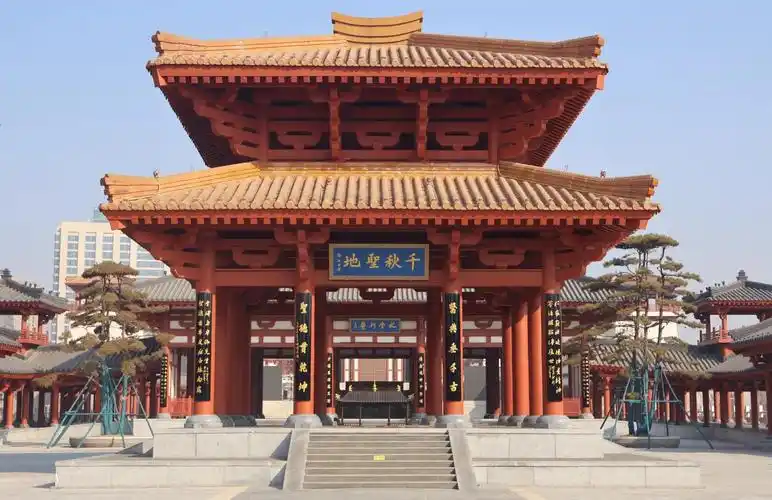
The walled compound follows a traditional north-south axial layout across roughly 1.2 hectares, framed at the entrance by a pair of imposing Han-style gate towers (que) that echo the ceremonial gateways of the Han imperial capital at Luoyang. Beyond the gates, visitors pass through an offering hall, the main sanctuary, six pavilions sheltering inscribed steles, and flanking galleries lined with stone tablets. Glazed-tile roofs, dougong bracketing, and upturned eaves evoke the gravitas of Han ceremonial architecture, comparable in spirit to the temple facades at Baalbek or Nîmes.
At the compound's heart lies Zhang Zhongjing's tomb, a dignified earthen mound shaded by ancient cypresses, honoring the "shrine-then-tomb" arrangement that mirrors classical Confucian temples dedicated to sages. The east and west stele corridors display calligraphy and commemorative verses from physician-scholars across the centuries, while a vivid sculptural group presents ten legendary doctors of Chinese medical history. A complete stone-engraved edition of Zhang's masterwork turns the entire site into a living textbook on the origins of Chinese pharmacology, pulse diagnosis, and holistic treatment philosophy.
Located at No. 7 Yishengci Street in Wancheng District, the temple sits along the scenic Wenliang River on Nanyang's eastern edge, easily reached by bus routes 19 or 26, or a short taxi ride from the city center. Admission runs roughly 25 RMB, with free entry for children, seniors, and holders of certain professional credentials. The site welcomes visitors daily from 8:30 a.m. to 5:30 p.m., and most find 60 to 90 minutes sufficient to explore at a contemplative pace.
This is a cultural sanctuary rather than a thrill-seeker's attraction, ideal for travelers drawn to medical history, comparative civilizations, or East Asian philosophy. Foreign visitors are strongly encouraged to arrange a bilingual guide or rent an audio device in advance, since on-site signage is primarily in Chinese. Pairing the visit with a meal at the nearby Zhongjing Market—where vendors serve herbal dishes inspired by Zhang's dietary prescriptions—transforms a museum stop into a full sensory encounter with China's medical heritage.
The temple commemorates Zhang Zhongjing, who practiced medicine during the turbulent final decades of the Eastern Han dynasty (25-220 CE)—the same era when Galen was refining medical theory across the world in Rome. Often likened to the Chinese Hippocrates, Zhang authored the Shanghan Zabing Lun, a text as foundational to Eastern medicine as the Hippocratic Corpus is to Western practice. Think of it as China's equivalent of the Asclepion at Epidaurus or the Temple of Apollo Medicus—a sacred space where healing arts were venerated and transmitted across generations of physician-scholars.
The walled compound follows a traditional north-south axial layout across roughly 1.2 hectares, framed at the entrance by a pair of imposing Han-style gate towers (que) that echo the ceremonial gateways of the Han imperial capital at Luoyang. Beyond the gates, visitors pass through an offering hall, the main sanctuary, six pavilions sheltering inscribed steles, and flanking galleries lined with stone tablets. Glazed-tile roofs, dougong bracketing, and upturned eaves evoke the gravitas of Han ceremonial architecture, comparable in spirit to the temple facades at Baalbek or Nîmes.
At the compound's heart lies Zhang Zhongjing's tomb, a dignified earthen mound shaded by ancient cypresses, honoring the "shrine-then-tomb" arrangement that mirrors classical Confucian temples dedicated to sages. The east and west stele corridors display calligraphy and commemorative verses from physician-scholars across the centuries, while a vivid sculptural group presents ten legendary doctors of Chinese medical history. A complete stone-engraved edition of Zhang's masterwork turns the entire site into a living textbook on the origins of Chinese pharmacology, pulse diagnosis, and holistic treatment philosophy.
Located at No. 7 Yishengci Street in Wancheng District, the temple sits along the scenic Wenliang River on Nanyang's eastern edge, easily reached by bus routes 19 or 26, or a short taxi ride from the city center. Admission runs roughly 25 RMB, with free entry for children, seniors, and holders of certain professional credentials. The site welcomes visitors daily from 8:30 a.m. to 5:30 p.m., and most find 60 to 90 minutes sufficient to explore at a contemplative pace.
This is a cultural sanctuary rather than a thrill-seeker's attraction, ideal for travelers drawn to medical history, comparative civilizations, or East Asian philosophy. Foreign visitors are strongly encouraged to arrange a bilingual guide or rent an audio device in advance, since on-site signage is primarily in Chinese. Pairing the visit with a meal at the nearby Zhongjing Market—where vendors serve herbal dishes inspired by Zhang's dietary prescriptions—transforms a museum stop into a full sensory encounter with China's medical heritage.