Tengger Desert
⭐ 4.00
Tengger Desert, Alxa Left Banner, Alxa League, Inner Mongolia Autonomous Region, China
 **A Living Desert Landscape**
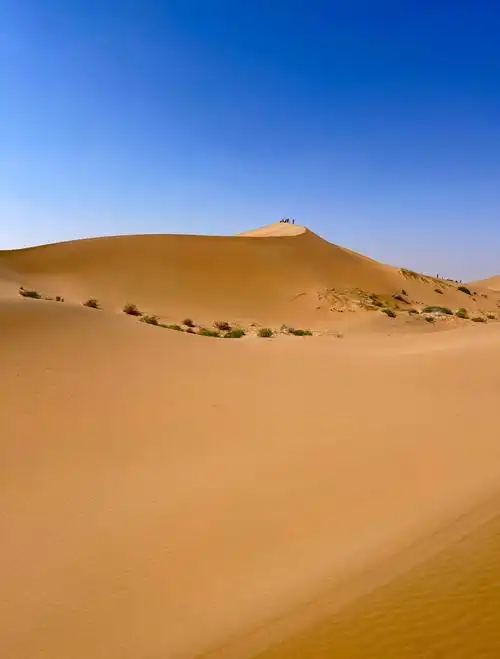
Spanning the southeastern corner of Alxa League and stretching southward across the Great Wall into Gansu and Ningxia, the Tengger Desert sits cradled between the Helan and Yabrai mountain ranges. Unlike the endless sand seas of the Sahara, the Tengger harbors some 400 small lakes and wetlands tucked between its dunes, creating a rare "sand-water coexistence" ecosystem. This juxtaposition—amber dunes tumbling into cobalt waters—rivals the surreal salt pans of Bolivia's Salar de Uyuni in visual drama, though saturated with a distinctly Mongolian character.
**Gateway Resorts and Iconic Lakes**
The best-developed base is Tonghu Grassland (4A-rated), a one-stop resort offering camel treks, dune-buggy rides, sand sliding, and bonfire evenings with stays in traditional *yurts* (called *mengguba* here). Swan Lake, to the north, lives up to its poetic name with seasonal flocks of migratory birds and mirror-still waters framed by dunes. For adventurous travelers, the "Five Lakes Crossing" route links a string of vividly pigmented salt lakes—scarlet Ulan, jade-green Emerald, and others—whose hues shift with the sun, comparable to Iceland's geothermal springs for sheer otherworldly color.
**Climate and the Best Time to Go**
Like the Atacama or the Arabian deserts, the Tengger swings between extremes: summer sand-surface temperatures can exceed 50°C while nights drop to a pleasant 15–20°C. The sweet spot is September to October, when daytime highs ease to around 30°C, the air turns crystalline, and the Milky Way blazes overhead with near-African-safari visibility. August visitors should treat the midday heat as seriously as they would a Red Sea summer—noon activities are strictly off-limits.
**Getting There and Where to Stay**
Most travelers fly into Yinchuan Hedong Airport or Zhongwei Shapotou Airport, then continue by high-speed rail or arranged car (2–3 hours) to Alxa Left Banner, the launch point for the various scenic zones. Entry fees are refreshingly modest: roughly 45–60 yuan at Tonghu and around 40 yuan at Swan Lake. Accommodation ranges from rustic felt-lined yurts to futuristic glass "star pods" and bubble domes designed for sleep-under-the-stargazing experiences. Book guided multi-day packages in advance—mobile signal vanishes in the interior.
**Culture, Ecology, and Why It Matters**
The Tengger is not just scenery but a working cultural landscape. Mongolian herders still graze camels here, and the air carries the long-drawn melodies of *urtiin duu* (Mongolian long-song) and the haunting tones of the *morin khuur* (horse-head fiddle); the annual Naadam festival brings wrestling, archery, and horse racing, echoing traditions that predate Genghis Khan. Ecologically, the desert's oases form critical stopovers on the East Asian–Australasian Flyway, a migratory route as globally significant as the Serengeti's wildebeest corridor. Visiting here supports both conservation and a living nomadic heritage.
**Safety Essentials**
Treat the Tengger with the same respect you would a high-altitude trek in the Andes. Pack SPF 50+ sunscreen, a wide-brimmed hat, polarized sunglasses, and sand-proof gaiters; hydration of 2–3 liters per day is non-negotiable. Avoid strenuous activity between 11 a.m. and 4 p.m., and elderly travelers or young children should be carefully assessed. Never venture off-trail alone—always book through licensed operators who provide satellite communicators and experienced guides.
**A Living Desert Landscape**
Spanning the southeastern corner of Alxa League and stretching southward across the Great Wall into Gansu and Ningxia, the Tengger Desert sits cradled between the Helan and Yabrai mountain ranges. Unlike the endless sand seas of the Sahara, the Tengger harbors some 400 small lakes and wetlands tucked between its dunes, creating a rare "sand-water coexistence" ecosystem. This juxtaposition—amber dunes tumbling into cobalt waters—rivals the surreal salt pans of Bolivia's Salar de Uyuni in visual drama, though saturated with a distinctly Mongolian character.
**Gateway Resorts and Iconic Lakes**
The best-developed base is Tonghu Grassland (4A-rated), a one-stop resort offering camel treks, dune-buggy rides, sand sliding, and bonfire evenings with stays in traditional *yurts* (called *mengguba* here). Swan Lake, to the north, lives up to its poetic name with seasonal flocks of migratory birds and mirror-still waters framed by dunes. For adventurous travelers, the "Five Lakes Crossing" route links a string of vividly pigmented salt lakes—scarlet Ulan, jade-green Emerald, and others—whose hues shift with the sun, comparable to Iceland's geothermal springs for sheer otherworldly color.
**Climate and the Best Time to Go**
Like the Atacama or the Arabian deserts, the Tengger swings between extremes: summer sand-surface temperatures can exceed 50°C while nights drop to a pleasant 15–20°C. The sweet spot is September to October, when daytime highs ease to around 30°C, the air turns crystalline, and the Milky Way blazes overhead with near-African-safari visibility. August visitors should treat the midday heat as seriously as they would a Red Sea summer—noon activities are strictly off-limits.
**Getting There and Where to Stay**
Most travelers fly into Yinchuan Hedong Airport or Zhongwei Shapotou Airport, then continue by high-speed rail or arranged car (2–3 hours) to Alxa Left Banner, the launch point for the various scenic zones. Entry fees are refreshingly modest: roughly 45–60 yuan at Tonghu and around 40 yuan at Swan Lake. Accommodation ranges from rustic felt-lined yurts to futuristic glass "star pods" and bubble domes designed for sleep-under-the-stargazing experiences. Book guided multi-day packages in advance—mobile signal vanishes in the interior.
**Culture, Ecology, and Why It Matters**
The Tengger is not just scenery but a working cultural landscape. Mongolian herders still graze camels here, and the air carries the long-drawn melodies of *urtiin duu* (Mongolian long-song) and the haunting tones of the *morin khuur* (horse-head fiddle); the annual Naadam festival brings wrestling, archery, and horse racing, echoing traditions that predate Genghis Khan. Ecologically, the desert's oases form critical stopovers on the East Asian–Australasian Flyway, a migratory route as globally significant as the Serengeti's wildebeest corridor. Visiting here supports both conservation and a living nomadic heritage.
**Safety Essentials**
Treat the Tengger with the same respect you would a high-altitude trek in the Andes. Pack SPF 50+ sunscreen, a wide-brimmed hat, polarized sunglasses, and sand-proof gaiters; hydration of 2–3 liters per day is non-negotiable. Avoid strenuous activity between 11 a.m. and 4 p.m., and elderly travelers or young children should be carefully assessed. Never venture off-trail alone—always book through licensed operators who provide satellite communicators and experienced guides.