Baihaba Village
⭐ 4.20
Baihaba Village, Habahe County, Altay Prefecture, Xinjiang Uygur Autonomous Region, China
 Tucked into a narrow valley where the Altay Mountains meet the Kazakh steppe, Baihaba has sheltered the Tuvan people for several centuries. Ethnically and linguistically linked to the Turkic peoples who shaped the great khanates of Central Asia, the Tuvans are often considered distant cousins of communities ranging from the Siberian taiga to the Caspian basin. Their ancestors likely traversed the same ancient caravan routes that once carried Silk Road merchants between Chang'an and the Mediterranean. The village's position at the edge of imperial Qing territory, later the Sino-Soviet frontier, lent it a strategic importance far out of proportion to its modest size.
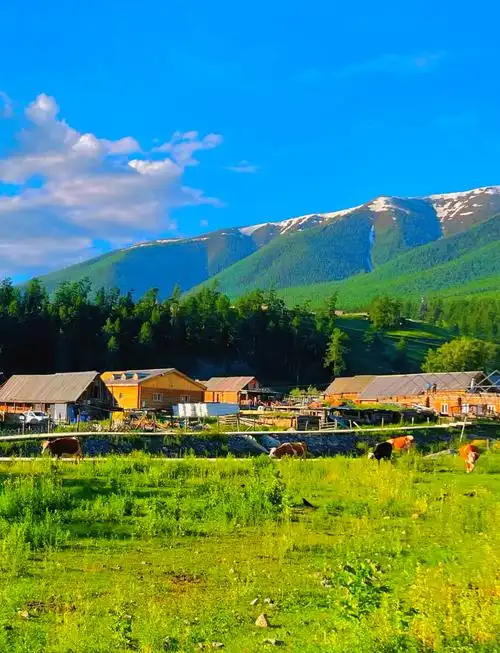
The village reads like a living museum of vernacular wooden architecture. The signature pointed-roof log cabins, stacked from cedar and pine without nails, recall both the stave churches of medieval Norway and the timber chalets of the Swiss Alps, yet possess their own distinct Siberian character. Wooden fences enclose tidy courtyards where felt yurts — close cousins to the gers of Mongolia — share space with the log houses. From a distance, the cluster of timber roofs and curling woodsmoke looks as though it might belong to a forgotten hamlet in the Carpathians, frozen in time.
The Tuvans are renowned musicians, and two traditional instruments remain central to village life: the chuur, an end-blown flute said to mimic the call of mountain winds, and the topshur, a two-stringed lute plucked with the fingers. Each September, during the great seasonal migration known as transhumance, herders drive their flocks from high summer pastures down to winter lowlands, a practice stretching back over a thousand years. Visitors may also sample traditional milk tea and curdled-milk snacks, and join evening bonfires where folk songs and dances continue long after dark.
Reaching Baihaba requires a degree of planning. The village sits within the 5A Kanas National Park and is accessible only by shuttle bus from the Kanas Transfer Centre, roughly one hour away. All visitors must hold a Border Crossing Permit: domestic travelers can obtain this free of charge with an ID card at their place of registration or at the Burqin County Government Centre, while foreign passport holders must arrange theirs through a licensed Chinese travel agency. The park operates from April 30 to November 30, 9:30 am to 6:30 pm daily.
Summers are pleasantly cool at 15–25°C, but the undisputed highlight is autumn, from mid-September to early October, when birch and larch forests blaze in yellow, orange, and crimson. Daytime temperature swings of 15°C or more mean a warm jacket remains essential even in July. Overnight stays are in simple wooden guesthouses with basic amenities; hot water can be unreliable, and some bathrooms are shared. The warm glow from cabin windows against snowy peaks or autumn leaves creates a scene photographers dream of.
Drones are strictly prohibited within the village, and crossing the river into Kazakhstan is both illegal and extremely dangerous. With its blend of living indigenous culture, frontier atmosphere, and unforgettable landscapes, Baihaba offers a glimpse of the Old Silk Road that survives almost nowhere else in China today. For travelers seeking something more remote and authentic than the well-trodden routes of central Xinjiang, this borderland hamlet provides a rare chance to step off the map entirely.
Tucked into a narrow valley where the Altay Mountains meet the Kazakh steppe, Baihaba has sheltered the Tuvan people for several centuries. Ethnically and linguistically linked to the Turkic peoples who shaped the great khanates of Central Asia, the Tuvans are often considered distant cousins of communities ranging from the Siberian taiga to the Caspian basin. Their ancestors likely traversed the same ancient caravan routes that once carried Silk Road merchants between Chang'an and the Mediterranean. The village's position at the edge of imperial Qing territory, later the Sino-Soviet frontier, lent it a strategic importance far out of proportion to its modest size.
The village reads like a living museum of vernacular wooden architecture. The signature pointed-roof log cabins, stacked from cedar and pine without nails, recall both the stave churches of medieval Norway and the timber chalets of the Swiss Alps, yet possess their own distinct Siberian character. Wooden fences enclose tidy courtyards where felt yurts — close cousins to the gers of Mongolia — share space with the log houses. From a distance, the cluster of timber roofs and curling woodsmoke looks as though it might belong to a forgotten hamlet in the Carpathians, frozen in time.
The Tuvans are renowned musicians, and two traditional instruments remain central to village life: the chuur, an end-blown flute said to mimic the call of mountain winds, and the topshur, a two-stringed lute plucked with the fingers. Each September, during the great seasonal migration known as transhumance, herders drive their flocks from high summer pastures down to winter lowlands, a practice stretching back over a thousand years. Visitors may also sample traditional milk tea and curdled-milk snacks, and join evening bonfires where folk songs and dances continue long after dark.
Reaching Baihaba requires a degree of planning. The village sits within the 5A Kanas National Park and is accessible only by shuttle bus from the Kanas Transfer Centre, roughly one hour away. All visitors must hold a Border Crossing Permit: domestic travelers can obtain this free of charge with an ID card at their place of registration or at the Burqin County Government Centre, while foreign passport holders must arrange theirs through a licensed Chinese travel agency. The park operates from April 30 to November 30, 9:30 am to 6:30 pm daily.
Summers are pleasantly cool at 15–25°C, but the undisputed highlight is autumn, from mid-September to early October, when birch and larch forests blaze in yellow, orange, and crimson. Daytime temperature swings of 15°C or more mean a warm jacket remains essential even in July. Overnight stays are in simple wooden guesthouses with basic amenities; hot water can be unreliable, and some bathrooms are shared. The warm glow from cabin windows against snowy peaks or autumn leaves creates a scene photographers dream of.
Drones are strictly prohibited within the village, and crossing the river into Kazakhstan is both illegal and extremely dangerous. With its blend of living indigenous culture, frontier atmosphere, and unforgettable landscapes, Baihaba offers a glimpse of the Old Silk Road that survives almost nowhere else in China today. For travelers seeking something more remote and authentic than the well-trodden routes of central Xinjiang, this borderland hamlet provides a rare chance to step off the map entirely.