Hemu Village
⭐ 4.80
Hemu Village, Burqin County, Altay Prefecture, Xinjiang Uyghur Autonomous Region, China
 Tucked into a glacial valley near the Mongolian border, Hemu is one of the last strongholds of the Tuvan people, a Turkic-speaking group whose roots stretch back to the reindeer-herding tribes of southern Siberia. Scholars link them to the broader family of Central Asian nomads chronicled by explorers like Wilhelm Radloff in the 19th century, and their presence here predates the Qing dynasty incorporation of the region. The village sits roughly 30 kilometers southeast of Kanas Lake, often called China's "last untouched wilderness," and the surrounding Altai range forms a natural corridor between Russia, Mongolia, Kazakhstan, and China that has shaped its culture for centuries.
The village's defining feature is its stock of "mukelun" log cabins, built using a horizontal log-stacking technique remarkably similar to the chalin style found across Norway's Gudbrandsdalen valley or the wooden churches of Transylvania. Each cabin is constructed without a single nail: whole tree trunks are notched and interlocked into a tight lattice, creating walls thick enough to withstand winter temperatures plunging below minus 30°C. The steeply pitched gables, designed to shed heavy snow, recall the alpine chalets of the Swiss Bernese Oberland, while small private courtyards give the settlement the intimate, scattered feel of a medieval Carpathian hamlet rather than a planned Chinese village.
Culturally, Hemu offers something increasingly rare in modern China: a living, breathing ethnic minority tradition. Visitors can sample salty milk tea and hand-pulled lamb, sip fermented mare's milk (ayran's distant cousin), and listen to khoomei, the haunting overtone throat-singing that UNESCO recognizes as part of Mongolia's intangible heritage. The Tuvans' animist reverence for sky, mountains, and rivers mirrors the shamanic traditions of indigenous Siberian peoples, lending the village a spiritual dimension that transcends sightseeing. Compared to the heavily staged ethnic villages of Lijiang or Guilin, Hemu remains refreshingly authentic, though modest tourism has begun to arrive.
Reaching the village requires planning. Travelers fly or drive to Burqin via Altay City, then transfer to a shuttle at either Burqin or Jiadengyu, since private vehicles are restricted. Stays should be booked at licensed guesthouses one to two months ahead for summer and Golden Week crowds. Drones are banned, horse trekking must be arranged through registered herders with prices agreed in advance, and swimming in the main Hemu River crossing is prohibited. Average July temperatures of 18–24°C make summer ideal for families, while December through February appeals to powder-skiing adventurers and photographers chasing the surreal "snow mushroom" formations.
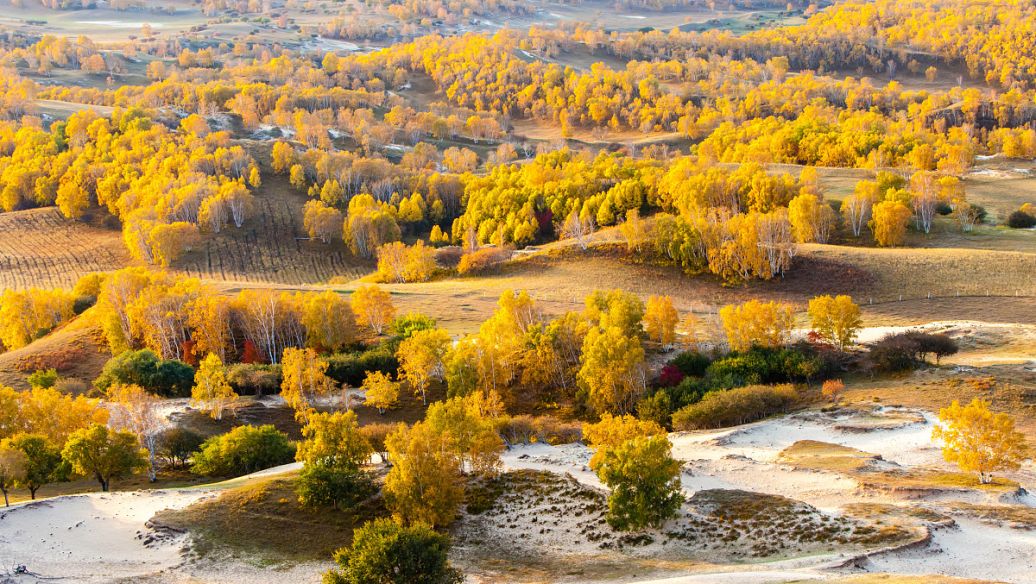
For photographers and nature lovers, the single most important ritual is the dawn hike up the Harding viewing platform, where golden birch canopy, drifting wood-smoke, and low river mist merge into what locals call a "divine moment." Autumn, particularly late September to early October, delivers the most iconic images, when the birches blaze yellow against weathered timber roofs. Hikers can also walk the seven-kilometer gentle trail toward Beautiful Peak, or simply wander the birch groves framing the wooden footbridge. Few places in Asia combine such accessible wilderness with such deep ethnographic resonance; Hemu feels less like a tourist site and more like a quiet threshold into the older, colder, more contemplative north.
Tucked into a glacial valley near the Mongolian border, Hemu is one of the last strongholds of the Tuvan people, a Turkic-speaking group whose roots stretch back to the reindeer-herding tribes of southern Siberia. Scholars link them to the broader family of Central Asian nomads chronicled by explorers like Wilhelm Radloff in the 19th century, and their presence here predates the Qing dynasty incorporation of the region. The village sits roughly 30 kilometers southeast of Kanas Lake, often called China's "last untouched wilderness," and the surrounding Altai range forms a natural corridor between Russia, Mongolia, Kazakhstan, and China that has shaped its culture for centuries.
The village's defining feature is its stock of "mukelun" log cabins, built using a horizontal log-stacking technique remarkably similar to the chalin style found across Norway's Gudbrandsdalen valley or the wooden churches of Transylvania. Each cabin is constructed without a single nail: whole tree trunks are notched and interlocked into a tight lattice, creating walls thick enough to withstand winter temperatures plunging below minus 30°C. The steeply pitched gables, designed to shed heavy snow, recall the alpine chalets of the Swiss Bernese Oberland, while small private courtyards give the settlement the intimate, scattered feel of a medieval Carpathian hamlet rather than a planned Chinese village.
Culturally, Hemu offers something increasingly rare in modern China: a living, breathing ethnic minority tradition. Visitors can sample salty milk tea and hand-pulled lamb, sip fermented mare's milk (ayran's distant cousin), and listen to khoomei, the haunting overtone throat-singing that UNESCO recognizes as part of Mongolia's intangible heritage. The Tuvans' animist reverence for sky, mountains, and rivers mirrors the shamanic traditions of indigenous Siberian peoples, lending the village a spiritual dimension that transcends sightseeing. Compared to the heavily staged ethnic villages of Lijiang or Guilin, Hemu remains refreshingly authentic, though modest tourism has begun to arrive.
Reaching the village requires planning. Travelers fly or drive to Burqin via Altay City, then transfer to a shuttle at either Burqin or Jiadengyu, since private vehicles are restricted. Stays should be booked at licensed guesthouses one to two months ahead for summer and Golden Week crowds. Drones are banned, horse trekking must be arranged through registered herders with prices agreed in advance, and swimming in the main Hemu River crossing is prohibited. Average July temperatures of 18–24°C make summer ideal for families, while December through February appeals to powder-skiing adventurers and photographers chasing the surreal "snow mushroom" formations.
For photographers and nature lovers, the single most important ritual is the dawn hike up the Harding viewing platform, where golden birch canopy, drifting wood-smoke, and low river mist merge into what locals call a "divine moment." Autumn, particularly late September to early October, delivers the most iconic images, when the birches blaze yellow against weathered timber roofs. Hikers can also walk the seven-kilometer gentle trail toward Beautiful Peak, or simply wander the birch groves framing the wooden footbridge. Few places in Asia combine such accessible wilderness with such deep ethnographic resonance; Hemu feels less like a tourist site and more like a quiet threshold into the older, colder, more contemplative north.