Yangshuo Karst Cave
⭐ 4.20
An Karst Cave, An Mountain, An Village, Xingping Village Committee, Xingping Town, Yangshuo County, Guilin City, Guangxi Zhuang Autonomous Region, China
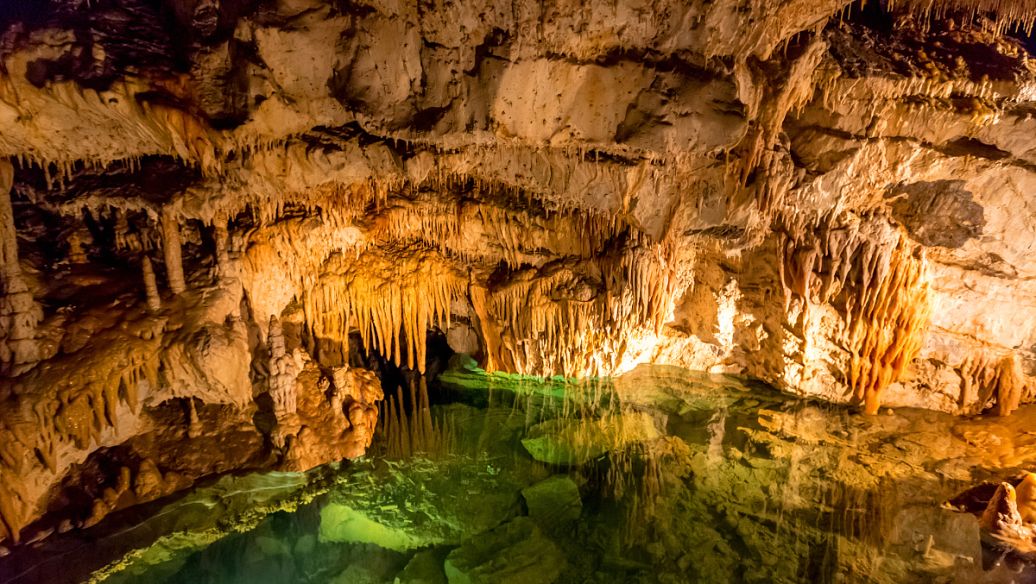 The Yangshuo cave system is a defining feature of the South China Karst, a UNESCO World Heritage landscape whose limestone peaks and sinkholes belong to the same geological family as Halong Bay in Vietnam and the Dolomites' subterranean networks in Italy. Formed over 400 million years through the slow dissolution of carbonate rock by groundwater, the caves descend into layered chambers bristling with stalactites and stalagmites. Their geological pedigree echoes Europe's Postojna Cave in Slovenia, yet the sheer concentration of formations within a few square kilometres makes Yangshuo singular in scale.
Silver Cave (Yinzhi Yan) is the crowd-pleaser of the group, threading through twelve peaks along a flat, dry walkway that any traveller can manage. Its 18°C interior is comfortably cool year-round, and coloured lighting has been used to dramatise three signature chambers nicknamed "Snow Mountain Waterfall," "Musical Stone Screen" (where tapping the stone plays actual notes, much like a lithophone), and "Jade Pool Wonderland." Visiting takes only an hour or so, making it comparable in convenience to Italy's Grotta dello Smeraldo or England's Speedwell Cavern, though with far more abundant formations.
For travellers craving raw adventure, Moon Water Cave (Longmen Shuiyan) cuts through eight peaks and strips away all decorative lighting, leaving only emergency lamps to reveal the original subterranean river. Groups wade, swim, scramble over boulders, and leap from ledges into cool pools, with optional mud baths and paddle-boarding along the way. The experience resembles caving expeditions in Slovenia's Skocjan Caves but with a tropical twist, and it rewards visitors with the closest possible encounter with unmediated karst geology. The April-to-October season is the safest window, when water levels are manageable.
Julongtan and Bilian Cave add cultural depth. Julongtan is Yangshuo's only cave offering both boat rides along an underground river and walking routes through dramatic chambers, often paired with folk-song performances inspired by the legendary singer Liu Sanjie, a regional icon comparable to Italy's troubadour traditions. Bilian Cave, tucked inside Yangshuo Park's Zhongling Mountain, is smaller but historically priceless: it is where Xu Xiake (1587–1641), China's greatest Ming-era travel geographer, recorded his observations in 1637, lending it the same antiquarian aura that visitors feel at Britain's Cheddar Gorge or France's Font-de-Gaume. Both sites are modestly priced and easily combined with a stroll through town.
Practicalities are straightforward. Silver Cave tickets run around 60 RMB, while Moon Water Cave adventure packages cost roughly 168 RMB including equipment and mud-bath access. Julongtan and Bilian Cave are cheaper still. All four caves lie within a few kilometres of Yangshuo town, reachable by e-scooter, taxi, or tour minibus; most operators based in Guilin offer half-day and full-day itineraries with hotel pick-up. Major caves have bilingual signage, English audio guides, and English-speaking staff at the ticket desks. Bring a thin layer for sightseeing caves (they stay cool even in summer) and, for Moon Water, sturdy water shoes, a headlamp, and a change of clothes. August brings rain and peak crowds, so check weather forecasts and opening status before setting out.
The Yangshuo cave system is a defining feature of the South China Karst, a UNESCO World Heritage landscape whose limestone peaks and sinkholes belong to the same geological family as Halong Bay in Vietnam and the Dolomites' subterranean networks in Italy. Formed over 400 million years through the slow dissolution of carbonate rock by groundwater, the caves descend into layered chambers bristling with stalactites and stalagmites. Their geological pedigree echoes Europe's Postojna Cave in Slovenia, yet the sheer concentration of formations within a few square kilometres makes Yangshuo singular in scale.
Silver Cave (Yinzhi Yan) is the crowd-pleaser of the group, threading through twelve peaks along a flat, dry walkway that any traveller can manage. Its 18°C interior is comfortably cool year-round, and coloured lighting has been used to dramatise three signature chambers nicknamed "Snow Mountain Waterfall," "Musical Stone Screen" (where tapping the stone plays actual notes, much like a lithophone), and "Jade Pool Wonderland." Visiting takes only an hour or so, making it comparable in convenience to Italy's Grotta dello Smeraldo or England's Speedwell Cavern, though with far more abundant formations.
For travellers craving raw adventure, Moon Water Cave (Longmen Shuiyan) cuts through eight peaks and strips away all decorative lighting, leaving only emergency lamps to reveal the original subterranean river. Groups wade, swim, scramble over boulders, and leap from ledges into cool pools, with optional mud baths and paddle-boarding along the way. The experience resembles caving expeditions in Slovenia's Skocjan Caves but with a tropical twist, and it rewards visitors with the closest possible encounter with unmediated karst geology. The April-to-October season is the safest window, when water levels are manageable.
Julongtan and Bilian Cave add cultural depth. Julongtan is Yangshuo's only cave offering both boat rides along an underground river and walking routes through dramatic chambers, often paired with folk-song performances inspired by the legendary singer Liu Sanjie, a regional icon comparable to Italy's troubadour traditions. Bilian Cave, tucked inside Yangshuo Park's Zhongling Mountain, is smaller but historically priceless: it is where Xu Xiake (1587–1641), China's greatest Ming-era travel geographer, recorded his observations in 1637, lending it the same antiquarian aura that visitors feel at Britain's Cheddar Gorge or France's Font-de-Gaume. Both sites are modestly priced and easily combined with a stroll through town.
Practicalities are straightforward. Silver Cave tickets run around 60 RMB, while Moon Water Cave adventure packages cost roughly 168 RMB including equipment and mud-bath access. Julongtan and Bilian Cave are cheaper still. All four caves lie within a few kilometres of Yangshuo town, reachable by e-scooter, taxi, or tour minibus; most operators based in Guilin offer half-day and full-day itineraries with hotel pick-up. Major caves have bilingual signage, English audio guides, and English-speaking staff at the ticket desks. Bring a thin layer for sightseeing caves (they stay cool even in summer) and, for Moon Water, sturdy water shoes, a headlamp, and a change of clothes. August brings rain and peak crowds, so check weather forecasts and opening status before setting out.