Big Banyan Tree Scenic Area
⭐ 2.80
Xingping Town, Yangshuo County, Guilin City, Guangxi Zhuang Autonomous Region, China
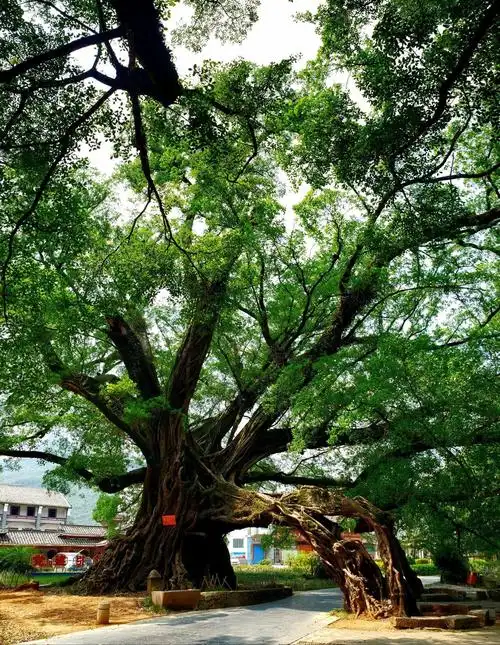 The Big Banyan, a Ficus altissima planted around 600 AD during the Sui Dynasty, has weathered fourteen centuries of subtropical climate and human history—roughly the same age as the earliest surviving stave churches of Norway or the founding era of Islam. Standing 17 meters tall with a trunk circumference exceeding seven meters, it ranks among the largest single-trunk banyans in southern China and earned a place in the Guinness World Records in 2002 for its sprawling crown. Aerial roots cascade like living curtains while interlocking branches weave a natural canopy that shelters more than 1,300 square meters of ground below, embodying the Chinese horticultural ideal of "one tree becomes a forest."
In 1961, the celebrated musical *Liu Sanjie*—often considered China's answer to *Romeo and Juliet* filtered through folk tradition—used this tree as the backdrop for the heroine and her suitor A Niu's embroidered-ball courtship scene. The film, a sensation across East Asia, transformed the ancient banyan into a symbol of love and ethnic Zhuang folk culture. Film enthusiasts still trace this cinematic pilgrimage route today, and the tree's image remains ubiquitous in regional tourism branding, much as the Abbey of Fontaine-les-Blanches anchors French film heritage.
The setting captures Guangxi's quintessential countryside aesthetic: emerald rice paddies, creaking wooden waterwheels, whitewashed village cottages, and the serpentine Jinbao River with karst pinnacles rising like nature's own cathedral spires. Early morning mist or late afternoon golden light casts the banyan and distant peaks into a watercolor tableau—a composition that recalls the Hudson River School paintings of America's nineteenth century, though here shaped by dramatic Asian geology reminiscent of Vietnam's Ha Long Bay or Slovenia's Lake Bled.
Practical visits require minimal exertion: the site lies roughly six kilometers from Yangshuo town, with admission around 20 RMB and opening hours typically 08:00 to 17:30. The core visit takes only thirty minutes along flat ground, making it accessible for all ages. Plan your arrival between 9-10 a.m. or 4-5 p.m. for soft photography light, bring sun protection and mosquito repellent in summer, and carry water. Ignore touts offering discounted tickets or unsolicited bamboo-raft transport at the entrance.
The Big Banyan truly rewards those who pair it with the surrounding Ten Mile Gallery corridor. Rent a bicycle or e-scooter and weave together Moon Hill—climbable in under an hour for a peek through its distinctive crescent arch—Gongnong Bridge, and the upper Yulong River in a satisfying half- or full-day loop. The karst spires, pastoral lanes, and stream-threaded valleys unfold continuously along this drive, delivering an immersion into Guangxi's rural landscape that a stand-alone ticket purchase can never match.
The Big Banyan, a Ficus altissima planted around 600 AD during the Sui Dynasty, has weathered fourteen centuries of subtropical climate and human history—roughly the same age as the earliest surviving stave churches of Norway or the founding era of Islam. Standing 17 meters tall with a trunk circumference exceeding seven meters, it ranks among the largest single-trunk banyans in southern China and earned a place in the Guinness World Records in 2002 for its sprawling crown. Aerial roots cascade like living curtains while interlocking branches weave a natural canopy that shelters more than 1,300 square meters of ground below, embodying the Chinese horticultural ideal of "one tree becomes a forest."
In 1961, the celebrated musical *Liu Sanjie*—often considered China's answer to *Romeo and Juliet* filtered through folk tradition—used this tree as the backdrop for the heroine and her suitor A Niu's embroidered-ball courtship scene. The film, a sensation across East Asia, transformed the ancient banyan into a symbol of love and ethnic Zhuang folk culture. Film enthusiasts still trace this cinematic pilgrimage route today, and the tree's image remains ubiquitous in regional tourism branding, much as the Abbey of Fontaine-les-Blanches anchors French film heritage.
The setting captures Guangxi's quintessential countryside aesthetic: emerald rice paddies, creaking wooden waterwheels, whitewashed village cottages, and the serpentine Jinbao River with karst pinnacles rising like nature's own cathedral spires. Early morning mist or late afternoon golden light casts the banyan and distant peaks into a watercolor tableau—a composition that recalls the Hudson River School paintings of America's nineteenth century, though here shaped by dramatic Asian geology reminiscent of Vietnam's Ha Long Bay or Slovenia's Lake Bled.
Practical visits require minimal exertion: the site lies roughly six kilometers from Yangshuo town, with admission around 20 RMB and opening hours typically 08:00 to 17:30. The core visit takes only thirty minutes along flat ground, making it accessible for all ages. Plan your arrival between 9-10 a.m. or 4-5 p.m. for soft photography light, bring sun protection and mosquito repellent in summer, and carry water. Ignore touts offering discounted tickets or unsolicited bamboo-raft transport at the entrance.
The Big Banyan truly rewards those who pair it with the surrounding Ten Mile Gallery corridor. Rent a bicycle or e-scooter and weave together Moon Hill—climbable in under an hour for a peek through its distinctive crescent arch—Gongnong Bridge, and the upper Yulong River in a satisfying half- or full-day loop. The karst spires, pastoral lanes, and stream-threaded valleys unfold continuously along this drive, delivering an immersion into Guangxi's rural landscape that a stand-alone ticket purchase can never match.