Li River
⭐ 4.80
Li River Scenic Area, Guilin City, Guangxi Zhuang Autonomous Region, China
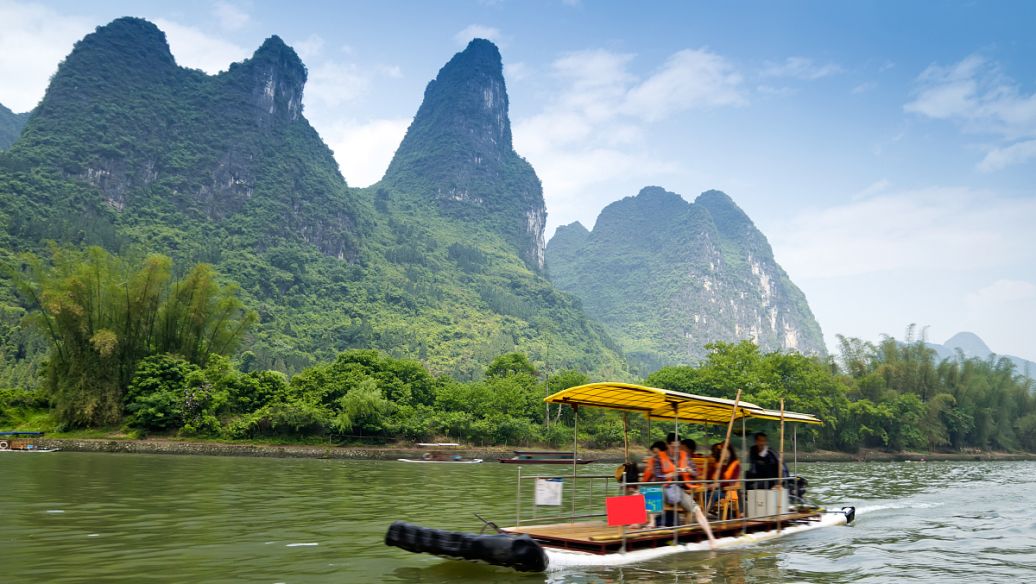 The dramatic scenery along the Li River is the product of roughly 300 million years of geological history, when vast limestone seabeds were uplifted and then sculpted by water into the towering peaks, hidden caves, and sinkholes that characterise karst topography. Comparable landscapes appear at Halong Bay in Vietnam and the dolomitic flanks of the Italian Alps, yet China's karst region around Guilin remains the world's finest and most studied example of this phenomenon. Geologists first began documenting it in the 17th century, and UNESCO's inclusion of South China Karst on its World Heritage List in 2007 confirmed its global scientific importance.
The river's most photographed stretch, from Yangdi to Xingping, is famously called the "Hundred-Li Gallery," a sequence of isolated pinnacles whose silhouettes have sparked the Chinese imagination for centuries. Nine Horse Hill invites visitors to count stone horses within its weathered face, while Yellow Cloth Shoals reflects the peaks so perfectly that the scene appears on the back of China's 20-yuan banknote — making it perhaps the most reproduced landscape in the country. Further downstream, formations like Child Worshipping Guanyin reveal how Chinese viewers traditionally read nature as a gallery of living forms, much as medieval Europeans saw saints and demons in rock outcrops along the Rhine.
Poetry has long claimed this river as its own. Tang dynasty writers such as Han Yu and Wang Zhenggong immortalised its peaks, and the celebrated phrase "Guilin's scenery outshines all others under heaven" was born here in the 12th century. For Chinese literati, the Li River embodies the Daoist ideal of harmonious union between humanity and nature — a concept that, in spirit, parallels how Romantic Europeans such as Byron and Wordsworth wrestled with the sublime. Travellers today encounter a living continuation of that tradition in cormorant fishing demonstrations and bamboo-raft craft still practiced along the banks, customs stretching back over a thousand years.
The classic experience is a 3.5-hour cruise from Mopanshan Dock in Guilin to Yangshuo aboard a three-star sightseeing boat, covering about 70 kilometers and passing all the major landmarks with onboard commentary in English and Mandarin. Travellers pressed for time can take a shorter one-hour ride from Xingping Dock, which stops directly opposite the 20-yuan backdrop — easily the most photogenic kilometre of river in Asia. For a slower, more intimate encounter, bamboo rafts depart from Yangdi or Chaobanshan, drifting close to the water and beneath the peaks, somewhat akin to punting along an English chalk stream but on a far grander scale.
The river rewards visitors year-round, but April through October offers the best conditions, and the hours immediately after rain are magical, when mist clings to the summits like a traditional ink wash. Early morning and late afternoon cruises provide softer light for photography and smaller crowds than midday departures. Docks are equipped with viewing platforms, shaded rest areas, and clean restroom facilities, while most boats include a simple boxed lunch and multilingual commentary. Round-trip transfers from Guilin hotels and Yangshuo guesthouse pickups are easily arranged through hotels or local tour operators.
Foreign visitors with two days should consider an overnight in Yangshuo, where the lively West Street pedestrian zone — a centuries-old trading lane — offers boutique guesthouses, restaurants serving both local and Western cuisine, and atmospheric river views after dark. The next morning, head to Xingping for the iconic banknote view and a bamboo-raft drift, then continue to the nearby Yulong River and Ten-Mile Gallery, where bicycles can be hired to wind through rice paddies and ancient villages. This route captures both the celebrated scenery and the quiet countryside life that has shaped Guilin's reputation for nearly a thousand years.
The dramatic scenery along the Li River is the product of roughly 300 million years of geological history, when vast limestone seabeds were uplifted and then sculpted by water into the towering peaks, hidden caves, and sinkholes that characterise karst topography. Comparable landscapes appear at Halong Bay in Vietnam and the dolomitic flanks of the Italian Alps, yet China's karst region around Guilin remains the world's finest and most studied example of this phenomenon. Geologists first began documenting it in the 17th century, and UNESCO's inclusion of South China Karst on its World Heritage List in 2007 confirmed its global scientific importance.
The river's most photographed stretch, from Yangdi to Xingping, is famously called the "Hundred-Li Gallery," a sequence of isolated pinnacles whose silhouettes have sparked the Chinese imagination for centuries. Nine Horse Hill invites visitors to count stone horses within its weathered face, while Yellow Cloth Shoals reflects the peaks so perfectly that the scene appears on the back of China's 20-yuan banknote — making it perhaps the most reproduced landscape in the country. Further downstream, formations like Child Worshipping Guanyin reveal how Chinese viewers traditionally read nature as a gallery of living forms, much as medieval Europeans saw saints and demons in rock outcrops along the Rhine.
Poetry has long claimed this river as its own. Tang dynasty writers such as Han Yu and Wang Zhenggong immortalised its peaks, and the celebrated phrase "Guilin's scenery outshines all others under heaven" was born here in the 12th century. For Chinese literati, the Li River embodies the Daoist ideal of harmonious union between humanity and nature — a concept that, in spirit, parallels how Romantic Europeans such as Byron and Wordsworth wrestled with the sublime. Travellers today encounter a living continuation of that tradition in cormorant fishing demonstrations and bamboo-raft craft still practiced along the banks, customs stretching back over a thousand years.
The classic experience is a 3.5-hour cruise from Mopanshan Dock in Guilin to Yangshuo aboard a three-star sightseeing boat, covering about 70 kilometers and passing all the major landmarks with onboard commentary in English and Mandarin. Travellers pressed for time can take a shorter one-hour ride from Xingping Dock, which stops directly opposite the 20-yuan backdrop — easily the most photogenic kilometre of river in Asia. For a slower, more intimate encounter, bamboo rafts depart from Yangdi or Chaobanshan, drifting close to the water and beneath the peaks, somewhat akin to punting along an English chalk stream but on a far grander scale.
The river rewards visitors year-round, but April through October offers the best conditions, and the hours immediately after rain are magical, when mist clings to the summits like a traditional ink wash. Early morning and late afternoon cruises provide softer light for photography and smaller crowds than midday departures. Docks are equipped with viewing platforms, shaded rest areas, and clean restroom facilities, while most boats include a simple boxed lunch and multilingual commentary. Round-trip transfers from Guilin hotels and Yangshuo guesthouse pickups are easily arranged through hotels or local tour operators.
Foreign visitors with two days should consider an overnight in Yangshuo, where the lively West Street pedestrian zone — a centuries-old trading lane — offers boutique guesthouses, restaurants serving both local and Western cuisine, and atmospheric river views after dark. The next morning, head to Xingping for the iconic banknote view and a bamboo-raft drift, then continue to the nearby Yulong River and Ten-Mile Gallery, where bicycles can be hired to wind through rice paddies and ancient villages. This route captures both the celebrated scenery and the quiet countryside life that has shaped Guilin's reputation for nearly a thousand years.