Wuyang River Rafting
⭐ 3.80
Wuyang River Scenic Area, Zhenyuan County, Qiandongnan Miao and Dong Autonomous Prefecture, Guizhou Province, China
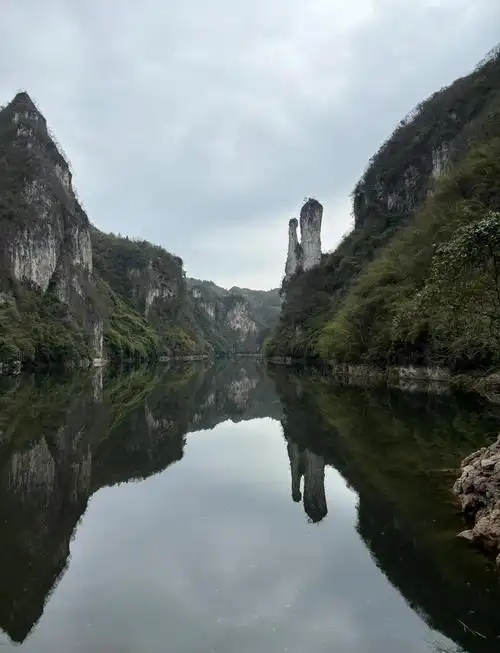 The Wuyang River carves its 400-km course through Guizhou as a tributary of the Yuan River, itself part of the greater Yangtze watershed. For millennia, this waterway served as a vital trade artery linking the Miao and Dong highlands with the central Yangtze plains, funneling goods, people, and ideas between southwest China's ethnic heartland and the Han Chinese heartland. Geologically, the river has spent millions of years sculpting a karst landscape that rivals Guilin in drama but feels far less crowded. Travelers familiar with the Rhine Gorge or Norway's Nærøyfjord will recognize the same recipe of sheer cliffs plunging into glassy water, though here the formations wear distinctly southern-Chinese silhouettes, with peaks resembling opening peacocks and roosters crowing at the heavens.
The cruise's centerpiece is a chain of three canyons, Zhuge, Dragon King, and West Gorge, where limestone spires rise 200 meters above the river and natural arches frame the sky. Between the cliffs, pockets of fertile floodplain shelter traditional Miao stilted houses (diaojiaolou) and Dong drum towers, their dark timber silhouettes mirrored perfectly in the jade water. Unlike the European Alps, where villages sit in alpine meadows, here vernacular architecture clings directly to canyon walls, creating an intimate dialogue between human settlement and geological drama that feels closer to Spain's El Tajo gorge in Ronda than to any Alpine valley.
The river's cultural anchor is Zhenyuan Old Town, a 2,200-year-old settlement whose cobbled lanes and Ming-era shopfronts line both banks like an organic extension of the waterway. Perched dramatically on the northern cliff is Qinglong Cave, a sprawling complex of Buddhist, Taoist, and Confucian temples built directly into the rock face, a feat of integration similar to Matera's cave dwellings in southern Italy. As dusk falls, the cruise passes beneath the town's illuminated facades, where lantern reflections ripple across the surface and the cliff temples glow like a miniature hanging city, an atmosphere locals poetically describe as "ink-wash night."
Practical planning centers on the high-speed rail connection from Guiyang to Zhenyuan Station, a comfortable 90-minute ride that has made day trips feasible from the provincial capital. Boats depart regularly from the old town dock, with the late-afternoon sailings most prized for catching both sunset and the town's evening illumination. The cruise itself lasts about an hour and requires no physical effort, making it ideal for families, seniors, and photographers alike. Bring a light jacket: canyon winds funnel reliably along the river, even in summer. June through August brings heavier rains that occasionally suspend operations, so calling ahead during monsoon season is wise.
Honest travelers should know that the word "drift" (piaoliu) in Chinese tourism often signals gentle floating rather than whitewater thrills. Those seeking genuine rapids should drive 40 minutes to the Shamu River in Shibing for a calm, spring-water float, or to the nearby Gaoguo River for a more adrenaline-charged descent. For most visitors, however, the Wuyang experience delivers something rarer than adrenaline: a meditative immersion in landscape and heritage that captures the essence of Guizhou, China's most underrated and ethnically rich province, far from the cruise-ship crowds of the Li River.
The Wuyang River carves its 400-km course through Guizhou as a tributary of the Yuan River, itself part of the greater Yangtze watershed. For millennia, this waterway served as a vital trade artery linking the Miao and Dong highlands with the central Yangtze plains, funneling goods, people, and ideas between southwest China's ethnic heartland and the Han Chinese heartland. Geologically, the river has spent millions of years sculpting a karst landscape that rivals Guilin in drama but feels far less crowded. Travelers familiar with the Rhine Gorge or Norway's Nærøyfjord will recognize the same recipe of sheer cliffs plunging into glassy water, though here the formations wear distinctly southern-Chinese silhouettes, with peaks resembling opening peacocks and roosters crowing at the heavens.
The cruise's centerpiece is a chain of three canyons, Zhuge, Dragon King, and West Gorge, where limestone spires rise 200 meters above the river and natural arches frame the sky. Between the cliffs, pockets of fertile floodplain shelter traditional Miao stilted houses (diaojiaolou) and Dong drum towers, their dark timber silhouettes mirrored perfectly in the jade water. Unlike the European Alps, where villages sit in alpine meadows, here vernacular architecture clings directly to canyon walls, creating an intimate dialogue between human settlement and geological drama that feels closer to Spain's El Tajo gorge in Ronda than to any Alpine valley.
The river's cultural anchor is Zhenyuan Old Town, a 2,200-year-old settlement whose cobbled lanes and Ming-era shopfronts line both banks like an organic extension of the waterway. Perched dramatically on the northern cliff is Qinglong Cave, a sprawling complex of Buddhist, Taoist, and Confucian temples built directly into the rock face, a feat of integration similar to Matera's cave dwellings in southern Italy. As dusk falls, the cruise passes beneath the town's illuminated facades, where lantern reflections ripple across the surface and the cliff temples glow like a miniature hanging city, an atmosphere locals poetically describe as "ink-wash night."
Practical planning centers on the high-speed rail connection from Guiyang to Zhenyuan Station, a comfortable 90-minute ride that has made day trips feasible from the provincial capital. Boats depart regularly from the old town dock, with the late-afternoon sailings most prized for catching both sunset and the town's evening illumination. The cruise itself lasts about an hour and requires no physical effort, making it ideal for families, seniors, and photographers alike. Bring a light jacket: canyon winds funnel reliably along the river, even in summer. June through August brings heavier rains that occasionally suspend operations, so calling ahead during monsoon season is wise.
Honest travelers should know that the word "drift" (piaoliu) in Chinese tourism often signals gentle floating rather than whitewater thrills. Those seeking genuine rapids should drive 40 minutes to the Shamu River in Shibing for a calm, spring-water float, or to the nearby Gaoguo River for a more adrenaline-charged descent. For most visitors, however, the Wuyang experience delivers something rarer than adrenaline: a meditative immersion in landscape and heritage that captures the essence of Guizhou, China's most underrated and ethnically rich province, far from the cruise-ship crowds of the Li River.