Zhenyuan Night View
⭐ 3.50
Zhenyuan Ancient Town, Zhenyuan County, Qiandongnan Miao and Dong Autonomous Prefecture, Guizhou Province, China
 With a continuous municipal history stretching back to 202 BCE, when the Western Han Dynasty established Zhenyuan County, this ancient town predates the fall of the Roman Empire by nearly two centuries. During the Ming and Qing dynasties (1368–1912), the Wuyang River became a vital artery of the "Southern Silk Road," connecting Hunan's hinterlands with the southwestern frontier and channeling merchants, scholars, and goods between Central China and the ethnic minority regions beyond. Think of it as a Chinese counterpart to medieval Bruges or Nuremberg—a fortified trading post where Han Chinese civilization met Miao and Dong cultures, producing a unique hybrid identity that survives in every stone and timber today.
The town's architecture is a remarkable palimpsest of styles. Huizhou-style houses with their distinctive upturned eaves and whitewashed walls—comparable to the elegant merchant homes of Salzburg's old quarter—mingle with stilted Miao and Dong wooden structures. The Zhuosheng Bridge, a seven-arched stone span built during the Ming Dynasty, supports the dignified Kuixing Pavilion at its center, while the Qinglong Cave complex rises improbably from a cliff face, fusing Confucian, Buddhist, and Daoist halls in a manner reminiscent of Italy's cliffside monasteries at Subiaco. Blue-grey tiles, carved wooden balconies, and tiered rooflines cascade down the hillsides in dense, harmonious layers.
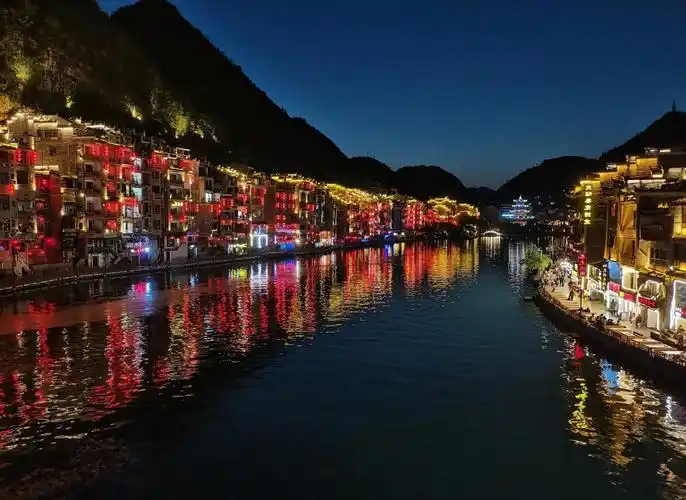
When darkness falls, the entire ensemble ignites. A coordinated lighting system illuminates the 4.8-kilometer riverside promenade, turning the S-curving waterway into a luminous ribbon. Traditional red lanterns hang above ancient lanes, their reflections shimmering on the slow-moving river like a constellation of earthly stars. A 3.6-kilometer boat cruise aboard replica wooden pleasure barges passes the Cultural Garden Square, Zhenjiang Pavilion, and the glowing cliffs of Qinglong Cave—offering perhaps the closest experience China has to a Venice gondola ride, though set against subtropical mountains rather than Mediterranean palaces.
Zhenyuan remains a living, multicultural town where Miao, Dong, Tujia, and Han Chinese communities share streets, markets, and festivals. Today, visitors rent traditional Miao or Dong costumes for atmospheric photoshoots on the lantern-lit bridges and alleys—an Instagram favorite—but the cultural depth extends far beyond photography. The riverside Heba Food Street serves regional specialties: rice tofu, fried glutinous rice cakes, Miao rice wine, and the fiery sour soup fish for which Guizhou cuisine is celebrated throughout China.
For the optimal experience, arrive at the Zhuosheng Bridge area around 7:20 PM to catch the 7:30 PM illumination moment when crowds are still thin and the first lights paint the empty streets. Allow two to three hours for exploration. Begin at Zhuosheng Bridge, walk the riverside path eastward to Qinglong Cave, then descend to Heba Food Street for dinner. During peak season (April–October and Chinese holidays), riverside walkways grow congested; consider the boat cruise as an uncrowded alternative that still showcases every key landmark from the water.
With a continuous municipal history stretching back to 202 BCE, when the Western Han Dynasty established Zhenyuan County, this ancient town predates the fall of the Roman Empire by nearly two centuries. During the Ming and Qing dynasties (1368–1912), the Wuyang River became a vital artery of the "Southern Silk Road," connecting Hunan's hinterlands with the southwestern frontier and channeling merchants, scholars, and goods between Central China and the ethnic minority regions beyond. Think of it as a Chinese counterpart to medieval Bruges or Nuremberg—a fortified trading post where Han Chinese civilization met Miao and Dong cultures, producing a unique hybrid identity that survives in every stone and timber today.
The town's architecture is a remarkable palimpsest of styles. Huizhou-style houses with their distinctive upturned eaves and whitewashed walls—comparable to the elegant merchant homes of Salzburg's old quarter—mingle with stilted Miao and Dong wooden structures. The Zhuosheng Bridge, a seven-arched stone span built during the Ming Dynasty, supports the dignified Kuixing Pavilion at its center, while the Qinglong Cave complex rises improbably from a cliff face, fusing Confucian, Buddhist, and Daoist halls in a manner reminiscent of Italy's cliffside monasteries at Subiaco. Blue-grey tiles, carved wooden balconies, and tiered rooflines cascade down the hillsides in dense, harmonious layers.
When darkness falls, the entire ensemble ignites. A coordinated lighting system illuminates the 4.8-kilometer riverside promenade, turning the S-curving waterway into a luminous ribbon. Traditional red lanterns hang above ancient lanes, their reflections shimmering on the slow-moving river like a constellation of earthly stars. A 3.6-kilometer boat cruise aboard replica wooden pleasure barges passes the Cultural Garden Square, Zhenjiang Pavilion, and the glowing cliffs of Qinglong Cave—offering perhaps the closest experience China has to a Venice gondola ride, though set against subtropical mountains rather than Mediterranean palaces.
Zhenyuan remains a living, multicultural town where Miao, Dong, Tujia, and Han Chinese communities share streets, markets, and festivals. Today, visitors rent traditional Miao or Dong costumes for atmospheric photoshoots on the lantern-lit bridges and alleys—an Instagram favorite—but the cultural depth extends far beyond photography. The riverside Heba Food Street serves regional specialties: rice tofu, fried glutinous rice cakes, Miao rice wine, and the fiery sour soup fish for which Guizhou cuisine is celebrated throughout China.
For the optimal experience, arrive at the Zhuosheng Bridge area around 7:20 PM to catch the 7:30 PM illumination moment when crowds are still thin and the first lights paint the empty streets. Allow two to three hours for exploration. Begin at Zhuosheng Bridge, walk the riverside path eastward to Qinglong Cave, then descend to Heba Food Street for dinner. During peak season (April–October and Chinese holidays), riverside walkways grow congested; consider the boat cruise as an uncrowded alternative that still showcases every key landmark from the water.