Heping Village
⭐ 3.20
Heping Village, Zhenyuan County, Qiandongnan Miao and Dong Autonomous Prefecture, Guizhou Province, China
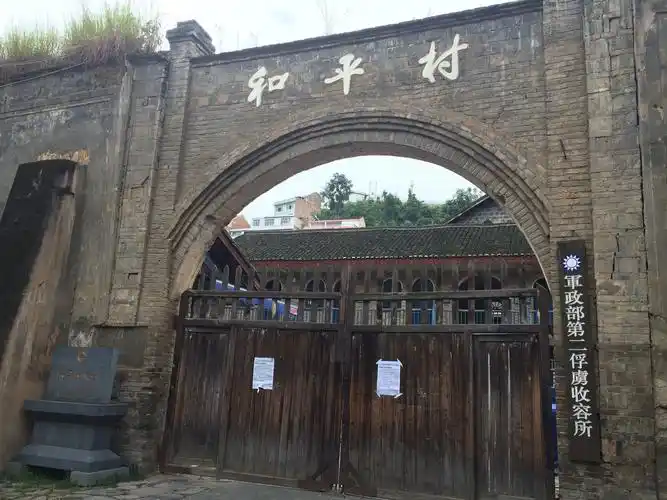 The Heping Village site carries layers of history dating to the late Qing dynasty, when it served as a garrison commander's headquarters, before becoming a Republican-era model prison. Its most significant chapter began in 1938, when the National Government converted it into the Second Japanese Prisoner-of-War Reception Center—ironically nicknamed "Peace Village" by the captives themselves. Over 600 Japanese soldiers passed through its gates during the war years. Comparable in spirit to the re-education work at Germany's Stalag camps or the famous Colditz Castle, this Chinese experiment in humane prisoner rehabilitation was distinctive: through cultural exchange and ideological re-education, the captives founded the Anti-War Revolutionary Alliance of Japanese People in China, a singular chapter in the global anti-fascist narrative.
The compound's most arresting feature is its towering earth-and-stone perimeter wall, rising roughly 8 meters high and half a meter thick—an intimidating barrier that still conveys the austere discipline of wartime detention. Within the original footprint, visitors will find reconstructed administrative offices, an assembly hall, and the hauntingly named "Mute Room," all built in the pragmatic Sino-Western hybrid style typical of Republican-era public architecture. The original layout has been carefully preserved: guard corridors, walled enclosures, and functional zones are clearly legible, allowing visitors to walk the same paths once trodden by guards and prisoners. The compact scale makes the site feel intimate rather than monumental, an atmosphere that intensifies its emotional weight.
What makes this site truly irreplaceable is its singular status as China's only intact WWII Japanese POW camp, offering tangible physical evidence of an ideological experiment rarely documented elsewhere. The museum's collections—handcrafts made by former prisoners, personal letters in Japanese, period photographs, and archival materials from the anti-war alliance—transform abstract history into human stories. Each artifact carries the weight of reflection on war and peace, inviting visitors to consider how humane treatment can dissolve the most entrenched enmity. For scholars and travelers alike, the site functions as a living textbook on pacifist reimagining, complementing rather than contradicting the more familiar narratives heard at Japan's Yasukuni Shrine debates or Nuremberg memorial sites.
The memorial sits within Zhenyuan's historic Weicheng district at 150 Heping Street, roughly 1.2 kilometers from the county government—an easy walk from any hotel in the old town. Admission is free, though visitors must register with a passport or ID card at the gate. Opening hours run daily from 8:30 a.m. to 5:30 p.m., year-round, with no closure days. Allow 40 to 60 minutes for a thorough visit. Standard guided tours are offered in Chinese; English-speaking and Japanese-speaking guides can be reserved in advance through the Zhenyuan Cultural Tourism Bureau. Because the memorial itself is relatively compact and largely static in display, plan to combine it with broader sightseeing rather than visiting alone.
A suggested itinerary begins in the morning at the spectacular Qinglongdong cliff-temple complex, where Buddhist, Confucian, and Taoist sanctuaries are fused into a single mountainside—a stunning example of religious pluralism that predates the war by centuries. After lunch, walk downhill to Heping Street to absorb the POW memorial's somber lessons, then continue to the nearby CPC Zhenyuan Branch Historic Site and the ancient Weicheng walls before strolling along the Wuyang River as Zhenyuan's lantern-lit waterfront comes alive at dusk. Remember that this is a place of solemn remembrance, not a folk-village attraction—dress and behave respectfully, and don't confuse it with the Miao and Dong ethnic villages found elsewhere in the prefecture.
The Heping Village site carries layers of history dating to the late Qing dynasty, when it served as a garrison commander's headquarters, before becoming a Republican-era model prison. Its most significant chapter began in 1938, when the National Government converted it into the Second Japanese Prisoner-of-War Reception Center—ironically nicknamed "Peace Village" by the captives themselves. Over 600 Japanese soldiers passed through its gates during the war years. Comparable in spirit to the re-education work at Germany's Stalag camps or the famous Colditz Castle, this Chinese experiment in humane prisoner rehabilitation was distinctive: through cultural exchange and ideological re-education, the captives founded the Anti-War Revolutionary Alliance of Japanese People in China, a singular chapter in the global anti-fascist narrative.
The compound's most arresting feature is its towering earth-and-stone perimeter wall, rising roughly 8 meters high and half a meter thick—an intimidating barrier that still conveys the austere discipline of wartime detention. Within the original footprint, visitors will find reconstructed administrative offices, an assembly hall, and the hauntingly named "Mute Room," all built in the pragmatic Sino-Western hybrid style typical of Republican-era public architecture. The original layout has been carefully preserved: guard corridors, walled enclosures, and functional zones are clearly legible, allowing visitors to walk the same paths once trodden by guards and prisoners. The compact scale makes the site feel intimate rather than monumental, an atmosphere that intensifies its emotional weight.
What makes this site truly irreplaceable is its singular status as China's only intact WWII Japanese POW camp, offering tangible physical evidence of an ideological experiment rarely documented elsewhere. The museum's collections—handcrafts made by former prisoners, personal letters in Japanese, period photographs, and archival materials from the anti-war alliance—transform abstract history into human stories. Each artifact carries the weight of reflection on war and peace, inviting visitors to consider how humane treatment can dissolve the most entrenched enmity. For scholars and travelers alike, the site functions as a living textbook on pacifist reimagining, complementing rather than contradicting the more familiar narratives heard at Japan's Yasukuni Shrine debates or Nuremberg memorial sites.
The memorial sits within Zhenyuan's historic Weicheng district at 150 Heping Street, roughly 1.2 kilometers from the county government—an easy walk from any hotel in the old town. Admission is free, though visitors must register with a passport or ID card at the gate. Opening hours run daily from 8:30 a.m. to 5:30 p.m., year-round, with no closure days. Allow 40 to 60 minutes for a thorough visit. Standard guided tours are offered in Chinese; English-speaking and Japanese-speaking guides can be reserved in advance through the Zhenyuan Cultural Tourism Bureau. Because the memorial itself is relatively compact and largely static in display, plan to combine it with broader sightseeing rather than visiting alone.
A suggested itinerary begins in the morning at the spectacular Qinglongdong cliff-temple complex, where Buddhist, Confucian, and Taoist sanctuaries are fused into a single mountainside—a stunning example of religious pluralism that predates the war by centuries. After lunch, walk downhill to Heping Street to absorb the POW memorial's somber lessons, then continue to the nearby CPC Zhenyuan Branch Historic Site and the ancient Weicheng walls before strolling along the Wuyang River as Zhenyuan's lantern-lit waterfront comes alive at dusk. Remember that this is a place of solemn remembrance, not a folk-village attraction—dress and behave respectfully, and don't confuse it with the Miao and Dong ethnic villages found elsewhere in the prefecture.