Huguo Temple
⭐ 3.00
Huguo Temple Scenic Area, Tianchang City, Chuzhou City, Anhui Province, China
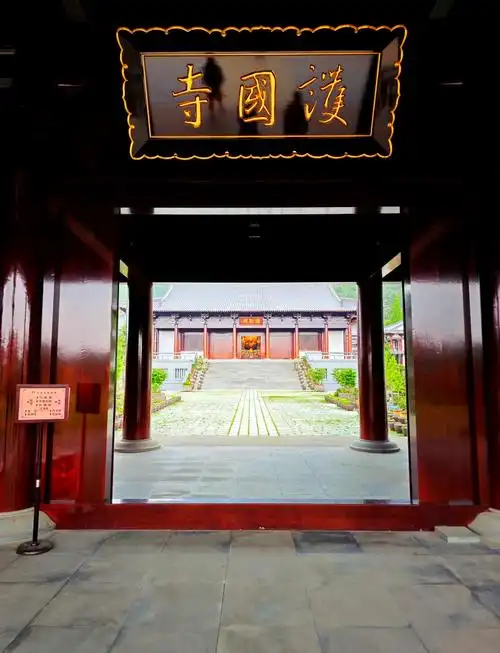 Huguo Temple was established in 1865, during the Tongzhi reign of the Qing Dynasty—an era when Empress Dowager Cixi was consolidating power in Beijing and the Taiping insurgents had only recently been crushed. While its history is modest compared to millennium-old monasteries like Kyoto's Kinkaku-ji, the temple carries deep local resonance. Its Er Xian Hall, or "Hall of Two Sages," honors Bao Zheng (999–1062), the upright Song-dynasty magistrate often compared to England's legendary Judge Jeffreys in folk imagination, alongside Zhu Shouchang, a Tianchang-born official celebrated for renouncing his post to search for his long-lost mother. Together, they embody the twin Chinese virtues of integrity and filial piety, traditions echoed in European tales of saints who sacrificed worldly success for family or justice.
The temple's architecture deliberately echoes the refined garden-monastery traditions of Suzhou and Yangzhou—cities whose classical landscapes inspired eighteenth-century Jesuit travelers to compare them to the villa gardens of Tivoli outside Rome. Within its compact 60 mu (about four hectares) footprint, visitors encounter a traditional axial Buddhist core: the Mountain Gate, Hall of Heavenly Kings, Great Treasure Hall, and Jade Buddha Tower. This central layout, mirroring the rational geometry of Renaissance monastic complexes like San Lorenzo, contrasts beautifully with the adjoining Xingyuan Garden, where willow-shaded ponds, the Yiran Pavilion, and borrowed scenery create an atmosphere akin to a small-scale Jardin de Monet at Giverny.
Culturally, Huguo Temple represents a rare fusion of Mahayana Buddhism and indigenous moral heritage. The presence of a "Fairy Footprint" curiosity stone beside Qing-dynasty guardian lions—a pairing reminiscent of medieval European cathedrals where pagan symbols were repurposed into Christian iconography—signals this layered spiritual landscape. The temple has earned recognition as a national 2A scenic site and a provincial-level open monastery, but it retains the feel of a working community place of worship rather than a museum.
Practicalities make this an effortless stop. Entry costs only 8 yuan and includes incense; the temple opens daily from 8:00 a.m. to noon and again from 2:00 to 6:00 p.m. Located centrally in Tianchang with straightforward access from anywhere in town, it is best explored in flat-soled shoes along the stone-paved paths in roughly 60 to 90 minutes. Free incense is provided at the entrance, vegetarian meals are available for visitors, and the grounds lack large commercial concessions, so bringing water is recommended. Mosquito repellent helps in summer, and visitors should observe silence and avoid photographing Buddha statues directly.
Why make the detour? Huguo Temple rewards travelers who prefer intimacy to grandeur. Where famous sites like Beijing's Lama Temple or Luoyang's Longmen draw crowds measured in thousands, this pocket-sized sanctuary offers the contemplative charm of a Cistercian abbey tucked into a Tuscan hillside—an authentic, living piece of Anhui's religious and ethical heritage, all for the price of a coffee.
Huguo Temple was established in 1865, during the Tongzhi reign of the Qing Dynasty—an era when Empress Dowager Cixi was consolidating power in Beijing and the Taiping insurgents had only recently been crushed. While its history is modest compared to millennium-old monasteries like Kyoto's Kinkaku-ji, the temple carries deep local resonance. Its Er Xian Hall, or "Hall of Two Sages," honors Bao Zheng (999–1062), the upright Song-dynasty magistrate often compared to England's legendary Judge Jeffreys in folk imagination, alongside Zhu Shouchang, a Tianchang-born official celebrated for renouncing his post to search for his long-lost mother. Together, they embody the twin Chinese virtues of integrity and filial piety, traditions echoed in European tales of saints who sacrificed worldly success for family or justice.
The temple's architecture deliberately echoes the refined garden-monastery traditions of Suzhou and Yangzhou—cities whose classical landscapes inspired eighteenth-century Jesuit travelers to compare them to the villa gardens of Tivoli outside Rome. Within its compact 60 mu (about four hectares) footprint, visitors encounter a traditional axial Buddhist core: the Mountain Gate, Hall of Heavenly Kings, Great Treasure Hall, and Jade Buddha Tower. This central layout, mirroring the rational geometry of Renaissance monastic complexes like San Lorenzo, contrasts beautifully with the adjoining Xingyuan Garden, where willow-shaded ponds, the Yiran Pavilion, and borrowed scenery create an atmosphere akin to a small-scale Jardin de Monet at Giverny.
Culturally, Huguo Temple represents a rare fusion of Mahayana Buddhism and indigenous moral heritage. The presence of a "Fairy Footprint" curiosity stone beside Qing-dynasty guardian lions—a pairing reminiscent of medieval European cathedrals where pagan symbols were repurposed into Christian iconography—signals this layered spiritual landscape. The temple has earned recognition as a national 2A scenic site and a provincial-level open monastery, but it retains the feel of a working community place of worship rather than a museum.
Practicalities make this an effortless stop. Entry costs only 8 yuan and includes incense; the temple opens daily from 8:00 a.m. to noon and again from 2:00 to 6:00 p.m. Located centrally in Tianchang with straightforward access from anywhere in town, it is best explored in flat-soled shoes along the stone-paved paths in roughly 60 to 90 minutes. Free incense is provided at the entrance, vegetarian meals are available for visitors, and the grounds lack large commercial concessions, so bringing water is recommended. Mosquito repellent helps in summer, and visitors should observe silence and avoid photographing Buddha statues directly.
Why make the detour? Huguo Temple rewards travelers who prefer intimacy to grandeur. Where famous sites like Beijing's Lama Temple or Luoyang's Longmen draw crowds measured in thousands, this pocket-sized sanctuary offers the contemplative charm of a Cistercian abbey tucked into a Tuscan hillside—an authentic, living piece of Anhui's religious and ethical heritage, all for the price of a coffee.