Feishan Pavilion
⭐ 3.80
Feishan Pavilion, Zhenyuan County, Qiandongnan Miao and Dong Autonomous Prefecture, Guizhou Province, China
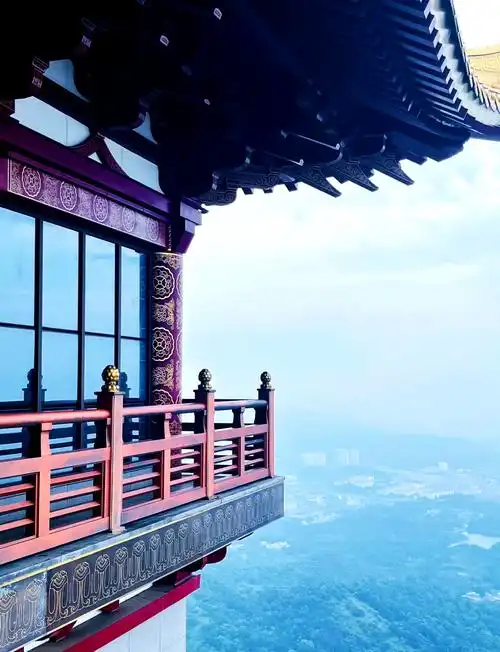 The pavilion traces its origins to 1769 during the Qianlong Emperor's long reign, while the surviving tower itself dates to a late-Qing reconstruction in the nineteenth century. It honors Yang Zaisi, a chieftain of Cheng Prefecture during the Five Dynasties and Ten Kingdoms period (907–979 CE) — a turbulent age that corresponds to Europe's Saxon and early Carolingian era, when local warlords held sway across fragmented territories. Enshrined as the "Feishan God," Yang is venerated by Miao, Dong, and Han settlers alike. This cross-ethnic devotion parallels the way medieval European saints drew worshippers from rival villages, binding distinct mountain communities beneath one shared shrine.
Rising 24.8 meters — roughly the height of an eight-story building — the four-story tower with its triple-eaved, pyramid-shaped roof ranks as the loftiest surviving wooden structure in Guizhou. The builders employed the chuandou system of timber-frame construction, fitting each beam with interlocking mortise-and-tenon joints so precisely that not a single iron nail was used. The technique evokes the half-timbered Fachwerk houses of medieval Germany or the all-wooden pagodas of Japan, yet here the craftsmanship was raised in a humid subtropical climate where decay is relentless. Delicate window latticework in ice-crack and swastika-fret patterns, plus gracefully upturned eaves that seem to lift skyward, reward close inspection.
The temple complex is more than a religious site — it stands as a monument to the timber trade that once prospered along the Qingshui River. From the Ming dynasty onward, enormous rafts of prized Chinese fir floated downstream to Han ports, in a story reminiscent of the Hanseatic League's commerce along the Baltic or the great log drives of North America's Mississippi. Miao and Dong merchants, boatmen, and villagers who profited from this traffic prayed at Feishan for safe passage and prosperity. Among the dozens of drum towers and wind-rain bridges that dot southeast Guizhou, the pavilion holds a singular place as the spiritual epicenter of an inter-ethnic folk religion that has endured for over a millennium.
The pavilion sits on the northeastern edge of Jinping town, a small county seat tucked into the river's bend. Opening hours run from 09:00 to 16:00 daily, with free admission upon registration at the entrance. Some interior sections are restricted, and photography is prohibited in those zones — simply follow staff instructions. Two cautions apply: no smoking or open flames are permitted inside, and the wooden staircase is notably steep and narrow. Elderly visitors and small children should be accompanied, and sturdy flat shoes are strongly recommended over sandals or heels. English signage is minimal, so a translation app proves helpful.
Plan to combine the pavilion with a half-day circuit through the surrounding river valley. The nearby Longli Ancient Town, a Ming-era military hamlet once garrisoned to pacify the Miao, offers cobbled lanes and weathered brick gateways reminiscent of an Italian hill village. The mellow light of early morning or late afternoon is best for photographers capturing the tower's soaring silhouette. Avoid the 18th day of the sixth lunar month, when the annual Feishan Temple Fair swells the crowds far beyond the pavilion's quiet weekday atmosphere.
The pavilion traces its origins to 1769 during the Qianlong Emperor's long reign, while the surviving tower itself dates to a late-Qing reconstruction in the nineteenth century. It honors Yang Zaisi, a chieftain of Cheng Prefecture during the Five Dynasties and Ten Kingdoms period (907–979 CE) — a turbulent age that corresponds to Europe's Saxon and early Carolingian era, when local warlords held sway across fragmented territories. Enshrined as the "Feishan God," Yang is venerated by Miao, Dong, and Han settlers alike. This cross-ethnic devotion parallels the way medieval European saints drew worshippers from rival villages, binding distinct mountain communities beneath one shared shrine.
Rising 24.8 meters — roughly the height of an eight-story building — the four-story tower with its triple-eaved, pyramid-shaped roof ranks as the loftiest surviving wooden structure in Guizhou. The builders employed the chuandou system of timber-frame construction, fitting each beam with interlocking mortise-and-tenon joints so precisely that not a single iron nail was used. The technique evokes the half-timbered Fachwerk houses of medieval Germany or the all-wooden pagodas of Japan, yet here the craftsmanship was raised in a humid subtropical climate where decay is relentless. Delicate window latticework in ice-crack and swastika-fret patterns, plus gracefully upturned eaves that seem to lift skyward, reward close inspection.
The temple complex is more than a religious site — it stands as a monument to the timber trade that once prospered along the Qingshui River. From the Ming dynasty onward, enormous rafts of prized Chinese fir floated downstream to Han ports, in a story reminiscent of the Hanseatic League's commerce along the Baltic or the great log drives of North America's Mississippi. Miao and Dong merchants, boatmen, and villagers who profited from this traffic prayed at Feishan for safe passage and prosperity. Among the dozens of drum towers and wind-rain bridges that dot southeast Guizhou, the pavilion holds a singular place as the spiritual epicenter of an inter-ethnic folk religion that has endured for over a millennium.
The pavilion sits on the northeastern edge of Jinping town, a small county seat tucked into the river's bend. Opening hours run from 09:00 to 16:00 daily, with free admission upon registration at the entrance. Some interior sections are restricted, and photography is prohibited in those zones — simply follow staff instructions. Two cautions apply: no smoking or open flames are permitted inside, and the wooden staircase is notably steep and narrow. Elderly visitors and small children should be accompanied, and sturdy flat shoes are strongly recommended over sandals or heels. English signage is minimal, so a translation app proves helpful.
Plan to combine the pavilion with a half-day circuit through the surrounding river valley. The nearby Longli Ancient Town, a Ming-era military hamlet once garrisoned to pacify the Miao, offers cobbled lanes and weathered brick gateways reminiscent of an Italian hill village. The mellow light of early morning or late afternoon is best for photographers capturing the tower's soaring silhouette. Avoid the 18th day of the sixth lunar month, when the annual Feishan Temple Fair swells the crowds far beyond the pavilion's quiet weekday atmosphere.