Qinglong Cave
⭐ 4.40
Qinglong Cave, Zhenyuan County, Qiandongnan Miao and Dong Autonomous Prefecture, Guizhou Province, China
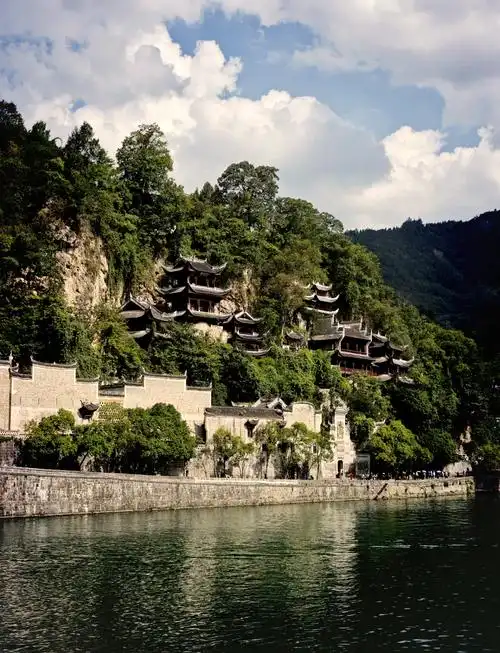 **A Cliffside Sanctuary Six Centuries in the Making**
Qinglong Cave's story begins in 1388, when Ming Dynasty builders began carving a spiritual complex into the 80-meter limestone cliffs overlooking the Wuyang River. While Europe was still fighting the Hundred Years' War and the Black Death was reshaping the continent, this remote corner of southwestern China was already producing sophisticated sacred architecture. Designated a National Key Cultural Relic in 1988, the 21,000-square-meter site contains 36 timber structures added and refined over the Ming and Qing dynasties, making it one of the most complete surviving examples of cliff-built religious architecture in East Asia.
**A Feat of Engineering Comparable to Meteora**
The construction techniques here will remind visitors of Greece's Meteora monasteries or the Italian cliff-dwelling towns of the Cinque Terre. Master builders used cantilevered supports, borrowed ledges, and clever integration with natural caves to create the illusion of buildings floating in mid-air. The signature phrase "buildings within caves, caves within buildings" captures the surreal quality of the place—timber halls actually nest inside the cliff's natural hollows, with prayer halls rising several stories above. The result is a vertiginous, photogenic labyrinth that has long drawn architecture enthusiasts from across the globe.
**Three Faiths, One Cliff Face**
What truly distinguishes Qinglong Cave is its role as a living museum of religious pluralism. On a single wall stand the Buddhist Zhongyuan Monastery, the Taoist Qinglong Temple and Jade Emperor Hall, the Confucian Ziyang Academy, and the Wanshou Guild Hall built by Hui merchants. While Europe was burning heretics and staging the Thirty Years' War, this Chinese cliff quietly assembled a working model of "harmony in diversity." Look for the exquisite wooden carvings of the Yang Generals in the Wanshou opera stage, the stele forest at Ziyang Academy, and the calligraphic couplets adorning Kuixing Pavilion on the historic Zhusheng Bridge.
**Planning Your Visit**
Entry costs around 60 RMB, with a combined ticket including nearby Shiping Mountain for about 80 RMB—well worth the small premium. The site opens 8:00 to 17:30 (last ticket 17:00) and easily fills 1.5 to 2 hours. Expect steep stone staircases, dim corridors, and uneven lighting throughout—comfortable shoes are essential, and visitors with mobility issues should consider hiring assistance. Photography is generally prohibited inside the halls, so absorb the interiors with your eyes. Hiring a local guide is highly recommended; the layered symbolism hidden in every beam and carving is easy to miss without interpretation.
**Making the Most of the Day**
Enter via the photogenic Zhusheng Bridge at the river and follow the "Buddhist–Confucian–Taoist" axis upward, circling down through the back-trail to avoid backtracking. Time your ascent to the Wangjiang Tower for late afternoon, when the Wuyang River traces its dramatic S-curve through old Zhenyuan—the golden-hour light on the rooftops and the river below is the most photographed view in the region. If you still have energy, return after dark for the nightly riverside illumination (19:00–22:00), when the entire cliff face glows with reflected lantern light.
**A Cliffside Sanctuary Six Centuries in the Making**
Qinglong Cave's story begins in 1388, when Ming Dynasty builders began carving a spiritual complex into the 80-meter limestone cliffs overlooking the Wuyang River. While Europe was still fighting the Hundred Years' War and the Black Death was reshaping the continent, this remote corner of southwestern China was already producing sophisticated sacred architecture. Designated a National Key Cultural Relic in 1988, the 21,000-square-meter site contains 36 timber structures added and refined over the Ming and Qing dynasties, making it one of the most complete surviving examples of cliff-built religious architecture in East Asia.
**A Feat of Engineering Comparable to Meteora**
The construction techniques here will remind visitors of Greece's Meteora monasteries or the Italian cliff-dwelling towns of the Cinque Terre. Master builders used cantilevered supports, borrowed ledges, and clever integration with natural caves to create the illusion of buildings floating in mid-air. The signature phrase "buildings within caves, caves within buildings" captures the surreal quality of the place—timber halls actually nest inside the cliff's natural hollows, with prayer halls rising several stories above. The result is a vertiginous, photogenic labyrinth that has long drawn architecture enthusiasts from across the globe.
**Three Faiths, One Cliff Face**
What truly distinguishes Qinglong Cave is its role as a living museum of religious pluralism. On a single wall stand the Buddhist Zhongyuan Monastery, the Taoist Qinglong Temple and Jade Emperor Hall, the Confucian Ziyang Academy, and the Wanshou Guild Hall built by Hui merchants. While Europe was burning heretics and staging the Thirty Years' War, this Chinese cliff quietly assembled a working model of "harmony in diversity." Look for the exquisite wooden carvings of the Yang Generals in the Wanshou opera stage, the stele forest at Ziyang Academy, and the calligraphic couplets adorning Kuixing Pavilion on the historic Zhusheng Bridge.
**Planning Your Visit**
Entry costs around 60 RMB, with a combined ticket including nearby Shiping Mountain for about 80 RMB—well worth the small premium. The site opens 8:00 to 17:30 (last ticket 17:00) and easily fills 1.5 to 2 hours. Expect steep stone staircases, dim corridors, and uneven lighting throughout—comfortable shoes are essential, and visitors with mobility issues should consider hiring assistance. Photography is generally prohibited inside the halls, so absorb the interiors with your eyes. Hiring a local guide is highly recommended; the layered symbolism hidden in every beam and carving is easy to miss without interpretation.
**Making the Most of the Day**
Enter via the photogenic Zhusheng Bridge at the river and follow the "Buddhist–Confucian–Taoist" axis upward, circling down through the back-trail to avoid backtracking. Time your ascent to the Wangjiang Tower for late afternoon, when the Wuyang River traces its dramatic S-curve through old Zhenyuan—the golden-hour light on the rooftops and the river below is the most photographed view in the region. If you still have energy, return after dark for the nightly riverside illumination (19:00–22:00), when the entire cliff face glows with reflected lantern light.