Ordos Desert Park
⭐ 4.20
Ordos Desert Park, Otog Front Banner, Ordos City, Inner Mongolia Autonomous Region, China
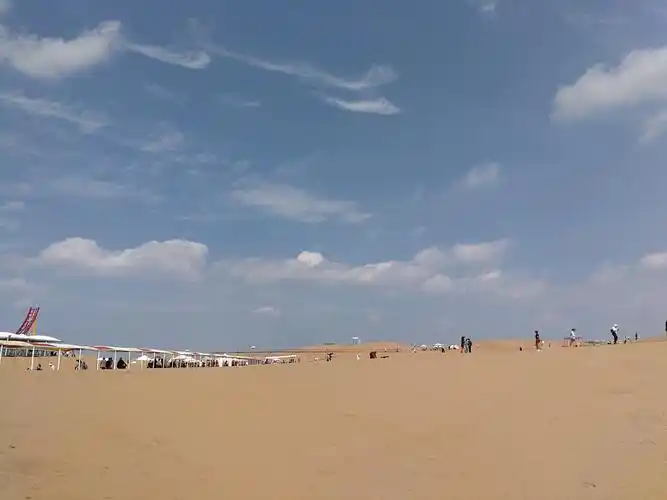 Once among China's most severe desertification zones, the Kubuqi Desert now hosts the United Nations' permanent forum on combating desertification—a transformation spanning more than three decades that mirrors the rehabilitation efforts along Africa's Sahel region. The park has become a worldwide case study in sustainable land recovery, attracting researchers and eco-tourists eager to witness how systematic reforestation and sand-fixing technology have turned encroaching dunes into a livable ecosystem.
The landscape itself reads like a chapter from a geography textbook brought vividly to life. Seven pristine lakes scatter across the sand sea in a near-perfect celestial alignment, recalling the constellation that gives the area its name. This improbable marriage of dune and lake—one might liken it to an oasis the size of a small country—supports wetlands, meadows, and migratory bird populations. Photographers flock here for the warm honey-and-rose hues that wash across the dunes at dawn and dusk, while the complete absence of urban light pollution reveals the Milky Way in stunning clarity.
Activities cater to a wide range of travelers and energy levels. Adventurous guests can ride Bactrian camels across the ridges, tear through the sand in 4x4 buggies, slide down dune slopes on sandboards, or skim the lakes on water-propelled jetboards. A Desert Science Museum and a working photovoltaic sand-control station reveal the cutting-edge techniques behind the region's revival, making the park especially rewarding for school groups and curious minds of all ages.
Accommodations match the setting: a desert hotel, grassland walking paths, and glamping sites allow for an immersive multi-day stay. The complex is roughly 260 kilometers from Ordos city in Inner Mongolia's Hanggin Banner, most easily reached by rental car or hired driver. Entry runs 100–150 yuan per person, with select activities charged separately. Summer hours run 08:00–18:00, with extended stargazing access until 23:00.
Plan for at least half a day, though two days unlocks the full experience. Visit in summer at dusk for sunset over the dunes, then stay for the night sky. Pack SPF 30+ sunscreen, a wide-brimmed hat, and a face scarf against blowing sand. Phone signal weakens deep in the dunes—download offline maps and carry small cash. English signage is limited, so booking an English-speaking guide in advance, or using a translation app, will greatly enrich your visit.
[DETAILED]
[BRIEF]
Ordos Desert Park, set within the once-devastated Kubuqi Desert, stands as a global model of ecological restoration—comparable in ambition to Africa's Great Green Wall project. Centered on the Seven Star Lake scenic area, seven crystal-clear lakes form a Big Dipper pattern amid rolling dunes, creating the rare phenomenon of sand and water coexisting in harmony. Designated a 4A-rated resort, it offers camel rides, dune-bashing, and stargazing under some of China's darkest night skies. Now the permanent home of the UN Kubuqi International Desert Forum, it welcomes visitors to witness a 30-year transformation from wasteland to oasis.
[DETAILED]
Once among China's most severe desertification zones, the Kubuqi Desert now hosts the United Nations' permanent forum on combating desertification—a transformation spanning more than three decades that mirrors the rehabilitation efforts along Africa's Sahel region. The park has become a worldwide case study in sustainable land recovery, attracting researchers and eco-tourists eager to witness how systematic reforestation and sand-fixing technology have turned encroaching dunes into a livable ecosystem.
The landscape itself reads like a chapter from a geography textbook brought vividly to life. Seven pristine lakes scatter across the sand sea in a near-perfect celestial alignment, recalling the constellation that gives the area its name. This improbable marriage of dune and lake—one might liken it to an oasis the size of a small country—supports wetlands, meadows, and migratory bird populations. Photographers flock here for the warm honey-and-rose hues that wash across the dunes at dawn and dusk, while the complete absence of urban light pollution reveals the Milky Way in stunning clarity.
Activities cater to a wide range of travelers and energy levels. Adventurous guests can ride Bactrian camels across the ridges, tear through the sand in 4x4 buggies, slide down dune slopes on sandboards, or skim the lakes on water-propelled jetboards. A Desert Science Museum and a working photovoltaic sand-control station reveal the cutting-edge techniques behind the region's revival, making the park especially rewarding for school groups and curious minds of all ages.
Accommodations match the setting: a desert hotel, grassland walking paths, and glamping sites allow for an immersive multi-day stay. The complex is roughly 260 kilometers from Ordos city in Inner Mongolia's Hanggin Banner, most easily reached by rental car or hired driver. Entry runs 100–150 yuan per person, with select activities charged separately. Summer hours run 08:00–18:00, with extended stargazing access until 23:00.
Plan for at least half a day, though two days unlocks the full experience. Visit in summer at dusk for sunset over the dunes, then stay for the night sky. Pack SPF 30+ sunscreen, a wide-brimmed hat, and a face scarf against blowing sand. Phone signal weakens deep in the dunes—download offline maps and carry small cash. English signage is limited, so booking an English-speaking guide in advance, or using a translation app, will greatly enrich your visit.</mm:think>[BRIEF]
Ordos Desert Park, set within the once-devastated Kubuqi Desert, stands as a global model of ecological restoration—comparable in ambition to Africa's Great Green Wall project. Centered on the Seven Star Lake scenic area, seven crystal-clear lakes form a Big Dipper pattern amid rolling dunes, creating the rare phenomenon of sand and water coexisting in harmony. Designated a 4A-rated resort, it offers camel rides, dune-bashing, and stargazing under some of China's darkest night skies. Now the permanent home of the UN Kubuqi International Desert Forum, it welcomes visitors to witness a 30-year transformation from wasteland to oasis.
[DETAILED]
Once among China's most severe desertification zones, the Kubuqi Desert now hosts the United Nations' permanent forum on combating desertification—a transformation spanning more than three decades that mirrors the rehabilitation efforts along Africa's Sahel region. The park has become a worldwide case study in sustainable land recovery, attracting researchers and eco-tourists eager to witness how systematic reforestation and sand-fixing technology have turned encroaching dunes into a livable ecosystem.
The landscape itself reads like a chapter from a geography textbook brought vividly to life. Seven pristine lakes scatter across the sand sea in a near-perfect celestial alignment, recalling the constellation that gives the area its name. This improbable marriage of dune and lake—one might liken it to an oasis the size of a small country—supports wetlands, meadows, and migratory bird populations. Photographers flock here for the warm honey-and-rose hues that wash across the dunes at dawn and dusk, while the complete absence of urban light pollution reveals the Milky Way in stunning clarity.
Activities cater to a wide range of travelers and energy levels. Adventurous guests can ride Bactrian camels across the ridges, tear through the sand in 4x4 buggies, slide down dune slopes on sandboards, or skim the lakes on water-propelled jetboards. A Desert Science Museum and a working photovoltaic sand-control station reveal the cutting-edge techniques behind the region's revival, making the park especially rewarding for school groups and curious minds of all ages.
Accommodations match the setting: a desert hotel, grassland walking paths, and glamping sites allow for an immersive multi-day stay. The complex is roughly 260 kilometers from Ordos city in Inner Mongolia's Hanggin Banner, most easily reached by rental car or hired driver. Entry runs 100–150 yuan per person, with select activities charged separately. Summer hours run 08:00–18:00, with extended stargazing access until 23:00.
Plan for at least half a day, though two days unlocks the full experience. Visit in summer at dusk for sunset over the dunes, then stay for the night sky. Pack SPF 30+ sunscreen, a wide-brimmed hat, and a face scarf against blowing sand. Phone signal weakens deep in the dunes—download offline maps and carry small cash. English signage is limited, so booking an English-speaking guide in advance, or using a translation app, will greatly enrich your visit.
Once among China's most severe desertification zones, the Kubuqi Desert now hosts the United Nations' permanent forum on combating desertification—a transformation spanning more than three decades that mirrors the rehabilitation efforts along Africa's Sahel region. The park has become a worldwide case study in sustainable land recovery, attracting researchers and eco-tourists eager to witness how systematic reforestation and sand-fixing technology have turned encroaching dunes into a livable ecosystem.
The landscape itself reads like a chapter from a geography textbook brought vividly to life. Seven pristine lakes scatter across the sand sea in a near-perfect celestial alignment, recalling the constellation that gives the area its name. This improbable marriage of dune and lake—one might liken it to an oasis the size of a small country—supports wetlands, meadows, and migratory bird populations. Photographers flock here for the warm honey-and-rose hues that wash across the dunes at dawn and dusk, while the complete absence of urban light pollution reveals the Milky Way in stunning clarity.
Activities cater to a wide range of travelers and energy levels. Adventurous guests can ride Bactrian camels across the ridges, tear through the sand in 4x4 buggies, slide down dune slopes on sandboards, or skim the lakes on water-propelled jetboards. A Desert Science Museum and a working photovoltaic sand-control station reveal the cutting-edge techniques behind the region's revival, making the park especially rewarding for school groups and curious minds of all ages.
Accommodations match the setting: a desert hotel, grassland walking paths, and glamping sites allow for an immersive multi-day stay. The complex is roughly 260 kilometers from Ordos city in Inner Mongolia's Hanggin Banner, most easily reached by rental car or hired driver. Entry runs 100–150 yuan per person, with select activities charged separately. Summer hours run 08:00–18:00, with extended stargazing access until 23:00.
Plan for at least half a day, though two days unlocks the full experience. Visit in summer at dusk for sunset over the dunes, then stay for the night sky. Pack SPF 30+ sunscreen, a wide-brimmed hat, and a face scarf against blowing sand. Phone signal weakens deep in the dunes—download offline maps and carry small cash. English signage is limited, so booking an English-speaking guide in advance, or using a translation app, will greatly enrich your visit.
[DETAILED]
[BRIEF]
Ordos Desert Park, set within the once-devastated Kubuqi Desert, stands as a global model of ecological restoration—comparable in ambition to Africa's Great Green Wall project. Centered on the Seven Star Lake scenic area, seven crystal-clear lakes form a Big Dipper pattern amid rolling dunes, creating the rare phenomenon of sand and water coexisting in harmony. Designated a 4A-rated resort, it offers camel rides, dune-bashing, and stargazing under some of China's darkest night skies. Now the permanent home of the UN Kubuqi International Desert Forum, it welcomes visitors to witness a 30-year transformation from wasteland to oasis.
[DETAILED]
Once among China's most severe desertification zones, the Kubuqi Desert now hosts the United Nations' permanent forum on combating desertification—a transformation spanning more than three decades that mirrors the rehabilitation efforts along Africa's Sahel region. The park has become a worldwide case study in sustainable land recovery, attracting researchers and eco-tourists eager to witness how systematic reforestation and sand-fixing technology have turned encroaching dunes into a livable ecosystem.
The landscape itself reads like a chapter from a geography textbook brought vividly to life. Seven pristine lakes scatter across the sand sea in a near-perfect celestial alignment, recalling the constellation that gives the area its name. This improbable marriage of dune and lake—one might liken it to an oasis the size of a small country—supports wetlands, meadows, and migratory bird populations. Photographers flock here for the warm honey-and-rose hues that wash across the dunes at dawn and dusk, while the complete absence of urban light pollution reveals the Milky Way in stunning clarity.
Activities cater to a wide range of travelers and energy levels. Adventurous guests can ride Bactrian camels across the ridges, tear through the sand in 4x4 buggies, slide down dune slopes on sandboards, or skim the lakes on water-propelled jetboards. A Desert Science Museum and a working photovoltaic sand-control station reveal the cutting-edge techniques behind the region's revival, making the park especially rewarding for school groups and curious minds of all ages.
Accommodations match the setting: a desert hotel, grassland walking paths, and glamping sites allow for an immersive multi-day stay. The complex is roughly 260 kilometers from Ordos city in Inner Mongolia's Hanggin Banner, most easily reached by rental car or hired driver. Entry runs 100–150 yuan per person, with select activities charged separately. Summer hours run 08:00–18:00, with extended stargazing access until 23:00.
Plan for at least half a day, though two days unlocks the full experience. Visit in summer at dusk for sunset over the dunes, then stay for the night sky. Pack SPF 30+ sunscreen, a wide-brimmed hat, and a face scarf against blowing sand. Phone signal weakens deep in the dunes—download offline maps and carry small cash. English signage is limited, so booking an English-speaking guide in advance, or using a translation app, will greatly enrich your visit.</mm:think>[BRIEF]
Ordos Desert Park, set within the once-devastated Kubuqi Desert, stands as a global model of ecological restoration—comparable in ambition to Africa's Great Green Wall project. Centered on the Seven Star Lake scenic area, seven crystal-clear lakes form a Big Dipper pattern amid rolling dunes, creating the rare phenomenon of sand and water coexisting in harmony. Designated a 4A-rated resort, it offers camel rides, dune-bashing, and stargazing under some of China's darkest night skies. Now the permanent home of the UN Kubuqi International Desert Forum, it welcomes visitors to witness a 30-year transformation from wasteland to oasis.
[DETAILED]
Once among China's most severe desertification zones, the Kubuqi Desert now hosts the United Nations' permanent forum on combating desertification—a transformation spanning more than three decades that mirrors the rehabilitation efforts along Africa's Sahel region. The park has become a worldwide case study in sustainable land recovery, attracting researchers and eco-tourists eager to witness how systematic reforestation and sand-fixing technology have turned encroaching dunes into a livable ecosystem.
The landscape itself reads like a chapter from a geography textbook brought vividly to life. Seven pristine lakes scatter across the sand sea in a near-perfect celestial alignment, recalling the constellation that gives the area its name. This improbable marriage of dune and lake—one might liken it to an oasis the size of a small country—supports wetlands, meadows, and migratory bird populations. Photographers flock here for the warm honey-and-rose hues that wash across the dunes at dawn and dusk, while the complete absence of urban light pollution reveals the Milky Way in stunning clarity.
Activities cater to a wide range of travelers and energy levels. Adventurous guests can ride Bactrian camels across the ridges, tear through the sand in 4x4 buggies, slide down dune slopes on sandboards, or skim the lakes on water-propelled jetboards. A Desert Science Museum and a working photovoltaic sand-control station reveal the cutting-edge techniques behind the region's revival, making the park especially rewarding for school groups and curious minds of all ages.
Accommodations match the setting: a desert hotel, grassland walking paths, and glamping sites allow for an immersive multi-day stay. The complex is roughly 260 kilometers from Ordos city in Inner Mongolia's Hanggin Banner, most easily reached by rental car or hired driver. Entry runs 100–150 yuan per person, with select activities charged separately. Summer hours run 08:00–18:00, with extended stargazing access until 23:00.
Plan for at least half a day, though two days unlocks the full experience. Visit in summer at dusk for sunset over the dunes, then stay for the night sky. Pack SPF 30+ sunscreen, a wide-brimmed hat, and a face scarf against blowing sand. Phone signal weakens deep in the dunes—download offline maps and carry small cash. English signage is limited, so booking an English-speaking guide in advance, or using a translation app, will greatly enrich your visit.