Kubuqi Desert
⭐ 4.50
Ordos City, Inner Mongolia, China
 Kubuqi Desert stretches roughly 18,000 square kilometers across the northern Ordos Plateau, a landscape whose scale rivals the great dunes of the Sahara or Namibia's Sossusvlei. Its name means "bowstring" in Mongolian, evoking the crescent shape visible from above. For millennia this region served as homeland to nomadic herders, and archaeologists have unearthed Bronze Age artifacts linking it to the broader Eurasian steppe cultures that stretched from Mongolia to Hungary. Today, after 30 years of dedicated greening efforts, nearly a third of the desert has been reclaimed — an achievement drawing comparison to Israel's Negev rehabilitation and standing as a global model for combating desertification.
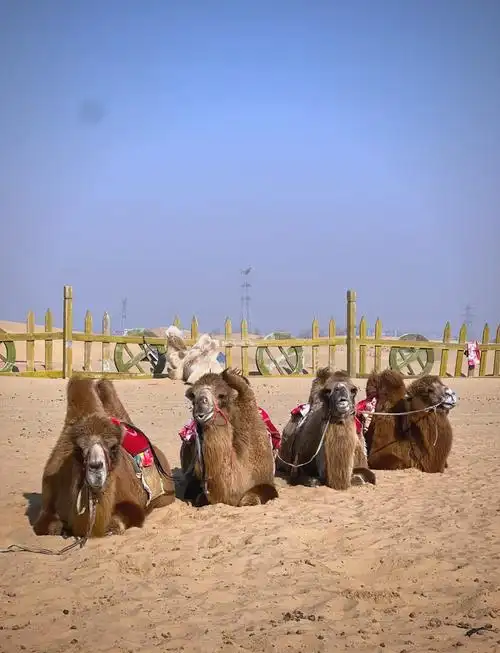
Xiangshawan (Singing Sands Bay), a 5A-rated scenic area on the desert's eastern edge, derives its name from the resonant hum produced when dry sand cascades down its slopes, a phenomenon so rare it shares kinship with Japan's legendary "singing" beaches. The dunes here rise in rolling waves of fine gold sand, traversed by cable cars that recall Alpine ski lifts. Visitors enjoy camel caravans, dune buggies, and sand-surfing, while evenings bring the lavish outdoor pageant "The Ordos Wedding," an operatic celebration of Mongolian nuptial traditions. On-site lodging ranges from the futuristic莲花 (Lotus) Hotel to traditional yurts, both delivering immersive desert nights.
Seven Star Lake nestles deep within the desert's heart, where seven shimmering saline pools mirror the Big Dipper's pattern — earning comparisons to Tunisia's desert oases or Egypt's Siwa. Far from urban light pollution, the site has become a pilgrimage point for astrophotographers; on moonless nights the Milky Way arcs overhead with startling clarity. Surrounding wetlands support migratory birds and, remarkably, solar farms that power the very restoration efforts that allow the greenery to thrive. Light hiking trails and quiet camping platforms invite contemplative exploration.
The region pulses with authentic Mongolian heritage. Travelers can sample hand-pulled mutton, butter tea, and airag (fermented mare's milk) — flavors echoing the nomadic feasts described by Marco Polo. Local hosts host traditional Naadam-style games featuring archery, wrestling, and horse racing, echoing festivities that date back to Genghis Khan's era. Handicraft markets sell snuff bottles, silver ornaments, and felt textiles that connect visitors to centuries of steppe artistry.
Practical planning rewards careful preparation. Visit April–May or September–October for mild temperatures around 20–25°C; August can scorch above 40°C with surface sand exceeding 60°C. Pack high-SPF sunscreen, sunglasses, a face-covering shemagh, sand gaiters, and a warm layer for evenings when desert temperatures plummet. Self-driving offers the most flexibility — navigate to Xiangshawan Visitor Center or Seven Star Lake Tourist Area — though high-speed rail to Dalad West Station from Hohhot or Baotou works well; private cars are banned inside the parks, with cable cars and shuttles providing access. Beware unlicensed taxis at scenic gates. Base tickets exclude activities, so bundle multi-attraction passes for value.
Kubuqi Desert stretches roughly 18,000 square kilometers across the northern Ordos Plateau, a landscape whose scale rivals the great dunes of the Sahara or Namibia's Sossusvlei. Its name means "bowstring" in Mongolian, evoking the crescent shape visible from above. For millennia this region served as homeland to nomadic herders, and archaeologists have unearthed Bronze Age artifacts linking it to the broader Eurasian steppe cultures that stretched from Mongolia to Hungary. Today, after 30 years of dedicated greening efforts, nearly a third of the desert has been reclaimed — an achievement drawing comparison to Israel's Negev rehabilitation and standing as a global model for combating desertification.
Xiangshawan (Singing Sands Bay), a 5A-rated scenic area on the desert's eastern edge, derives its name from the resonant hum produced when dry sand cascades down its slopes, a phenomenon so rare it shares kinship with Japan's legendary "singing" beaches. The dunes here rise in rolling waves of fine gold sand, traversed by cable cars that recall Alpine ski lifts. Visitors enjoy camel caravans, dune buggies, and sand-surfing, while evenings bring the lavish outdoor pageant "The Ordos Wedding," an operatic celebration of Mongolian nuptial traditions. On-site lodging ranges from the futuristic莲花 (Lotus) Hotel to traditional yurts, both delivering immersive desert nights.
Seven Star Lake nestles deep within the desert's heart, where seven shimmering saline pools mirror the Big Dipper's pattern — earning comparisons to Tunisia's desert oases or Egypt's Siwa. Far from urban light pollution, the site has become a pilgrimage point for astrophotographers; on moonless nights the Milky Way arcs overhead with startling clarity. Surrounding wetlands support migratory birds and, remarkably, solar farms that power the very restoration efforts that allow the greenery to thrive. Light hiking trails and quiet camping platforms invite contemplative exploration.
The region pulses with authentic Mongolian heritage. Travelers can sample hand-pulled mutton, butter tea, and airag (fermented mare's milk) — flavors echoing the nomadic feasts described by Marco Polo. Local hosts host traditional Naadam-style games featuring archery, wrestling, and horse racing, echoing festivities that date back to Genghis Khan's era. Handicraft markets sell snuff bottles, silver ornaments, and felt textiles that connect visitors to centuries of steppe artistry.
Practical planning rewards careful preparation. Visit April–May or September–October for mild temperatures around 20–25°C; August can scorch above 40°C with surface sand exceeding 60°C. Pack high-SPF sunscreen, sunglasses, a face-covering shemagh, sand gaiters, and a warm layer for evenings when desert temperatures plummet. Self-driving offers the most flexibility — navigate to Xiangshawan Visitor Center or Seven Star Lake Tourist Area — though high-speed rail to Dalad West Station from Hohhot or Baotou works well; private cars are banned inside the parks, with cable cars and shuttles providing access. Beware unlicensed taxis at scenic gates. Base tickets exclude activities, so bundle multi-attraction passes for value.